
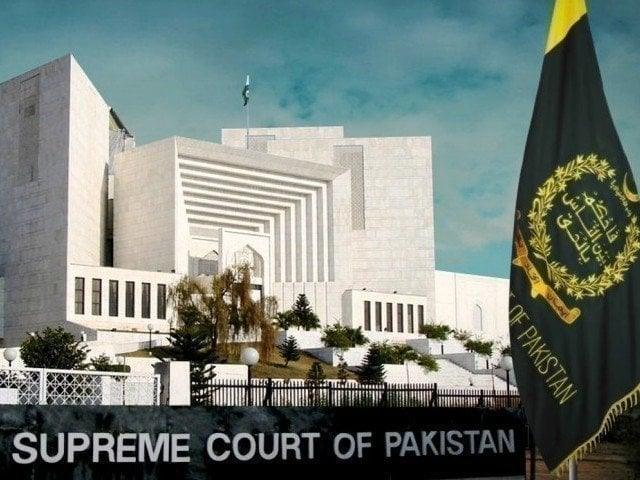
A member of the constitutional bench (CB) of the Supreme Court observed that it is the work of the Parliament to slow down terrorism, and not the judiciary. On Monday, lawyer for the Ministry of Defense, Khawaja Haris, continued his arguments in front of a CB of 7 members, hearing intra-core calls against the October 2023 ordinance of the Supreme Court of the Apex which prohibited the trial of the rioters of May 9 in military courts. Haris argued that if a civilian attacks a military installation or steals military equipment such as a reservoir, then Pakistan Army Act, 1952 – the law which deals with the formation of military courts – will be applied to this person. Justice Jamal Khan Mandokhail asked Haris if a first information report (FIR) would also be filed in a scenario such as the question concerns the trial of such a accused.
"We want to know how the tree [for such an attack/stealing] will be recorded; who will investigate the case and where the trial will be held," He added. The lawyer of the Ministry of Defense replied that those who make laws [parliament] will determine where the crime trial to attack a military installation must take place. Haris added that by virtue of Pakistan Army Act, 1952, the armed forces have the right to stop these attackers. Judge Muhammad Ali Mazhar noted that it was a legal obligation to record a FIR before arresting an accused. Judge Syed Hasan Azhar Rizvi also reminded the Council that after an arrest, an accused is also supposed to be presented before a magistrate. Justice Jamal Khan Mandokhail noted that the courts are not supposed to ensure that the trials are held in accordance with the Constitution.
"The control of terrorism is the work of the Parliament, not that of the judiciary. The courts cannot work if they start to wonder if a verdict would cause a reduction in terrorism or an increase in terrorist activities," He added. The CB will resume hearing the business today. Civil and military leaders of the country decided to hold the trial of more than 100 people, who attacked and vandalized military facilities and commemorative monuments after the arrest of former Prime Minister Imran Khan on May 9, 2023 before military courts. A certain number of petitioners challenged this decision before the Supreme Court, of which on October 23 of five members canceled the trials of the military courts. The bench – led by judge Ijazul Ahsan and including judge Munib Akhtar, judge Yahya Afridi, judge Sayyed Mazahar Ali Akbar Naqvi and judge Ayesha Malik – made the ordinance on the pets deposited by the head of PTI and others. Four of the five judges said that article 2 (1) (d) of the 1952 and 59 law (4) (49 (4) (civil offenses) "ultra vires the constitution and without legal effect".
"Without prejudice to the generality of the preceding the trials of civilians and the accused, being around 103 people […] must be judged by criminal courts of competent jurisdiction established under the ordinary and / or special law of the land compared to these offenses which they may be accused," short order reading. The government subsequently filed intra-haired calls against the verdict, that another larger SC bench suspended in November 2023 by a majority vote.


