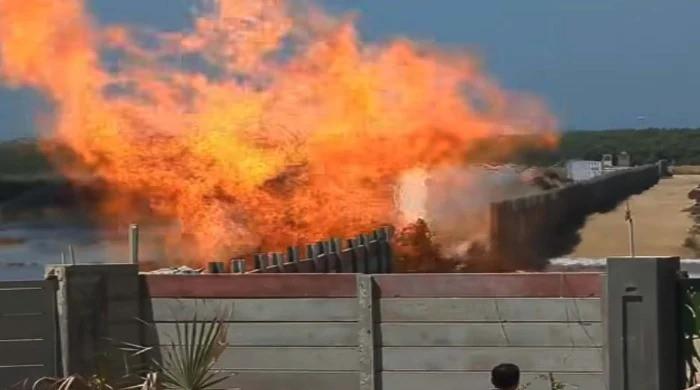
- Govt to buy two cutting -edge gas detection counters.
- Experts evaluating the borehole filling option with cement.
- The fire started after a bore 1,200 feet deep was drilled on the spot.
The authorities have decided to request the help of a renowned United States company PK Press Club News.
In the midst of increasing concerns concerning the fire that has been on fire for 12 days, the Ministry of Energy (Division of Petroleum) formed a technical committee to assess and contain a pocket of natural gas found in the Karangi Creek region of Karachi.
The Committee includes the chief of operation of Pakistan Petroleum Limited (PPL) Sikandar Ali Memon, as well as the chief geologist of the oil and gas development company (OGDCL), Khurrum Shahzad, the production director Habibullah Chohan and the general manager of Pakistan Refinery Limited (PRL) Abdul Majid as members.
According to sources, the technical committee has also decided to buy two cutting -edge gas detection counters to precisely measure the presence and concentration of natural gas in the region, the sources added.
In addition, the experts also assess the option of filling out drilling with cement as part of the fire confinement strategy, they added.
In addition, the PRL was invited to immediately install a camp office in its premises, and all energy, oil and services companies operating in the Sindh have been invited to provide the technical and logistical support necessary to help the fight against fire and repair operations.
The flame of fire, as opposed to its previous blue shade, has now become reddish, indicating incomplete burns and the emission of carbon monoxide.
The fire, which started after a bore 1,200 feet depth was drilled on the site on March 29, aroused concerns about the type and volume of gas responsible for the fire.
A preliminary chemical analysis, in accordance with the sources of PPL, of the water coming out of the ditch on the site of the current fire in the Korangi region has revealed the presence of dangerous chemicals.
The initial ratio, compiled following the water sampling of the fire site, detected excessive quantities of benzene, toluene and tetrachlorethylene.
The report indicates that tetrachlorethylene has been measured at 33 micrograms per liter, significantly above the standard limit of 5 mg. The benzene concentrations were recorded at 19 mg per liter, again exceeding the authorized 5 mg threshold.
Likewise, toluene was found at 15 micrograms per liter, three times higher than the recommended level of security. In addition, a slightly high quantity of o -xlene was also detected in the water sample, although the exact quantity has not been specified.
However, the overall content of hydrocarbons in the water has proven to be within the authorized limits, according to the preliminary results.
In addition, the amount of chemicals found in samples due to toxic waste dumped via the Malir river should be determined and absorbed in the soil.
Specialized companies exist to manage these flames; Until now, there is no update that the authorities have contacted such a company or undertaken to formulate an emergency plan or study to assess the extent of the gas reservoir.