
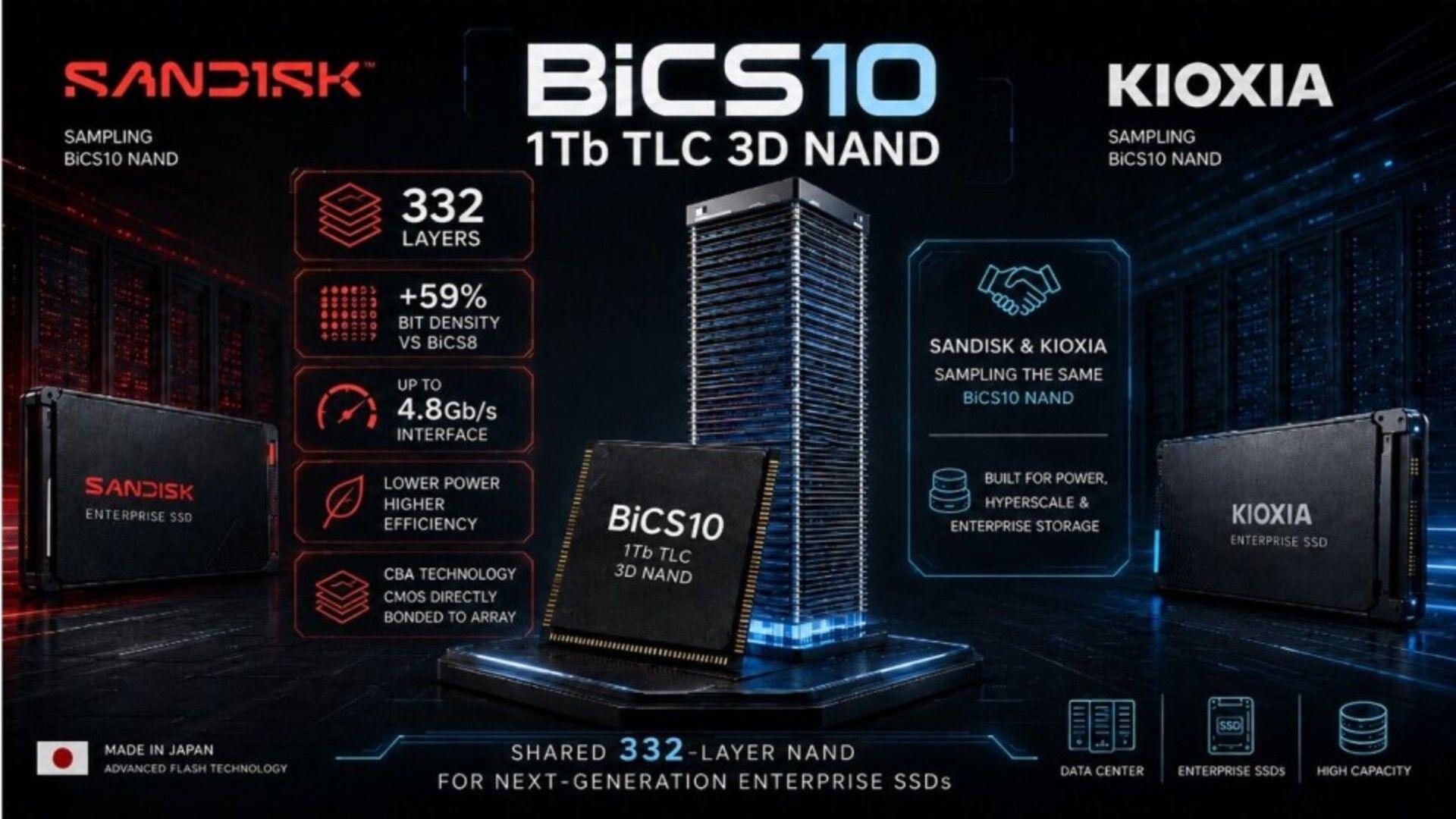
- SanDisk’s BiCS10 chip achieves a density of 29 GB per square millimeter
- Bit density improved by 59% compared to the previous generation of BiCS8
- Interface speeds now reach 4.8 Gbps, an increase of 33%
SanDisk has confirmed that it is now sampling BiCS10, its 10th generation 3D NAND flash chip, built jointly with its long-time manufacturing partner Kioxia.
The 1TB TLC chip integrates 332 memory layers into a chip that achieves an area bit density of more than 29 GB per square millimeter, which the company calls an industry leader.
This figure represents a 59% improvement in bit density compared to the previous generation BiCS8 currently in mass production.

A small chip designed to scale to massive drives
BiCS10 uses Sandisk CMOS directly linked to an array architecture, combined with a new Toggle DDR6.0 interface that pushes data transfer speeds up to 4.8 Gb/s.
This represents a 33% improvement over the previous generation’s interface speed, according to SanDisk’s announcement regarding the sampling stage.
Power efficiency has also improved significantly, with input power consumption down 10% and output power consumption down 34% compared to BiCS8.
SanDisk has already confirmed a broader roadmap built around this chip, targeting a 256TB SSD in 2026 and a 512TB drive in 2027.
The company also teased a possible 1PB data center drive, although it didn’t commit to a specific year for that product.
These capacity increases depend on the adoption of QLC memory, with SanDisk moving to QLC for most capacity-focused products by 2028.
The technology behind these future drives comes from a new generation 332-layer 3D NAND developed as part of the SanDisk and Kioxia partnership.
The chip is built as a 1TB TLC chip, with capacity increases resulting from layer stacking and improved lateral scaling rather than adding bits per cell.
Instead of adding more bits into each memory cell, companies are increasing density through additional layers, improved configurations, and new circuit designs.
The company said the new generation achieves a data transfer rate of 4.8 Gbps while reducing read power consumption by 29% compared to previous designs.
These improvements aim to increase capacity without sacrificing endurance and reliability as much as methods using higher bits per cell could create.
Current prices show why 512TB drives won’t come cheap
Existing high-capacity enterprise drives offer the clearest signal as to where the 512TB price will ultimately land.
Solidigm’s 122.88TB D5-P5336 series currently sells for between $49,275 and $64,168, depending on configuration and packaging options chosen.
Changing that cost per terabyte to a 512TB drive suggests a price comfortably above $300,000 once SanDisk’s version hits the market in 2027.
Competition in this area remains intense, with Kioxia, Samsung, Solidigm and Micron all racing toward similar capacity milestones in comparable time frames.
Samsung separately confirmed plans for a 512TB PCIe 6.0 drive around 2027, following a 256TB Gen 5 launch expected in 2026.
The supply of NAND itself remains limited, with flash contract prices expected to increase 70-75% quarter-over-quarter through mid-2026.
This shortage, driven largely by enterprise demand related to generative AI infrastructure, will likely keep prices for these drives high well beyond the initial launch.
SanDisk’s BiCS10 sampling marks only the first technical step toward this 2027 goal, with mass production and finished drives still several years away from wide availability.

Follow TechRadar on Google News And add us as your favorite source to get our news, reviews and expert opinions in your feeds.
| Row 0 – Cell 0 | Line 0 – Cell 1 | Line 0 – Cell 2 |
| Row 1 – Cell 0 | Line 1 – Cell 1 | Line 1 – Cell 2 |
| Line 2 – Cell 0 | Line 2 – Cell 1 | Line 2 – Cell 2 |


