
Court Says Constitutional Amendments Must Follow Article 33, Rejects Changes Through Protest or Pressure
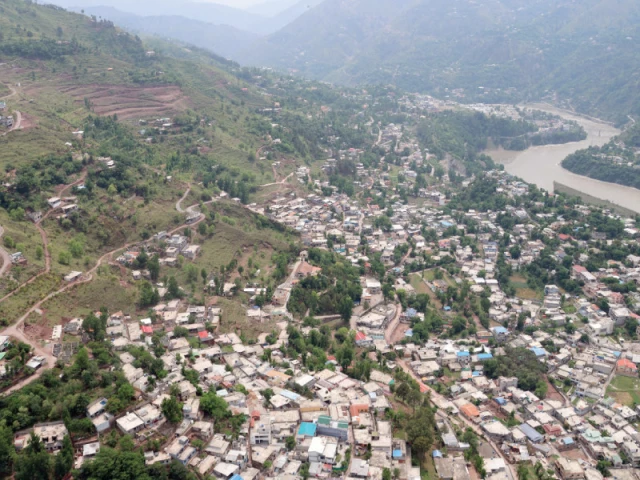
An aerial view from a Pakistani military helicopter shows Muzaffarabad, AJK. PHOTO: REUTERS
The Azad Jammu and Kashmir (AJK) High Court on Sunday ruled that the 12 seats reserved for refugees in the Legislative Assembly are constitutionally protected and cannot be changed by administrative measures, political agreements or public pressure, according to a detailed advisory opinion issued on presidential reference.
The 53-member AJK Legislative Assembly has 12 seats reserved for Kashmiri refugees who migrated from Indian illegally occupied Jammu and Kashmir during the 1947 and 1965 conflicts and are now settled across Pakistan.
Six seats represent refugees from Jammu division, estimated at around 434,000 people, while six seats represent refugees from Kashmir valley, whose population is estimated at around 30,000 people.
The issue of refugee representation has long been a key demand of the now-banned Awami Joint Action Committee (JAAC), which last year led a series of protests that turned violent and left several people dead.
In its opinion, the court reaffirmed that refugee seats are guaranteed by Article 22 of the AJK Constitution and are rooted in a long legislative history dating back to the electoral provisions introduced in 1960 and subsequent constitutional reforms of 1964 and 1970.
The court described these seats as “the constitutional expression of a profound historical and legal truth” arising from the displacement of Kashmiris following the 1947 partition and the conflict that followed. He noted that this arrangement was further strengthened by successive legal instruments before being explicitly incorporated into the Constitution through the 13th Amendment.
Underscoring constitutional supremacy, the Court held that any change in the composition of the Assembly can only be made through the amendment procedure provided for in Article 33.
“The provisions of the Constitution may be amended in accordance with Article 33,” the notice said, adding that the amendment process is “exhaustive and exclusive” and no authority other than the legislature can legally amend the constitutional provisions.
The Court declared that decrees, political agreements and public agitation have no legal effect on amending the Constitution, emphasizing that constitutional change must occur through “public mandate, parliamentary debate and constitutional procedure.”
A significant part of the opinion focused on the use of protests and blockades to assert political demands. While affirming that peaceful assembly is a fundamental right, the court said that this right is “neither absolute nor unlimited” and must be exercised in a manner consistent with public order and the rights of others.
The court warned that roadblocks, forced business closures and disruptions to supply routes do not fall within constitutional protection. “The exercise of a fundamental right cannot be permitted in a manner that substantially infringes or destroys the fundamental rights guaranteed to others,” it said.
It further observed that attempts to achieve constitutional change through coercive means are “legally unenforceable” and inconsistent with the rule of law. “The Constitution protects peaceful dissent; it does not protect conduct that violates public order,” the opinion added.
The court also highlighted the constitutional requirement to hold elections in a timely manner, referring to Article 22(4), which requires general elections to be held within the prescribed time.
Describing the obligation as mandatory and non-negotiable, the Court said constitutional deadlines “allow no exceptions” and cannot be delayed due to political uncertainty or public unrest.
He called on the Electoral Commission and relevant executive authorities to ensure that free, fair and transparent elections are held within the constitutional deadlines, while maintaining the necessary conditions for voting.
Tracing the historical evolution of refugee representation, the Court noted that refugee seats have existed in various forms since 1960 and have been consistently retained through successive constitutional and legal frameworks.
He described this arrangement as a “continuously affirmed constitutional principle” reflecting the political status of displaced Kashmiris and said its uninterrupted maintenance demonstrates that refugee representation is a “deep-rooted constitutional commitment” rather than a temporary administrative measure.
The court reiterated that its opinion is advisory in nature and does not create binding orders between the parties. He said the purpose of the reference was to assist the constitutional authorities rather than to resolve a dispute in the conventional sense.
The move comes two days after the AJK government declared the JAAC a banned organization, accusing it of being involved in terrorism, promoting hatred and creating anarchy ahead of the group’s planned protest on June 9.
The move also came hours after the AJK Election Commission announced that the general elections for the Legislative Assembly would be held on July 27. The commission said preparations were underway to ensure transparent, orderly and impartial elections under judicial supervision.
Meanwhile, the Pakistan Tehreek-e-Insaf (PTI) criticized the government’s decision to ban the JAAC.
“If the JAAC was truly a terrorist organization, why did the government spend months negotiating with it, signing agreements with it, implementing its demands, holding meetings with its leaders, and treating it as a legitimate stakeholder until yesterday? the party said in a statement.
The 12 places
The issue of refugee representation has long been a key demand of the JAAC, which last year led a series of protests that turned violent and resulted in the deaths of several people.
The region experienced one of its most turbulent periods in October 2025, when JAAC-led protests erupted demanding constitutional and governance reforms. At least nine people, including three police officers, were killed during the unrest.
The JAAC, which organized the protests and strike, had presented a broad charter of demands, including an end to the privileges enjoyed by the ruling elite, the removal of 12 assembly seats reserved for refugees and the abolition of the quota system.
Two days after the violence, the government and the JAAC reached an agreement on 12 basic points and 13 additional points. Under the agreement, both sides agreed to constitute a high-level committee to look into the issue of refugee seats in the AJK Legislative Assembly.
The unrest also sparked political upheaval in the region. The Pakistan People’s Party then proposed a no-confidence resolution against then Prime Minister Chaudhry Anwarul Haq, with the Pakistan Muslim League-Nawaz joining the effort. Haq, elected in April 2023 with 48 votes, chose to face the vote rather than resign.
On 17 November, Raja Faisal Mumtaz Rathore received 36 votes in the elections and became the 16th Prime Minister of AJK.
With elections approaching and the refugee seat issue still unresolved, the AJK government has convened an All Party Conference (APC) in Muzaffarabad to reach a consensus. Almost all major parties were present – except the PTI and JAAC, which boycotted it.
The JAAC’s position is that the government had already rejected its written proposals submitted on May 30 and therefore there would be no point in attending. He had proposed either maintaining token representation of refugees until the Kashmir conflict is finally resolved or replacing the 12 seats in the Assembly with 4 seats in the AJK Council – a body chaired by the Prime Minister, which he said would better preserve the political dimension of the Kashmir cause.
The APC rejected any changes outside the constitutional and legislative framework, saying only the elected assembly could change the distribution of refugee seats. The JAAC called the resolution “a page and a half of utterly trivial lines” and accused participants of coming together to serve their own interests rather than those of the public.


