Chinese emperors once prayed for bountiful harvests under the blue-tiled, triple-eaves roof of Beijing’s Hall of Good Harvest Prayer, in sacred rites affirming their mandate to rule.
U.S. President Donald Trump and Chinese President Xi Jinping will tread the same imperial turf inside Beijing’s Temple of Heaven on Thursday, as the two leaders seek to reap a different kind of harvest from a high-stakes summit.
For Xi, welcoming Trump there provides a scene rich with messages about China’s endurance and civilizational depth. For Trump, this context has a more literal resonance: agriculture will be high on his list of priorities, with American farmers seeking larger Chinese purchases of soybeans, other crops – and meat.
“As a Chinese leader, this is the perfect backdrop to show the depth of Chinese history, its length and sophistication,” said Lars Ulrik Thom, a Beijing-based historian and founder of the historical walking tour company Beijing Postcards.
Trump is expected to arrive in Beijing on Wednesday ahead of his meetings on Thursday and Friday. The two leaders are scheduled to visit the Temple of Heaven on Thursday, according to the White House.
Trump is heading to China with ambitions blunted by court rulings on tariffs, limiting his goals to a few deals on beans, beef and Boeing planes, and seeking China’s help in resolving its unpopular war with Iran, analysts say.
Xi could go all out for pomp-loving Trump
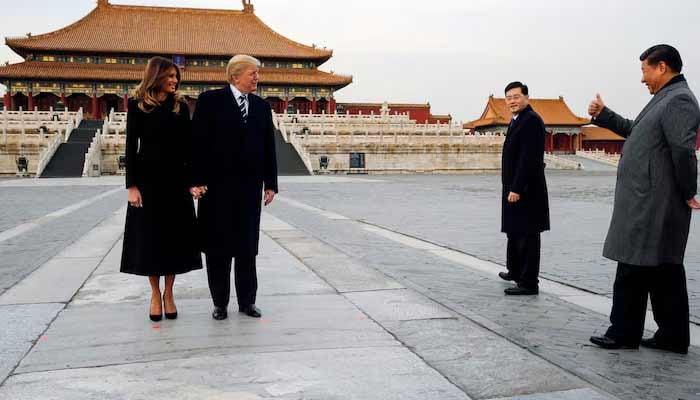
In 2017, Xi and his wife gave Trump and the first lady a rare private tour of the Forbidden City, the ancient home of China’s emperors.
Analysts are watching whether Xi, who enters negotiations with more confidence than Trump, will once again go all out for the mercurial U.S. leader, known for his love of pomp and pageantry.
Located about 7 km (4.35 miles) south of the Forbidden City, the temple was built in 1420 under the same Ming emperor responsible for building the imperial palace.
Surrounded by centuries-old pine and cypress trees, today it is a popular tourist site and a park where Beijingers practice tai chi, play chess or dance.
Under dynastic rule, emperors traveled once a year from the Forbidden City to the Temple of Heaven, accompanied by an entourage of thousands of men and elephant carriages, to perform a religious ceremony affirming their right to rule.
This right was not unconditional: bad harvests, famine or disorder could harm an emperor’s reputation.
The Hall of Prayer for Good Harvests, the temple’s best-known monument, was rebuilt in the late 1800s with large redwoods imported from the United States, Thom said.
American farmers want China to buy more of their crops
After the tour, Trump will seek greater commitments from Xi on purchases of soybeans, grains and meat.
China is the biggest market for U.S. farmers, with about $24 billion in sales of their products in 2024 before Trump takes office. Beijing has frozen much of that trade and reduced its need for U.S. supplies, using it as powerful leverage against Trump’s tariffs.
Soybean farmers will be watching to see how China fulfills its pledge last year to buy 25 million tons of soybeans a year through 2028. Bigger Chinese purchases could appease struggling U.S. farmers, who are among Trump’s largest electorate, as November’s midterm elections approach.
For Xi, the place offers much more than an imperial landscape.
“It’s a really good backdrop to tell Donald Trump and the world that China is here and it’s been here for thousands of years,” Thom said.