
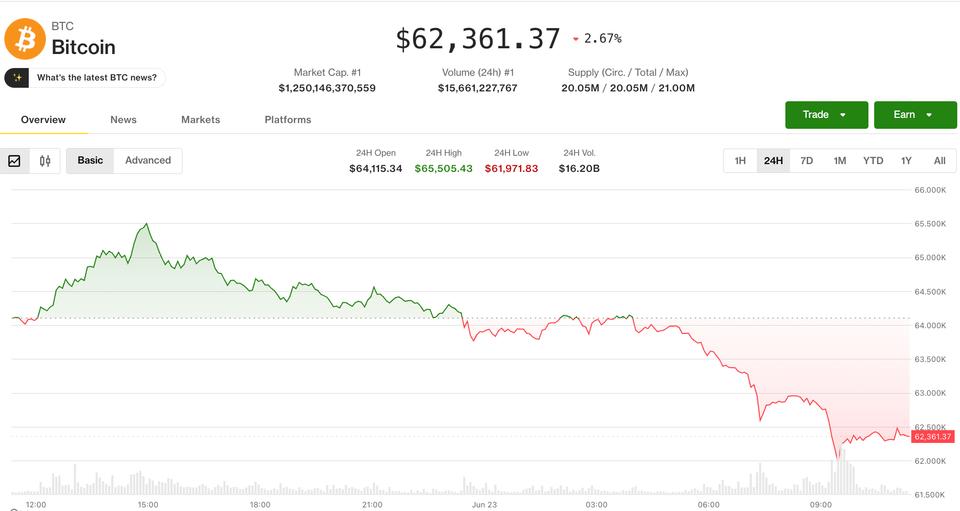
The crypto market fell on Tuesday, with bitcoin trading at $62,300, having lost 2.5% since midnight UTC, while ether (ETH) fell more than 4% to $1,650.
The sell-off follows a slowdown in technology stocks on Monday, with another day in the red heralded by Nasdaq 100 futures, which have fallen 2.5% since midnight.
Tech stocks are struggling due to profit-taking and the risk of higher bond yields, according to Patrick Munnelly, market strategy partner at TickMill.
Altcoins performed worse than Bitcoin and Ether, with tokens such as Ethena (ENA) and Hype (HYPE) losing 5-6% and $717 million in market liquidations causing exaggerated declines.
The Dollar Index (DXY) hit its highest level in over a year, reaching 101.15, its highest level since May 2025.
Positioning of derivative products
- The most notable data point in the derivatives space is the 10% rise in open interest (OI) in SpaceX perpetuals listed on Hyperliquide, Binance and other exchanges, while the price fell 15%.
- This combination validates the downtrend and suggests the deployment of leverage on the short side. The increase in OI is highest among major tokens, a clear sign of increased preference for trading traditional assets over blockchain rails.
- SpaceX futures are also now the sixth largest in the world, ahead of several major coins such as ZEC, but still behind BTC, ETH, XRP and others.
- XRP futures open interest increased to 2.38 billion tokens, revisiting eight-month highs. These continued capital flows come alongside a nearly 2% decline in the token for the week and follow last week’s 5% decline.
- As with SpaceX, this combination validates the bearish trend. More so, in fact, as the OI-adjusted 24-hour cumulative volume delta (CVD) is negative for the second day in a row, a sign of price action driven by traders shorting at market prices rather than passive limit orders.
- Traders continue to reduce their exposure to BTC futures. Open interest fell to 720,000 BTC from 742,000 BTC last week. It reached a high of 800,000 BTC earlier this month.
- In ether, OI futures have rebounded from a five-week low of 14.13 million ETH, but overall positioning remains light compared to the May 28 high of 15.98 million ETH.
- Generally speaking, sellers seem to dominate most of the top 25 coins. Most of these parts have a negative 24-hour CVD adjusted for RO.
- Traders are also likely to keep an eye on Bitcoin’s 30-day implied volatility index, BVIV, which has moved up from 40%. This increase suggests higher demand for options. Ether’s volatility index, EVIV, shows a similar trend. Increases in volatility indices are generally a characteristic of downward price trends.
- In the options market, the structure is long calls (or bullish bets) before the quarter expires on Friday. However, these long positions remain loss-making, given the collapse of spot prices throughout the quarter. Meanwhile, puts, or bearish bets, stay in the money or in profit.
- Buy and sell biases show the market continues to pay for downside protection, a sign of persistent and cautious sentiment.
Symbolic discussion
- Privacy coins Dash (DASH) and Monero (XMR) showed strength despite Tuesday’s cryptocurrency selloff, with DASH down just 0.2% since midnight and XMR down about 0.7%.
- The same cannot be said for zcash (ZEC), a rival privacy coin that was hit by an AI-inspired exploit earlier this month. ZEC lost 4.2% during the same period, in line with the broader altcoin market.
- AI tokens FET, RENDER, and TAO also struggled, falling 3-5% as negative sentiment from tech stocks spilled over into crypto.
- A positive for investors is that the average relative strength index (RSI) for cryptocurrencies is currently at 39.05, suggesting “oversold” conditions that could pave the way for a rebound or relief rally during the day.


