
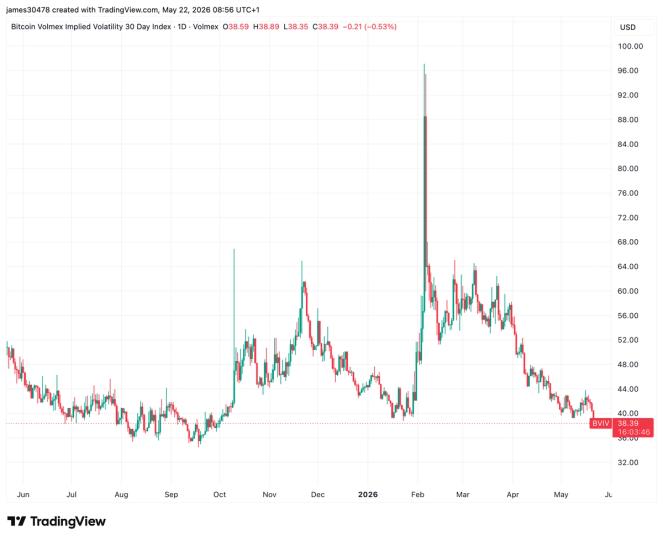
Financial headlines continue to warn of macroeconomic risks, but Bitcoin the volatility metric seems to think this is all just noise.
The cryptocurrency’s 30-day annualized implied volatility index, BVIV, continues to decline, reaching 38%, its lowest level since October 2025, according to data source Volmex. When implied volatility decreases, it indicates that traders expect calmer price action and fewer large moves ahead.
“Bitcoin volatility has collapsed, and you can see this clearly in the BVIV levels, which we track closely to monitor market complacency,” said Shiliang Tang, managing partner at Monarq Asset Management.
“First, geopolitical risk from the Iranian conflict is finally moving to the later stages. Second, continued purchases of BTC from Strategy (MSTR) and its preferred perpetual STRC complex mitigate BTC’s downward volatility by acting as a structural floor,” Tang added.
He also blamed systematic “call cancellations” for lowering output. Squeezing involves selling an out-of-the-money call option of a higher strike price to obtain additional return on top of the spot market position. BTC is currently trading near $77,300, so anyone holding BTC and selling calls above that price is a call crush.
Systematic overwriters, typically institutional funds pursuing return-enhancing strategies, continually sell Bitcoin options to collect premium income. This constant supply of options removes implied volatility and dampens expectations of large price swings.
“Finally, because Bitcoin has underperformed other risk assets on the upside, systematic overwriters are aggressively selling yield options, thereby maintaining heavy control over the entire volatility complex,” Tang noted.
Bitcoin is currently trading around $77,000, while oil markets, often used as a proxy for geopolitical risk, remain relatively contained, with WTI crude trading below $100 per barrel.
Meanwhile, Strategy purchased 171,238 BTC in 2026, far surpassing the approximately 63,450 BTC mined during the same period. This imbalance reinforces persistent institutional demand and reduces market supply.
Bitcoin’s declining volatility also reflects its maturation as an institutional asset. As adoption grows among ETFs, asset managers, corporations and cash allocators, liquidity deepens and ownership becomes more diversified, naturally reducing the extreme volatility that characterized bitcoin’s early years.


