
The current American-Chinese trade war should reduce inflation in the American economy, indicate the key sections of the financial market, offering bull clues to risk assets, including Bitcoin (BTC).
In his inaugural speech on January 20, President Donald Trump promised to “price and tax foreign countries to enrich our citizens”, then pulled the first blow against China, Canada and Mexico on February 1. Since then, trade tensions have increased to such an extent than to the drafting, the United States and China have imposed 100%reprisal rates.
The prices increase the cost of imported goods, which are then transmitted to the consumer and could lead to a higher general price level in a consumer-oriented economy like the United States
Consequently, since the trade war broke out, the markets have been worried about a resurgence led by prices in American inflation, the Fed adding to these concerns through its economic projections stagflationaries last month. Stagflation, representing a combination of low growth, high inflation and unemployment, is considered to be the worst result for risky assets.
Bitcoin, therefore, has dropped by almost 20% since the beginning of February, in parallel with a large risk aversion to Wall Street which has experienced investors spilling stocks, bonds and the US dollar.
Breakevens suggest disinflation
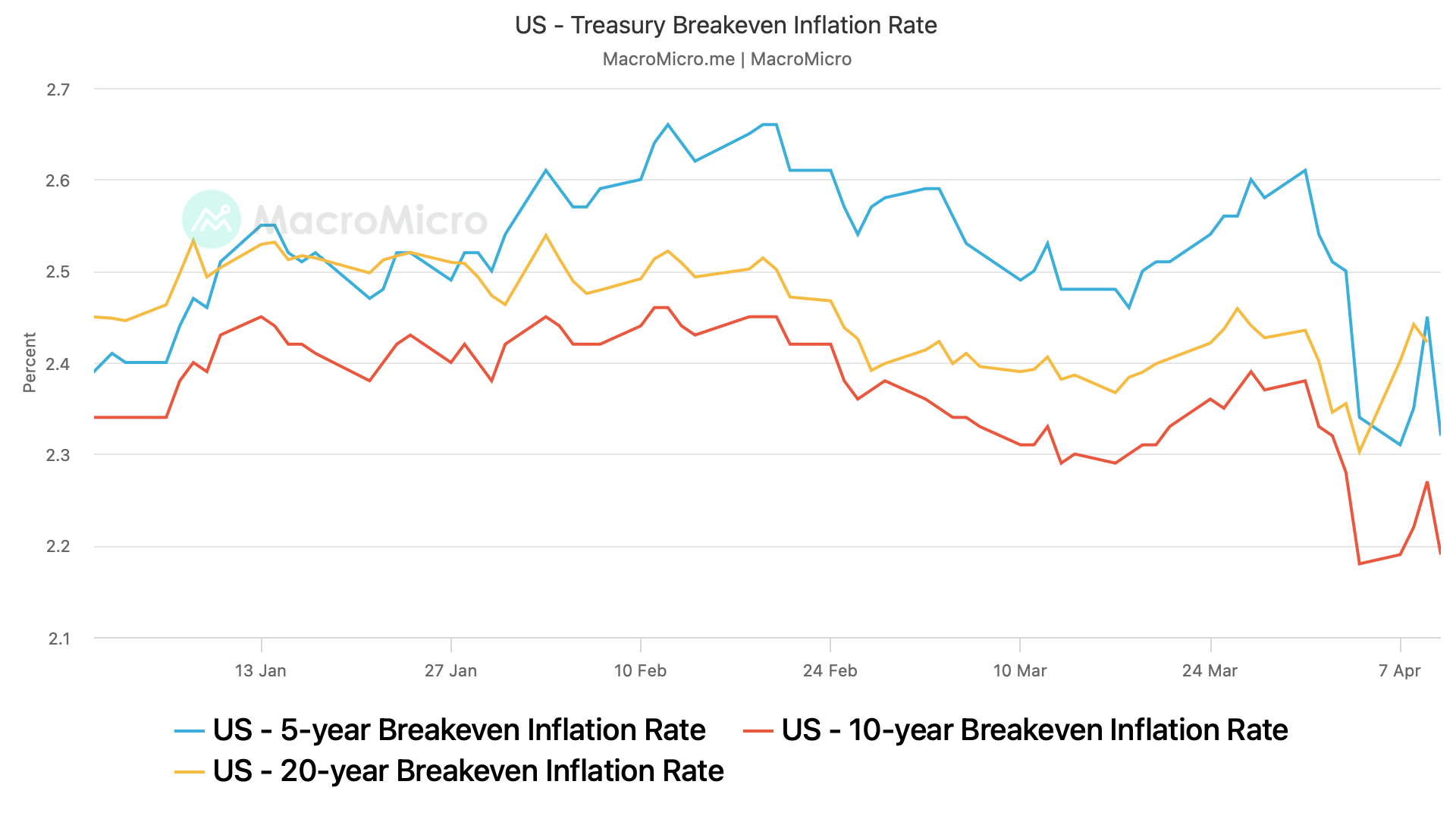
However, measures based on the inflation market, such as Breakevens, suggest that the prices could be disinfusion in the long term. In other words, the Fed could be wrong to fear stagflation and will soon have room for maneuver to reduce rates.
Inflation strands are derived from yields on traditional cash obligations and securities protected by treasury inflation (TIPS). The rate of inflation of the profitability threshold at five years reached a culmination greater than 2.6% in early February and has since fallen to 2.32%, according to the data followed by the Federal Reserve Bank of St. Louis.
The 10 -year balance rate increased from 2.5% to 2.19%. Meanwhile, the expected inflation of the Federal Bank of the Cleveland Reserve took place at around 2.6%.
Single cost
According to observers, the impact of prices, considered as a single cost adjustment, is based on the reactions of other macroeconomic variables and tends to be a long -term disinflationary.
When producers pass the rate increase on consumers, inflation levels increase. However, if there is no corresponding increase in income, consumers are forced to reduce their consumption. This reduction can lead to an accumulation of stocks and, ultimately, contribute to a drop in prices of goods and services.
“Since the time of Smoot-Hawley, the prices have never been inflationary. They are rather deflationary and” stimulating themselves “. In addition, the disinflation shown in these graphics will help to encourage the Fed to relieve soon too.
An article published by the American economist Ravi Batra in 2001 made a similar observation, saying: “Prices in the United States have never been associated with the rise in prices, and with commercial liberalization with a drop in prices.
All well considered, the recent turbulence of the financial market probably results from fears of growth rather than inflation. The bull could soon reappear in anticipation of a dominant position of the federal reserve.


