
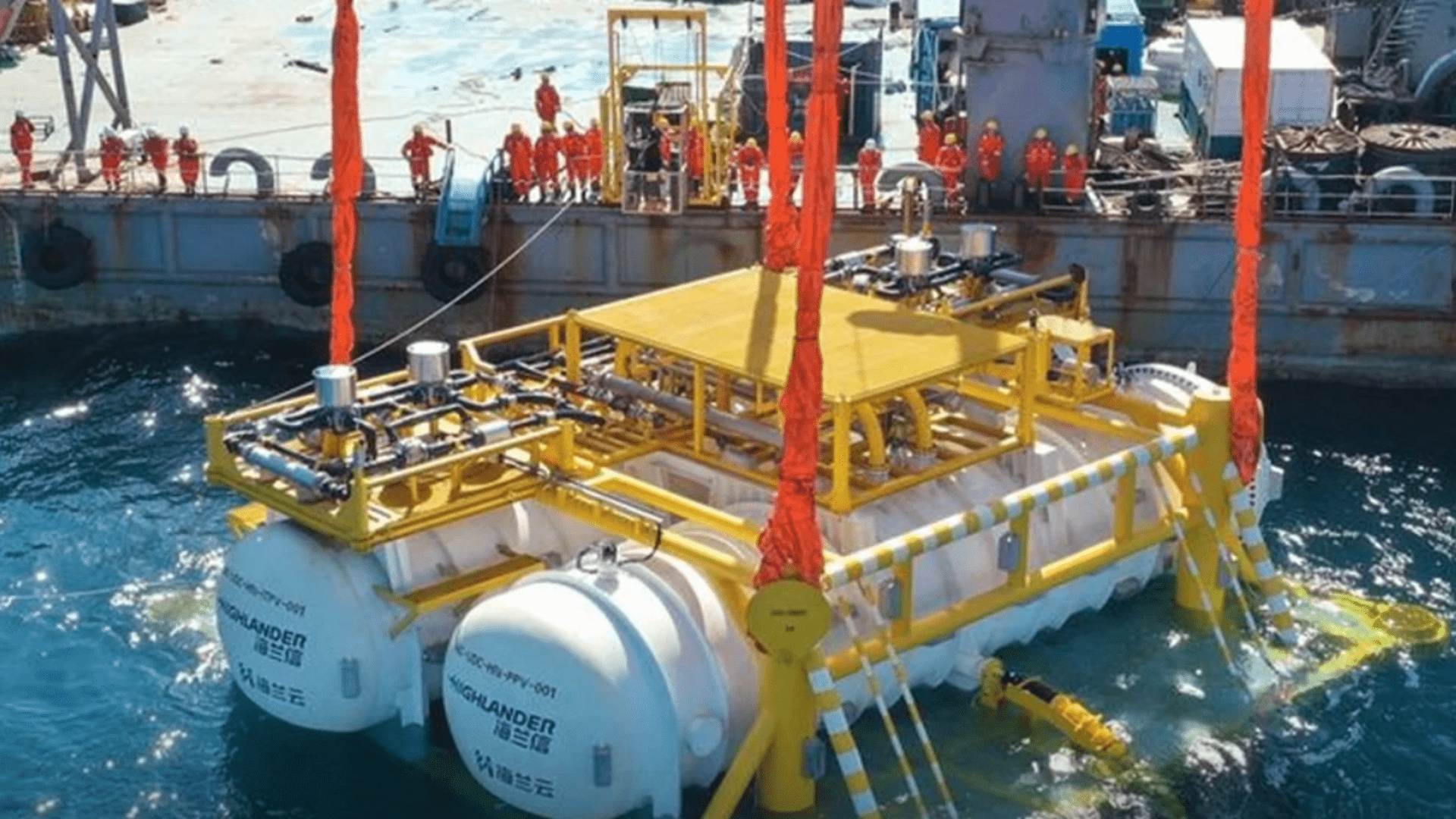
- China submerged nearly 2,000 AI servers under the ocean near Shanghai
- Seawater now cools Chinese AI servers without traditional industrial coolers running continuously
- China has connected offshore wind farms directly to an underwater artificial intelligence facility
China has begun commercial operations in an underwater data center where sealed server modules operate under the ocean using seawater for passive cooling.
The project combines offshore wind generation with underwater IT infrastructure to reduce electricity pressures from the expansion of artificial intelligence around the world.
This underwater data center sits approximately 35 meters below the ocean surface near Shanghai’s Lingang Special Zone and hosts nearly 2,000 servers, including GPUs. clusters of China Telecom and LinkWise.

Stable ocean temperatures promote cooling
Chinese authorities and private engineering firm HiCloud Technology jointly developed the $226 million facility.
This 24-megawatt facility handles artificial intelligence workloads, 5G services and large-scale data annotation operations requiring significant computing capacity.
Unlike conventional land-based installations using industrial cooling systems, the underwater structure relies heavily on the naturally stable ocean temperatures surrounding the pressure-resistant server modules.
Cooling demands have increasingly become a major obstacle for modern data centers, as advanced GPU clusters generate enormous heat during continuous computing operations.
According to Chinese media reports, the subsea installation achieved a power consumption efficiency (PUE) rating of less than 1.15, lower than the industry average which hovers around 1.5.
A lower PUE indicates that more electricity directly supports computing tasks instead of ancillary systems such as cooling equipment, ventilation, and infrastructure maintenance.
Industry analysts are increasingly examining alternative cooling methods as the expansion of artificial intelligence infrastructure continues to put pressure on national power grids and electricity availability.
The Shanghai project also reflects China’s broader efforts to integrate renewable energy generation directly into digital infrastructure.
Offshore wind farms connected to the subsea facility would provide a substantial portion of operational electricity, reducing their reliance on conventional grid-based energy supplies.
Previous projects encountered bottlenecks
Officials described the project as the world’s “first” offshore wind-powered underwater data center operating on a commercial scale, although underwater computing experiments already existed elsewhere.
Microsoft has already tested an submerged data center capsules through its Project Natick initiative, carried out near Scotland and California before stopping commercial development efforts.
These earlier experiments nevertheless suggested that underwater systems might experience lower hardware failure rates because sealed environments limited exposure to oxygen and temperature fluctuations.
However, large-scale subsea deployments continue to face significant engineering challenges related to corrosion, pressure sealing, subsea cable durability, and long-term hardware accessibility in emergencies.
Replacing faulty equipment underwater remains considerably more complicated than in conventional installations, where technicians can physically inspect servers and infrastructure in minutes.
Operators therefore rely heavily on remote monitoring technologies, modular waterproof systems and redundant infrastructure intended to minimize direct maintenance requirements throughout the operational lifespan.
Similar concepts continue to emerge globally as governments and technology companies examine unconventional approaches to managing demands for artificial intelligence infrastructure without overburdening Earth’s resources.
Recent reports detail how Peter Thiel-backed startup Panthalassa is developing floating data centers using wave energy and seawater cooling systems.
Although subsea installations can significantly reduce cooling energy consumption, long-term operational reliability remains uncertain as large-scale commercial deployments remain relatively rare worldwide.
Via Toms Hardware

Follow TechRadar on Google News And add us as your favorite source to get our news, reviews and expert opinions in your feeds.


