
After the war in Iran cut off a fifth of the world’s oil supply, oil prices surged, at one point reaching nearly $120 a barrel. But they did not rise, even though some analysts warned of a $200 barrel of oil, and prices have since fallen.
At more than $80 per barrel, oil is expensive. But it could be much higher.
One of the main reasons was China.
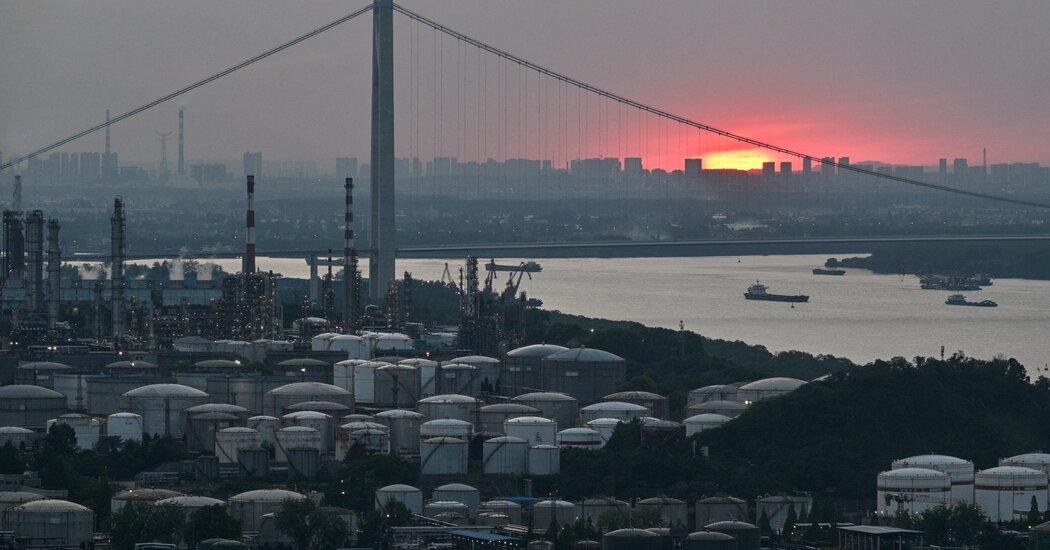
The world’s largest oil buyer, China has kept prices under control by rapidly reducing the amount of oil it imports. Before the start of the war, China imported an average of 11.6 million barrels per day. In May, its overseas oil purchases had fallen below eight million barrels per day, its lowest level in more than eight years, according to customs data released by Beijing.
As oil prices hit a three-month low on Monday as the United States and Iran announced they had reached a framework agreement to end the war, analysts say China will retain considerable influence over the global market.
“Reductions in Chinese oil imports are one of the main reasons oil prices are not skyrocketing right now,” said Jason Bordoff, founding director of the Center on Global Energy Policy at Columbia University.
The world has lost more than 14 million barrels per day since the United States and Israel launched a joint military campaign against Iran on February 28, prompting Iran to close the Strait of Hormuz and create the worst oil shock in modern history.
The energy economy has been disrupted around the world. Drivers have reduced their gasoline purchases. Governments have imposed power cuts to reduce demand for electricity. Airlines have cut flights to save on jet fuel.
China has also taken steps to reduce its demand for imports. It has exploited its enormous oil reserves, which dwarf those of other countries, while reducing production at refineries and using more coal, according to Michal Meidan, director of China energy research at the Oxford Institute for Energy Studies.
“The fact that China, so far, has not needed to significantly tap the market for alternative supplies has limited the price rise,” she added.
The country’s transformation in recent years into the world’s leading clean energy superpower has also contributed to this situation.
Another factor that has put downward pressure on oil prices over the past three months has been the increase in U.S. production to record levels. Some oil also continues to flow out of the Persian Gulf, partly via onshore pipelines, tankers willing to pay tolls to Iran, and fleets in the dark with their transponders turned off to evade detection.
But falling Chinese oil imports have played an outsized role in capping global prices.
Just as it did after Russia’s invasion of Ukraine in 2022, China has restricted its exports of diesel and gasoline, retaining more for its own use. Just days after the war began, the government ordered its major state-owned energy companies to temporarily suspend exports, turn to domestic stocks and rely on a mix of energies to meet its needs.
China’s oil inventories have allowed Beijing to wait for oil prices to fall before starting to buy on the global market. Muyu Xu, a senior oil analyst at data firm Kpler, said she expects China to withdraw around a million euros. barrels per day over the next two months from its commercial stockpile.
At this rate, China could continue to exploit its reserves until this time next year without beginning to draw on its official strategic stockpile, which stands at around 1.23 billion barrels, according to Ms. Xu’s analysis. Beijing would only take such a step reluctantly, as it could threaten years of work to establish energy security.
At the same time, China has reduced its demand for combustion fuels like gasoline and diesel thanks to meteoric growth in electric vehicles and renewable energy.
China is the world leader in clean energy, operating about twice as much wind and solar capacity as the rest of the world combined. It also produces and sells more electric vehicles than the rest of the world combined.
That growth was key to China’s greenhouse gas emissions plateauing last year. Scientists say it is crucial that China, the world’s largest annual emitter, reaches its peak and begins to rapidly reduce its planet-warming pollution if the world hopes to keep global warming at relatively safe levels. But that has hardly been the goal of the exponential expansion of wind, solar and electric vehicles in Beijing.
“The main reason China has developed renewable energy is not for the sake of the climate, but for energy security,” said Mathias Larsen, a senior policy researcher at the Grantham Research Institute at the London School of Economics.
“This bet, and the fact that renewable energy is now cheaper than fossil fuels, especially imported gas and oil, means that China has not been as exposed to the post-Iran war fossil fuel price surge as it would have been,” Mr. Larsen said.
Electric vehicles alone have significantly reduced China’s oil demand, replacing tens of millions of tons of gasoline, according to the International Energy Agency. At the same time, Beijing has also expanded its high-speed rail network. According to China’s Ministry of Railways, 421.7 million people used the railways in April, an increase of 11% from the previous year, a seasonal record.
“This represents a years-long effort that now serves as the basis for China to systematically reduce its oil consumption,” said Li Shuo, Asia director of the China Climate Hub. Institute for Social Policy.
And yet, stocks, even those of China, cannot be used indefinitely. If the Strait of Hormuz remains closed, “no one knows” how long China can maintain its reduced levels of oil imports, said Logan Wright, who leads the study of Chinese markets at the Rhodium Group, a consultancy.
“It’s not a year from now, and it’s probably not even six months from now. There will be a comeback,” he said. When that happens, he added, it will be “a signal that prices are probably on the way up.”
Murphy Zhao contributed to the research from Hong Kong.


