
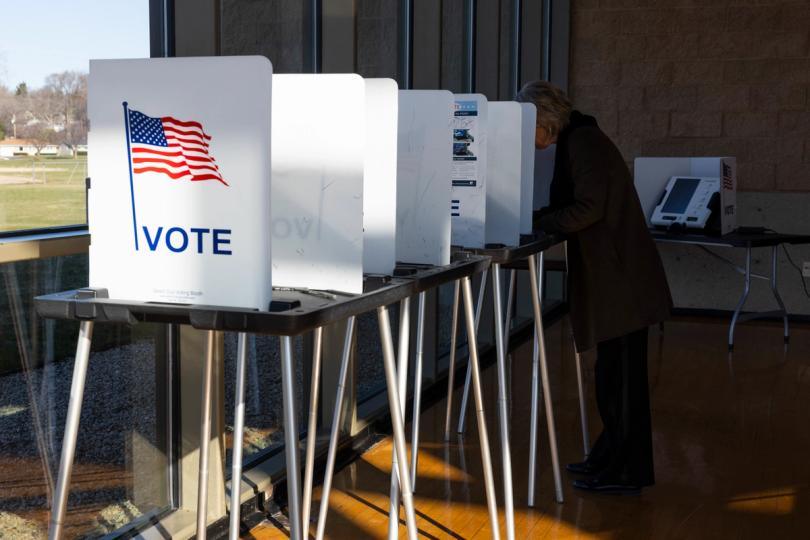
American voters have placed cryptocurrencies low on the list of their biggest priorities for the upcoming midterm elections.
According to a survey of 1,000 randomly selected registered U.S. voters, only 1% of respondents said they ranked crypto as their top concern, although other responses revealed a broader view of technology as an important policy issue.
The survey was conducted in late April by Public Opinion Strategies on behalf of CoinDesk, as part of CoinDesk’s coverage of the 2026 US midterm elections. The survey was evenly split between Republican and Democratic respondents (41% of respondents identified to some extent with each party), with a credibility interval of plus or minus 3.53%.
Crypto won’t be on the ballot this year, but the industry still has a vested interest in who wins. The Market Structure Bill, one of the most important pieces of legislation, is considered the top priority for crypto. Although the bill known as the Clarity Act still has a way to go to become law before the end of the year, it has taken much longer than expected and still needs to overcome a number of hurdles. Other bills, including expected tax reform, will likely come before Congress in the coming months. Ahead of the election, the crypto industry dedicated hundreds of millions of dollars intended to support friendly candidates, after being the largest donor in the 2024 elections.
This article is part of a CoinDesk series on voter opinions for the 2026 midterm elections.
As of press time, the most likely outcome of the 2026 elections is that Democrats will become the majority party in the House of Representatives, while the Senate will likely remain dominated by Republicans. A generic question in the POS poll for CoinDesk about whether voters would choose the Republican or Democratic candidate gave Democrats a slight edge (44% vs. 41%); That +3 margin is roughly in line with a number of other polls, according to a tracker hosted by The New York Times.
Prediction market provider Kalshi has the Senate equally. But Democrats have a much tougher road ahead to gain a majority there, Cook Political Report said in April.
That poll also showed that U.S. President Donald Trump had a negative net approval rating, with 40% of respondents saying they somewhat or strongly approved of his performance, while 60% disapproved.
And not surprisingly, respondents said the cost of living (36%), jobs and the economy (13%), and Social Security and Medicare (11%) were their most important issues. Other issues, such as immigration and border security, health care, national security, government spending and more, all had single-digit percentage responses. Crypto ranks low, largely among voters leaning toward the Republican Party. Artificial intelligence came in slightly higher, with 2% of respondents calling it the most important issue.
Opinions on crypto
Crypto itself does not enjoy a favorable image among those surveyed. While participants who leaned GOP had a slightly more favorable than unfavorable view of cryptocurrency (41% to 39%), core GOP voters (33% to 39%), independents (27% to 48%), Democratic-leaning voters (26% to 54%), and core Democrats (25% to 58%) all had a more unfavorable view.
Just over a quarter of participants (27%) said they had invested in, traded or used cryptocurrency, while 27% said they had not but might one day. Of those who invested, 2% currently own more than $10,000 in digital assets, 9% reported owning between $1,001 and $10,000, and 12% reported having $1,000 or less in crypto.

As for the November election, 49% of participants who said they were “much more interested” in this year’s election than in 2022 said they own $1,000 or more in crypto.
According to the data, 47% of respondents said Republicans were more supportive of cryptocurrencies, compared to just 14% who said the same about Democrats. However, these figures do not necessarily indicate whether respondents consider this a good thing. Interestingly, Democrats maintained a slight edge in voter confidence in crypto, with 27% of respondents saying they trust the party, compared to 25% who said they trust Republicans more. A larger proportion of respondents – 40% – said they did not trust either party.
About 40% of respondents also said they would be more likely to vote for a candidate who shared their views on crypto, although the survey did not ask whether this was related to positive or negative views on crypto.
Crypto was also less favorable (30%) than Republicans (39%) or Democrats (43%). At the same time, DeFi – also known as finance on the blockchain – has 17% of respondents saying they have a favorable opinion, although only 60% of respondents overall said they had heard of it.
Artificial intelligence has more positive numbers: 46% of respondents have a favorable opinion, while 45% have an unfavorable opinion.
Despite all this – and somewhat at odds with not reporting crypto as their top issue – when asked directly how important crypto is to the 2026 election, 3% of respondents said it was the “most important” issue, and another 22% said it was an important issue. This represents a much greater awareness of digital assets than voters had several years ago.
CoinDesk will release data from this survey on Tuesday at Consensus Miami.


