
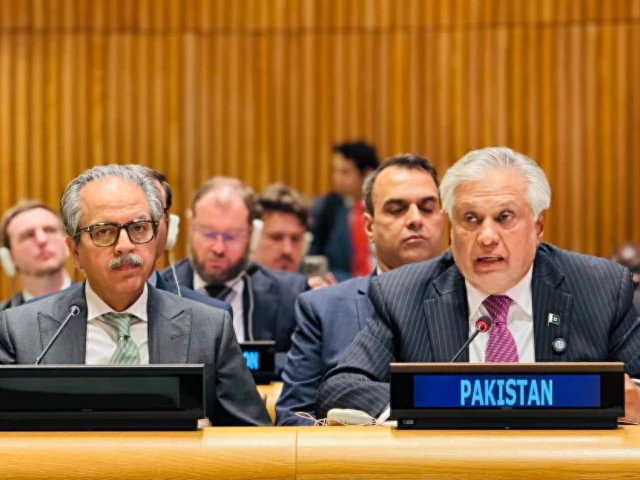
According to him, confidence in collective action is eroding and the selective application of international law undermines global stability.
Deputy Prime Minister and Minister of Foreign Affairs Ishaq Dar, during the meeting of the Group of Friends of Global Governance PHOTO:
Deputy Prime Minister and Foreign Minister Ishaq Dar on Friday called for a “more democratic, more representative and more accountable” United Nations Security Council (UNSC), warning that unilateralism and selective application of international law were undermining global stability.
Speaking at a meeting of the Group of Friends of Global Governance at the United Nations, Dar said the international community faces “multiple and interconnected crises”, including conflict, climate emergencies, food insecurity and governance challenges linked to emerging technologies.
“In this uncertain environment, the world urgently needs renewed solidarity and a more effective system of global governance anchored in the purposes and principles of the United Nations Charter,” he said.
Statement by HE Senator Mohammad Ishaq Dar,
Deputy Prime Minister and Minister of Foreign Affairs of Pakistan,
At the meeting of the Group of Friends of Global Governance
Topic: Reforming and improving global governance; Working together to tackle global challenges
(May 28, 2025)
****… pic.twitter.com/rsLjLaR1ou– Permanent Mission of Pakistan to the UN (@PakistanUN_NY) May 29, 2026
The meeting, hosted by China, focused on reforming and improving global governance and responding to global challenges through multilateral cooperation.
Dar criticized what he described as a weakening of confidence in collective action. “At the same time, confidence in collective action is eroding, with unilateralism and the selective application of international law endangering global stability,” he said.
Calling for reform of the UN Security Council, the foreign minister said small and medium-sized states should have greater representation.
“The UN Security Council must become more democratic, more representative and more accountable,” he said. “The small and medium-sized states that constitute the vast majority of UN members must be fully and adequately represented on the Security Council. »
He also opposed increasing the number of permanent members of the Council, arguing that “adding new permanent members would violate the fundamental principle of sovereign equality and make the Council even less representative”, he said.
Dar reaffirmed Pakistan’s support for multilateralism, describing it as “not an abstract aspiration but a principled commitment anchored in cooperation and collective responsibility.”
Read: Chinese Foreign Minister Wang Yi reiterates appreciation for Pakistan’s constructive role in US-Iran talks during his meeting with Dar
He quoted Pakistan’s founder, Quaid-e-Azam Muhammad Ali Jinnah, who said: “Pakistan will never fail to uphold the principles of the United Nations Charter. »
The foreign minister also praised China’s role in international affairs and supported President Xi Jinping’s Global Governance Initiative. “Pakistan deeply appreciates China’s role as a stabilizing force in international affairs,” he said, while describing Pakistan and China as “iron brothers and ironclad strategic cooperation partners.”
Dar said the Chinese initiative represented “a timely, comprehensive and forward-looking framework to address the governance deficits of our time.” He added that Pakistan fully supported the initiative, which he said strengthened “the centrality of the United Nations while advocating greater representation and voice for the Global South.”
The foreign minister said Pakistan believed international law should be “applied uniformly and without double standards”. “The sovereignty and territorial integrity of all States must be respected,” he said. “Cooperation rather than confrontation should be the default setting in international relations. »
Dar also called for disputes to be resolved through “dialogue and diplomacy” and said people living under foreign occupation should be allowed to exercise their right to self-determination “in accordance with international law and relevant UN resolutions.”
Concluding his speech, Dar said Pakistan would continue to work with China and other international partners to promote “lasting peace and stability in the world.”
Learn more: FM Dar to visit US Secretary Rubio in Washington after UN Security Council engagements in New York
The Deputy Prime Minister visited New York at the invitation of FM Yi to attend the United Nations Security Council (UNSC) open debate on “Maintaining international peace and security: upholding the purposes and principles of the United Nations Charter and strengthening the UN-centered international system.”
The debate was held on May 26 under China’s presidency of the Security Council, which called for restraint and de-escalation in the Middle East, warning that another protracted conflict would endanger regional peace and further strain the fragile international order.
Addressing the open debate, he said the principle of peaceful settlement must apply equally to all long-standing disputes on the Security Council’s agenda, referring to ongoing efforts to reach a resolution to the conflict between Iran and the United States.
“The whole world is watching us. We must succeed in the interest of regional and global peace and security,” Dar told the 15-member Security Council. “As a friendly neighbor of Iran and the brotherly Gulf countries, Pakistan always advocates restraint, de-escalation and a return to diplomacy. »
Dar said that during his recent visit to Beijing, Pakistan and China announced a five-point initiative for peace and stability in the Gulf and the Middle East, warning that another conflict would pose a serious threat not only to the region but to the world as a whole.
“Another prolonged conflict would serve no one,” warned the Minister of Foreign Affairs. “It would endanger regional peace, disrupt global energy flows, worsen humanitarian suffering and strain an already fragile international order. »


