
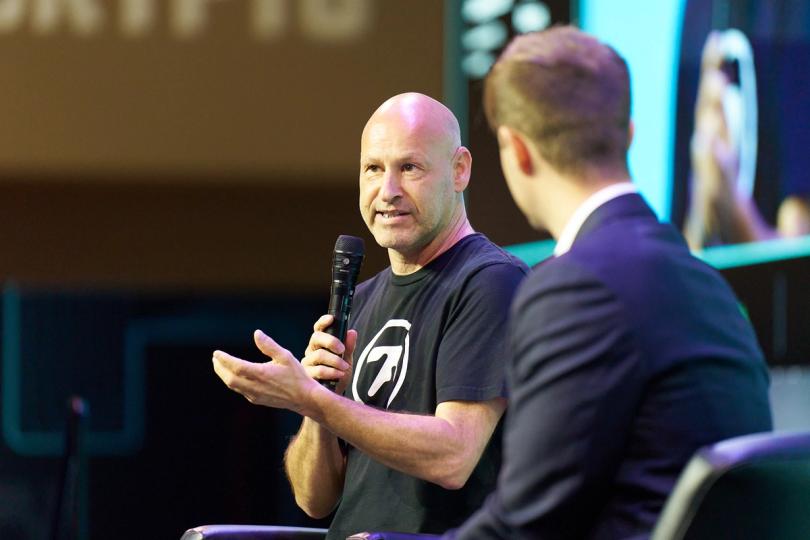
“We are entering a world where essentially the entire economy will be tokenized,” said Joseph Lubin, CEO and founder of Consensys during a fireside chat Tuesday at Consensus Miami 2026.
In his fireside chat with Robbie Klages, founder of The Rollup, Lubin said he believes tokenization is no longer experimental, but inevitable.
The global economy is steadily moving on-chain and Ethereum is structurally positioned to benefit the most, said the founder of Consensys, a blockchain company founded in 2014 by Lubin, co-founder of Ethereum. His company focuses on building infrastructure, development tools, and decentralized applications (dApps), primarily for the Ethereum blockchain.
Lubin traced tokenization back to the origins of Ethereum, describing it as a breakthrough allowing anyone to issue assets without building a new blockchain.
Today, this early design choice is paying off as financial institutions increasingly move their assets onto blockchain rails.
Lubin highlighted bitcoin’s evolution as the first decentralized token towards Ethereum’s role enabling the creation of new tokens without building separate blockchains. He said the technology has reached a level of maturity that is attractive to traditional financial institutions and regulators.
“We are now mature enough to attract traditional financial bodies and regulators,” he said, highlighting Ethereum’s reliability, security and scalability as key differentiators.
He said tokenization is expanding from stablecoins to treasures and other real-world assets, and more financial activity is expected to move toward blockchain infrastructure.
Lubin also described Ethereum’s scaling approach. Layer 2 networks are increasing their capacity and developments such as synchronous composability aim to enable transactions across multiple networks to execute within a shared system.
“All these transactions on all these different networks are going to burn ether,” he said, referring to how activity in the ecosystem restores value to Ethereum.
He described ETH as a “trust commodity,” arguing that its role in securing and settling transactions could give it monetary characteristics as economic activity moves on-chain.
Lubin added that recent disruptions in decentralized finance reflect developing technology and said the ecosystem continues to grow stronger through collaboration.


