
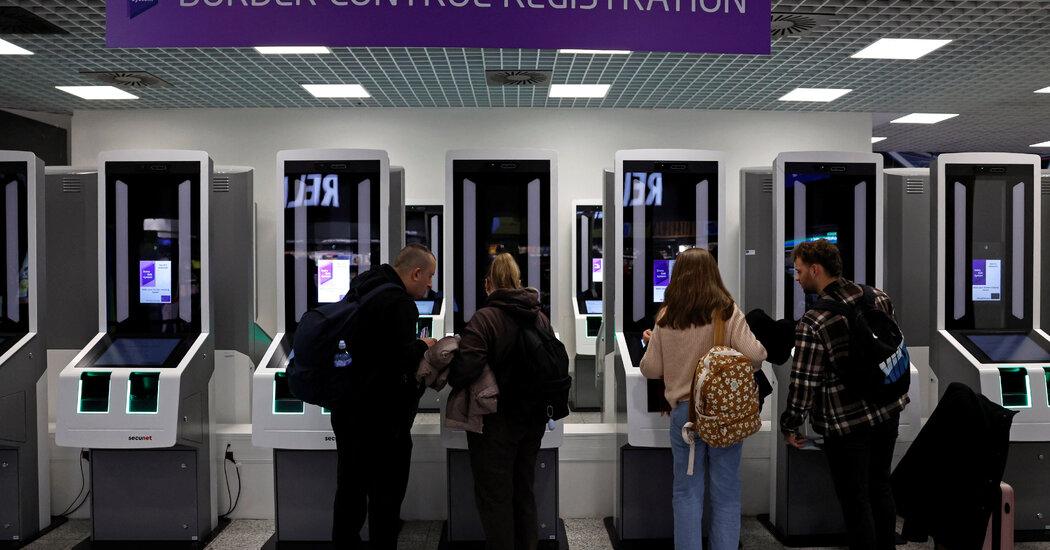
European leaders are standing firm on a security program that has led to long queues, confusion and missed flights at airports this summer, despite an urgent call from the aviation industry to suspend it.
The Entry/Exit System, or EES, requires members of the 29-country Schengen open border area to collect biometric data such as facial photos and fingerprints from travelers upon arrival and confirm their identity upon exit. Since the system went into full effect in April, airports and airlines have reported widespread chaos — including hours-long queues at security checkpoints and confusion over procedures — and feared the headaches would worsen with the start of the peak travel season.
These problems led top European aviation industry officials last week to call on the European Union to suspend the EES requirement this summer. The system “damages Europe’s reputation, European tourism and connectivity”, says the open letter addressed to the President of the European Commission.
But on Tuesday, European Commission leaders formally rejected the request in a meeting with industry players, saying the new system’s security benefits outweighed its drawbacks.
The system “makes EU citizens safer while minimizing the impact on legitimate non-EU travelers,” a European Commission spokesperson said in a statement after the meeting, noting that the system had already recorded 110 million trips and turned away 45,000 visitors.
The EES applies in the 29-country Schengen Area, which includes 25 members of the European Union plus Iceland, Liechtenstein, Norway and Switzerland. Anyone who is not a national of a country using the system, or an Irish or Cypriot citizen, is required to pass through its checkpoints.
Since the system began rolling out across Europe in October, travelers have faced an inconsistent set of procedures, which can take anywhere from minutes to hours. Some airports have self-service kiosks where travelers can register their biometric data. In others, border control agents manually register travelers. Only two countries, Sweden and Portugal, currently allow travelers to use a dedicated app. EES is intended to ultimately be an automated system.
“At present, the system is failing to achieve one of its fundamental objectives: facilitating efficient border crossings while maintaining the smooth functioning of the European transport network,” aviation officials wrote in the open letter urging the European Union to act.
Under current rules, the EES can only be partially suspended, allowing airports to bypass the collection of biometric data for six hours at a time, although they still have to record travelers’ information, a European Commission spokesperson said. The possibility of relaxing the rules is not enough to actually reduce delays, aviation industry officials said. They have unsuccessfully sought greater flexibility to suspend the system and revert to standard visa passports until there are more border control staff and consistency in how passengers are checked in.
A survey of 85 airports in 20 member states by Airports Council International, whose European director general is one of the signatories to the open letter, found that during peak times in June, passengers could wait up to five hours at the airport to enter a country. And although the system is supposed to store travelers’ data for three years, some visitors said they were repeatedly asked to provide their biometric data, leading to delays.
Some people posted on social media to say all the problems were making them reconsider traveling to Europe.
Warnings that the system is not prepared for the peak summer season are reverberating throughout the aviation industry. Ryanair, Europe’s largest budget airline, flagged several airports “experiencing major disruption” in an alert to passengers, advising them to arrive early. The list included Tenerife South, in the Canary Islands; Palma, in Majorca; Alicante and Malaga, Spain; Milan Bergamo, Italy; Krakow, Poland; and Paris-Beauvais.
Summer travelers are being forced to “endure unnecessary passport control chaos,” Ryanair chief operating officer Neal McMahon said in a statement.
“Passengers and their families should not be used as guinea pigs for a poorly designed passport control system that risks creating long queues, missed flights and unnecessary stress at airports this summer,” he added.
In Rome, airports have already suspended biometric data collection almost daily this summer, said a spokesperson for Aeroporti di Roma, which operates the city’s airports. Rome Fiumicino, Italy’s busiest airport, expects around 11 million passengers in June and July, which could reach 180,000 passengers on peak days, the spokesperson said.
Follow the travels of the New York Times on Instagram And sign up for our Travel Dispatch newsletter for expert tips on traveling smarter and inspiration for your next vacation. Are you dreaming of a future getaway or simply an armchair trip? Check out our 52 places to go in 2026.


