
Something was wrong at the Berlin Olympic Stadium.
It was a cold Saturday evening in January. German fans of the Hertha Berlin football club lined up to buy beer from the taps in the hall. But the beer wasn’t German.
The stadium had replaced its national beer, Beck’s, with an American import, Budweiser.
The fans seemed surprised. What was this mainstream lager from American baseball parks doing at a German soccer game?
Why was it sold to the Germans under the name “Anheuser-Busch Bud” rather than its American name?
And why was its parent company trying – at a difficult time for American products abroad – to persuade Germans to drink it?
The answer appears to be: It’s a bet on a small but growing share of one of the world’s largest beer markets.
The multinational company that has owned the American Budweiser since 2008 is called AB InBev. It is based in Belgium and also owns Beck’s. Its representatives declined to answer most of my questions about what is now Bud’s third attempt to sell it in Germany.
Officials would not say why they chose, once again, to introduce a distinctly American product into such an insular beer market. Or why they chose a time when many Germans are full of anger at President Trump and not at all in love with the United States.
“I think Germany is probably the most difficult beer market in the world,” Oliver Lemke, who runs an eponymous brewery with a string of restaurants around Berlin, told me. “You have a lot of breweries. You have an audience that doesn’t appreciate any other beer styles than what they’re used to.”
Mr. Lemke said he did not mix politics and sales. But based on the market, he said: “I don’t see why they would have come here.” »
The company sees this decision as a return to basics. Eberhard Anheuser and Adolphus Busch were born in Germany, emigrated to St. Louis, and in 1876 began brewing a mild lager. They called it Budweiser, after a Czech beer they admired, hoping to appeal to immigrants who remembered the brand.
I’ve always had a weakness for it. When I was in my senior year of college, my favorite professor and mentor took me to lunch at an off-campus sports bar to discuss the magic and mystery of journalism. His name was Bill Woo. Because he was from St. Louis, we always drank Budweiser.
Most Germans have no such affection for beer – nor such exposure. That’s because Anheuser-Busch failed for over a century to sell its version of Budweiser in Germany.
The Czech brewery from which Anheuser and Busch take their name, Budejovicky Budvar, has claimed trademark infringement. The parties agreed in 1911 and 1939 to divide their brewing worlds. The Czechs couldn’t sell their Budweiser in the United States, and Anheuser-Busch couldn’t sell its version in much of Europe.
Twice the Americans tried to conquer the German market under different brands. Both attempts failed. The first was abandoned after several years of disappointing sales. The second was scuttled due to ongoing legal issues surrounding the Budweiser name.
Last fall, AB InBev announced a new attempt, now with a product that it had to, for legal reasons, call “Anheuser-Busch Bud.” A company official said the expansion would return Bud to its German “roots” – the home country of its founders – in time for its 150th anniversary.
“We are proud to make Anheuser-Busch Bud available again in Germany,” Florian Farken, spokesperson for AB InBev Germany, wrote to me in a message.
Hertha Berlin, the football club, announced that Bud would replace Beck in home matches. Later, elite club Bayer Leverkusen and recently relegated Wolfsburg followed suit with a similar sponsorship deal.
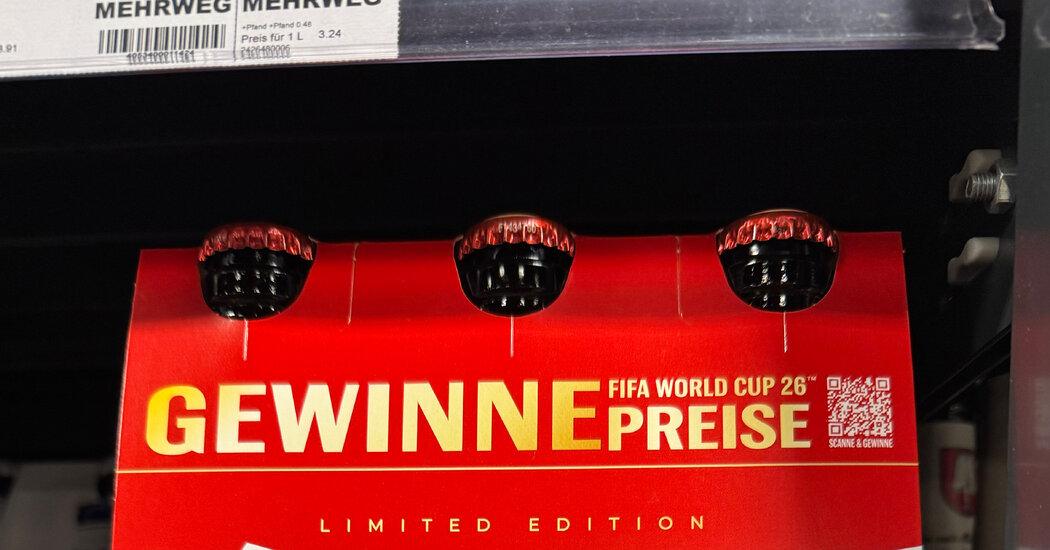
Otherwise, beer is hard to find. It’s rare to see them in grocery stores, not even the special packages the company sells to commemorate the FIFA World Cup.
The story has another explanatory data point. German beer consumption is decreasing year by year. It was down 6 percent last year and is already down 9 percent this year, Holger Eichele, chief executive of the German Brewers Association, told me.
But one segment of the market is gaining slightly, from a very small base: imports. Announcing its German Bud campaign last year, AB InBev noted that “international lagers are among the fastest growing beer segments in Germany.”
Mr. Eichele could not speak directly about InBev’s strategy. But he told me that “German consumers are very interested in testing, in discovering new products, new styles, new brands.”
Analysts have doubts. “Given the still difficult situation on the German beer market and the recent decline in the image of American products,” wrote the trade journal Getränke News this spring, sales of Bud in Germany “risk being lower than expected.”
At a Hertha game this spring, a visiting American fan was also skeptical: my father.
“Can’t we have a German beer?” he asked online.
But when we got back to our seats, he called me across the row. He raised his cup.
“It’s better here!” he said.
Tatiana Firsova reports contributed.


