
Retailers must pay a flat 1% tax on sales. A program aimed at covering merchants with a single point of sale. Minister describes initiative
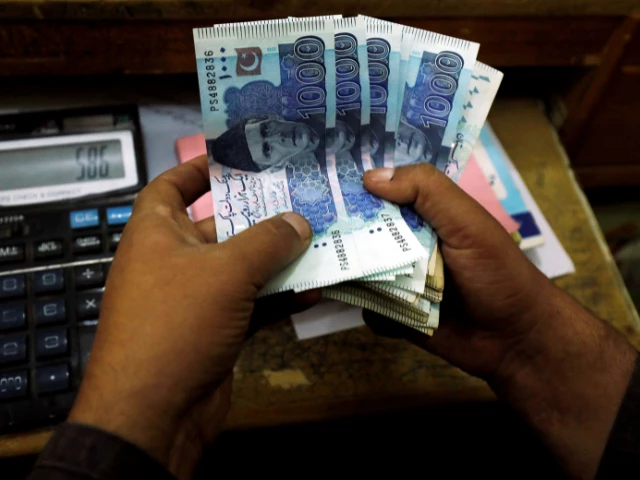
A trader counts Pakistani rupee notes at a currency exchange stand in Peshawar, Pakistan December 3, 2018. REUTERS
ISLAMABAD:
The government on Friday announced a “small merchant scheme” under which retailers will pay a flat 1% tax on sales in exchange for exemptions from tax audits and requirements related to digital transaction systems, with officials projecting annual revenues of 50 billion rupees.
Finance Minister Muhammad Aurangzeb unveiled the project alongside Minister of State for Finance Bilal Azhar Kayani, who described the initiative as a “win-win solution” for the government and small traders.
This is the government’s second such initiative to bring traders into the tax net after a previous “Tajir Dost” program failed to produce the expected results. Officials said the new program was developed in consultation with the trading community.
According to Kayani, the program will apply to traders with a single outlet whose annual sales are less than Rs200 million for the last three consecutive years. Eligible participants will pay 1% tax on the total value of merchandise sold.
He said participants would also be required to pay a minimum annual tax of Rs25,000 at the time of filing a one-page simplified income tax return. This payment would be in addition to any applicable tax withholding. He added that the system would be optional, allowing traders to either opt-in or continue to file standard tax returns.
Kayani is the project architect who finalized these proposals in consultation with the traders. The traders’ representatives had demanded the government to introduce a single-page tax return with a fixed tax rate on income.
Traders welcome the announcement of the scheme and the government has accepted our long-standing demand for a single-page return in national and regional languages, said Kashiif Chaudhry, president of Tanzeem Tajraane-e-Pakistan.
Pakistan has informed the International Monetary Fund that it will raise a minimum of 50 billion rupees from the trader’s project.
The scheme, applicable from FY 2026, will exclude Tier 1 registered suppliers, wholesalers, distributors, manufacturers and importers. This will also not apply to lawyers and doctors.
Officials said merchants already filing returns for tax year 2025 would also be eligible to join the program through a streamlined application process with no additional qualification requirements.
Under the framework, registered traders would not be subject to routine tax audits, with checks limited to risk-based screening, economic indicators or credible information regarding undeclared assets. Disputes, if any, would be resolved through mediation involving trade bodies.
Small traders have been exempted from the obligation to install machines at points of sale or issue digital invoices. This would keep a large number of businesses out of the digital economy and promote the cash economy in the country.
Officials further stated that participants who fail to comply with the program’s conditions – including failing to file returns, concealing sales or failing to maintain records – will lose program benefits and be subject to customary sanctions.
A penalty structure of Rs 10,000 for the first month, Rs 25,000 for the second month and Rs 50,000 for subsequent monthly payment defaults has also been outlined.
The system also exempts participants from installing point-of-sale systems and acting as withholding tax agents. However, no refunds will be made on the tax payments nor will the excess tax be adjustable.
An almost similar project was debated in 2023, at the time of the PDM, but certain elements of the government at the time blocked this decision. Revenue Reform and Mobilization Commission chairman Ashfaq Tola had finalized the project with the traders. But he was later shot dead by the FBR.
The difference between the 2023 regime and the 2026 regime is that under the 2023 regime, it was proposed that the 1% tax would be collected at the time of deliveries, but under the new regime, traders will make their payments at the time of filing their annual tax returns.
Kayani said registered traders would display a plaque issued by the Federal Board of Revenue (FBR) outside their premises, having the details of the business, NTN and a QR code. He added that FBR officials would not be allowed to enter compliant shops and any violation by officials would attract disciplinary action.
Officials said the plan should not be seen as a tax amnesty. “This project should not be construed as a tax amnesty scheme for traders,” said Dr Hamid Ateeq Sarwar, member reforms at the FBR.
The salaried class, heavily taxed and crumbling under double-digit inflation, also demanded a simple tax return with the option of paying a flat tax of 1% on their gross income.
In the last financial year, the salaried class paid over Rs 600 billion in income tax.


