
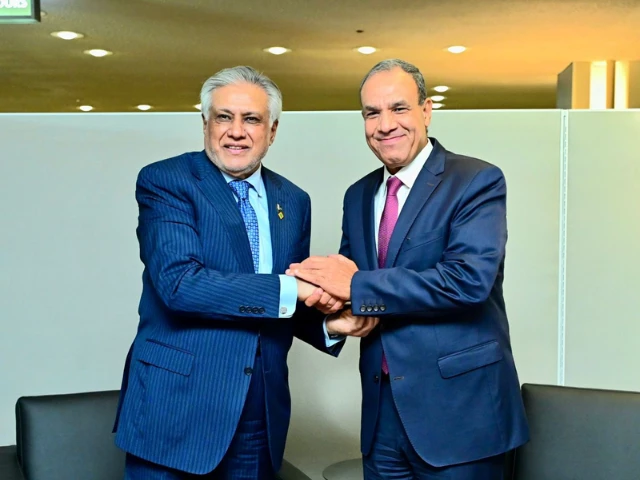
Both sides stress importance of dialogue and engagement for peace and stability
Deputy Prime Minister and Minister of Foreign Affairs Ishaq Dar on Tuesday held a telephone conversation with Egyptian Foreign Minister Badr Abdelatty to discuss the latest regional developments, according to a statement released by the Ministry of Foreign Affairs on X.
The statement said the two ministers “underlined the importance of dialogue and engagement for peace and stability” during their discussion. He added that the two sides “agreed to remain in close contact” as part of ongoing diplomatic coordination on regional issues.
Deputy Prime Minister / Minister of Foreign Affairs, Senator Mohammad Ishaq Dar @MIshaqDar50 spoke today with Egyptian Foreign Minister Badr Abdelatty @BadrAbdelatty to discuss the latest regional developments.
Both stressed the importance of dialogue and commitment for peace and… pic.twitter.com/GVkQGcNQWf
— Ministry of Foreign Affairs – Pakistan (@ForeignOfficePk) April 21, 2026
FM Dar received unprecedented international recognition for its diplomatic leadership, as Pakistan positioned itself at the center of high-stakes mediation efforts during the escalating Iran-US-Israel crisis.
Over the past week, senior officials and influential voices from more than ten countries, including Saudi Arabia, Iran, the United States, China, Turkey, Azerbaijan, Bahrain and Uzbekistan, have publicly acknowledged Dar’s role in facilitating ceasefire negotiations.
Read: Trump sends negotiators for second round of Islamabad
Meanwhile, Islamabad is gearing up to host the second round of Iran-US talks after Washington confirmed that a high-level delegation led by US Vice President JD Vance would arrive in Pakistan.
Pakistan has emerged as a central facilitator on the sensitive diplomatic track, positioning itself as an “honest broker” amid sharply polarized positions between Washington and Tehran.
While the first round highlighted deep disagreements over sanctions, maritime security and regional influence, officials suggest both sides have so far kept the channel open, even as public discourse has hardened ahead of the next phase of talks.


