
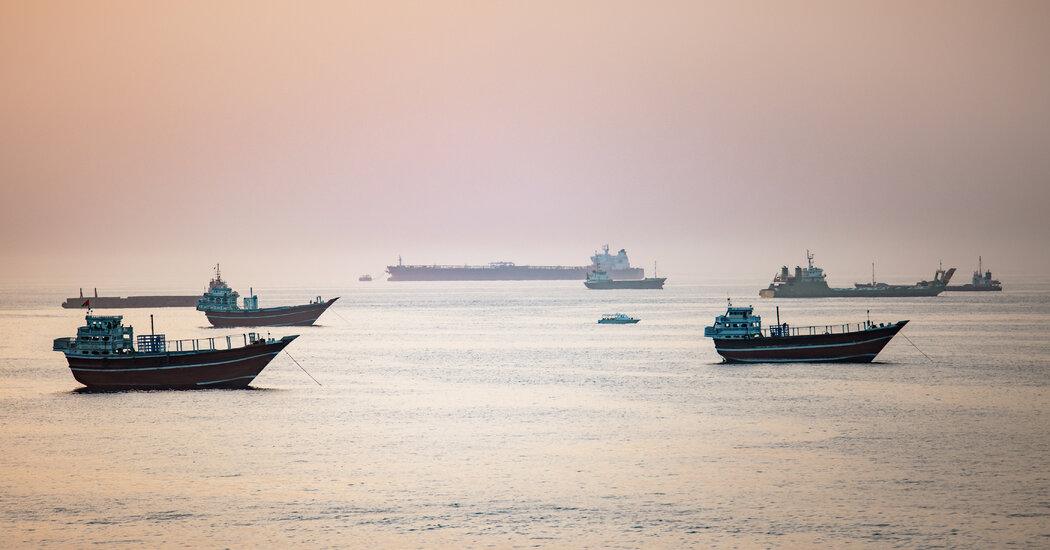
New reports of strikes on commercial shipping in the Strait of Hormuz posed another test of the fragile ceasefire between the United States and Iran, as President Trump traveled to a NATO summit on Tuesday where talks on war were expected.
Iranian missiles hit two ships in the strait, but there were no casualties, a U.S. official said Monday evening, Eastern Time.
According to a notice issued Tuesday by United Kingdom Maritime Trade Operations, a monitoring center run by the British Navy, the crew of an oil tanker off the coast of Oman reported the strike of an unidentified projectile, which caused a fire on the vessel.
The report does not identify the tanker or its cargo and says no casualties or environmental effects were reported. The tanker was near the eastern mouth of the strait when it was hit, according to the report.
There was no immediate public comment from authorities in Iran, where a program of one-day funeral ceremonies is underway for Ayatollah Ali Khamenei, the supreme leader killed on the first day of the war. Negotiations between Iran and the United States were suspended until after the funeral.
Mr. Trump, who was traveling to Turkey for the NATO summit, also did not immediately comment on reports of strikes on ships in the strait. He criticized NATO members for not supporting the United States in the war against Iran.
The strait, which is normally the conduit for a fifth of the world’s oil, was effectively blocked by Tehran after the United States and Israel sparked war with attacks on Iran in late February. The US Navy also imposed its own blockade of Iranian ports. European economies were among the hardest hit by the ensuing energy supply crisis.
Traffic around the strait has accelerated since June 20, when the preliminary ceasefire agreement between the United States and Iran took effect. This agreement has already been called into question by sporadic fighting. The latest strikes were reported nearly two weeks after a new series of attacks on ships by Iran, which prompted US retaliation against Iranian military infrastructure.
From Friday to Sunday, 108 ships passed through the Strait of Hormuz, according to Kpler, a maritime data company. This was 21 fewer than the previous three days. Before the war, more than 100 ships a day regularly crossed the strait.
Iran has said it expects ships to pass through the strait along its coast, not the opposite side near Oman. The traditional route through the middle of the strait is considered dangerous due to the risk of mines planted by the Iranian army.
Many ships turn off their transponders before sailing through the strait, making it difficult to accurately identify their routes and giving an incomplete view of traffic volumes.
The price of Brent crude oil, the global benchmark, rose more than 1% on Tuesday, to $73 a barrel. As Persian Gulf energy exports have recovered, however tentatively, the price of oil has fallen back to near prewar levels. The price of Brent reached $118 per barrel at the height of the fighting.
However, the effects of the energy shock persist, particularly in oil-derived products. The average price of a gallon of gasoline in the United States was $3.80 Tuesday, according to the AAA automobile club, about 27 percent higher than before the war.


