
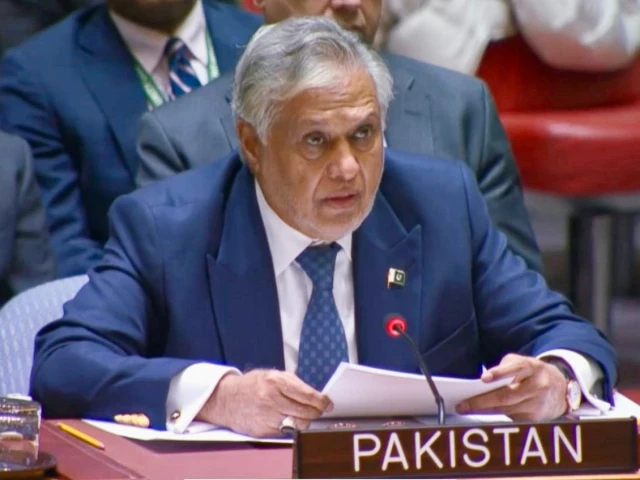
Over the past week, officials from more than 10 countries have praised Dar for his contribution to ceasefire negotiations and stability.
DPM and FM Ishaq Dar address the UN Security Council session on Palestine in New York. PHOTO: MOFA
ISLAMABAD:
Deputy Prime Minister and Foreign Minister Ishaq Dar received unprecedented international recognition for his diplomatic leadership, as Pakistan positioned itself at the center of high-stakes mediation efforts during the escalating Iran-US-Israel crisis.
Over the past week, senior officials and influential voices from more than ten countries, including Saudi Arabia, Iran, the United States, China, Turkey, Azerbaijan, Bahrain, Uzbekistan and Egypt, have publicly acknowledged Dar’s role in facilitating ceasefire negotiations and promoting regional stability.
Diplomatic channels and international media coverage suggest overwhelmingly favorable sentiment toward Pakistan’s top diplomat, underscoring his credibility, strategic positioning and continued efforts toward de-escalation at a time of heightened regional tensions.
Based on sentiment analysis from April 5-11, 2026, FM Dar ranked as the most positively perceived global leader in the world, recording the highest positive/negative sentiment ratio among all leaders assessed.
During the last 24-hour window (April 10-11), Dar recorded 30.5% positive sentiment compared to just 8.5% negative, putting him ahead of prominent global figures including Chinese President Xi Jinping, Saudi Crown Prince Mohammed bin Salman, French President Emmanuel Macron and German Chancellor Friedrich Merz.
Learn more: Kuwait hails Pakistan’s role in US-Iran peace efforts (FO)
The data highlights Pakistan’s growing diplomatic importance, particularly in managing crises involving key global and regional stakeholders.
This momentum culminated with the arrival of US Vice President JD Vance in Islamabad on April 11 to participate in a high-level peace summit, a development widely seen as validation of Pakistan’s central role in ongoing diplomatic efforts.
Officials said Dar’s engagement helped bridge communication gaps between the adversaries, enabling dialogue at a time when conventional diplomatic channels were at a standstill.
As Islamabad emerges as a key venue for crucial negotiations, Pakistan’s diplomatic action appears to be reshaping perceptions in world capitals, strengthening its position as a credible mediator in one of the most volatile geopolitical crises in recent years.


