
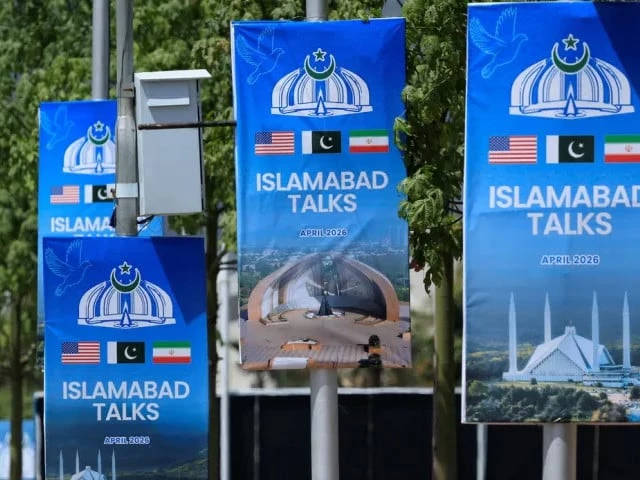
Pakistani mediators have stepped up to ensure that diplomacy does not falter.
ISLAMABAD:
When news of the evacuation of 22 Iranian crew members from the ship seized by the US Navy to Pakistan broke on Monday, it was a testament to the effectiveness of Islamabad’s mediation efforts.
This development was seen as an important confidence-building measure and a precursor to other potential positive outcomes.
However, hours before what could be a defining phase in diplomatic efforts, US President Donald Trump announced “Project Freedom” aimed at helping stranded ships pass through the Strait of Hormuz with the help of the US Navy.
The announcement sparked an immediate reaction from Iran, which called the move a violation of the ceasefire. Tehran later claimed to have struck a US Navy ship with missiles, but CENTCOM denied the incident. Instead, he claimed that as part of “Project Freedom,” two US-flagged ships had successfully crossed the Strait of Hormuz.
Amidst this, the UAE has been the victim of alleged missile strikes from Iran. Plumes of smoke coming from Fujairah, a strategic energy hub, sent shock waves across the region.
Alarm bells have been sounded about the imminence of a resumption of war.
The hard-won ceasefire and the progress made through behind-the-scenes negotiations were on the verge of collapse.
As the world prepared for the worst, one country refused to give up hope.
Pakistani mediators have fired up the fuse to ensure that diplomacy does not falter.
It has not only intensified its engagement with the main parties involved in the conflict, but also with other stakeholders who could have influence.
While the world waited with bated breath, Pakistani diplomacy moved to prevent an escalation.
Pakistan, although it acted cautiously throughout the conflict, did not mince its words when the UAE was attacked. Prime Minister Shehbaz Sharif condemned the attacks and urged all parties to exercise restraint and respect the ceasefire.
Interestingly, Iran has distanced itself from the UAE strikes, even though Iran’s state media initially owned it.
This was perhaps due to the backlash Iran faced after the strikes, as the timing was such that talks were progressing behind the scenes.
Meanwhile, Pakistan has reached out to other regional players, particularly Saudi Arabia, to find common ground that could prevent the inevitable.
Islamabad, alongside Riyadh, persuaded the Trump administration to reconsider “Project Freedom.”
The challenge, however, was whether President Trump could be convinced.
But as has happened throughout this conflict, Pakistan once again sprung a surprise when President Trump agreed to suspend operations in the Strait of Hormuz at the request of Pakistan and other countries.
“This is certainly a remarkable achievement by Pakistan,” said a diplomatic source, whose own country is also participating in the diplomatic effort.
Prime Minister Shehbaz thanked Trump for the gesture and at the same time acknowledged the role of Saudi Crown Prince Muhammad bin Salman.
Following Trump’s announcement, US media suggested that Washington and Islamabad were moving closer to a “one-page” memorandum of understanding to permanently end the war.
Pakistan remains tight-lipped as part of its deliberate approach not to reveal details of complex secret negotiations.
But a diplomatic source said much more happened and took place behind closed doors. The results of these efforts would soon begin to surface.
Still, observers warn against setting expectations too high, as things could get worse at the last minute.
Yet Pakistan is pushing for the process to reach its logical end. “Pakistan has managed to bring things back from the brink, at least for now,” a source remarked.


