
According to him, such reckless actions lead to potentially catastrophic and irreversible consequences for human life.
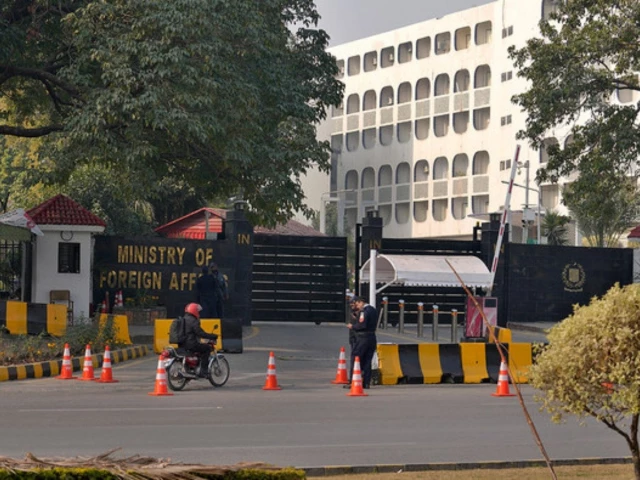
Police officers stand guard outside the main gate of the Ministry of Foreign Affairs in Islamabad on January 18, 2024. Photo: File
Pakistan on Monday condemned the drone attack on the Barakah nuclear power plant in the United Arab Emirates (UAE), saying the deliberate targeting of nuclear facilities constitutes a serious violation of international law and such reckless actions lead to potentially catastrophic and irreversible consequences on human life.
In a statement issued by the Ministry of Foreign Affairs (MOFA), Pakistan said it “stands in full solidarity with the brotherly people and government of the UAE.”
“Any deliberate targeting of nuclear facilities constitutes a serious violation of international law, the Charter of the United Nations and the fundamental principles of nuclear safety and security enshrined in the Statute and resolutions of the International Atomic Energy Agency (IAEA),” the statement added.
He further said: “Nuclear facilities should not be targeted under any circumstances,” noting that “such reckless actions result in potentially catastrophic and irreversible consequences for human life, the environment, and regional and global peace and security.”
The statement further said that the inviolability of civilian nuclear infrastructure is a well-established international norm that must be respected without exception, adding that “Pakistan calls on all parties to exercise maximum restraint.”
“All parties must fulfill their obligations under international law and international humanitarian law, and avoid any action likely to exacerbate tensions with consequences extending well beyond the region,” the text adds.
The ministry concluded by calling for dialogue and diplomacy as “the only viable path towards lasting peace, stability and de-escalation in the region.”
Read: UAE says it needs no external protection, vows to defend sovereignty
The day before, a drone struck a power generator outside the inner perimeter of the Barakah power plant, causing a fire. However, radiological safety levels were not affected and no injuries were reported.
The IAEA had said emergency diesel generators were powering “unit 3” of the plant and called for “maximum military restraint in the vicinity of any nuclear power plant.” The agency also said it was closely monitoring the situation.
The attack came as progress appears to have stalled in efforts to end the U.S.-Israeli war with Iran and resume shipping in the Gulf region.
Emirati officials said after the strike that they were investigating the source of the attack, reaffirming their right to respond to such “terrorist attacks.” The United Arab Emirates has already accused Tehran of attacking its energy targets in what it called an escalation of conflict in the region.
Learn more: Iran’s Araghchi warns UAE over Netanyahu meeting, says ‘collusion with Israel’ ‘unforgivable’
Since the United States and Israel launched a joint offensive against Iran on February 28, Tehran has repeatedly targeted the United Arab Emirates and other Gulf states that host U.S. military bases, striking sites including civilian and energy infrastructure.
This month, Iran stepped up its attacks on the United Arab Emirates after U.S. President Donald Trump announced a naval mission to try to open the Strait of Hormuz, which he suspended after 48 hours.
The disruption of shipping through the Strait of Hormuz has caused the largest oil supply crisis in history, sending energy prices soaring. The United States, meanwhile, imposed its own blockade of Iranian ports, further escalating tensions in the region.


