
Both review bilateral relations and reaffirm commitment to strengthening cooperation in areas such as security, defense
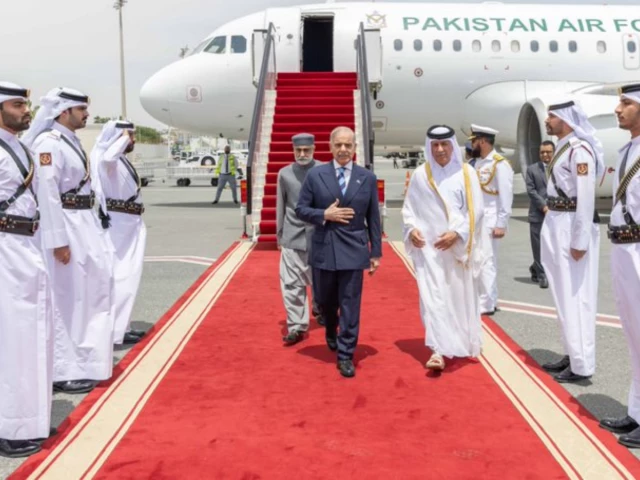
Qatari Minister of State for Foreign Affairs Sultan bin Saad Al-Muraikhi receives Prime Minister Shehbaz Sharif at Doha Airport. PHOTO: Prime Minister’s Office/X
Prime Minister Shehbaz Sharif on Thursday expressed solidarity with Qatar and called for de-escalation and dialogue for peace in the Middle East during a meeting with Qatari Emir Sheikh Tamim bin Hamad Al Thani.
According to a statement issued by the Prime Minister’s Office (PMO) on X, the meeting, which was held at the Amiri Diwan, lasted for over an hour. The two leaders discussed the latest regional and international developments, particularly in the Middle East.
“At the outset, the Emir of Qatar welcomed Prime Minister Shehbaz and his delegation and expressed his deep appreciation for Pakistan’s central role in supporting efforts to defuse tensions in the region and promote diplomatic dialogue in a manner that serves regional security and stability,” the Prime Minister’s statement read.
It added that the Prime Minister renewed his condemnation of the attacks on Qatar and other Gulf countries, while reaffirming Pakistan’s full solidarity and support to the leadership and people of Qatar.
Prime Minister Muhammad Shehbaz Sharif, who arrived in Doha earlier today, had a warm and cordial meeting with His Highness Sheikh Tamim bin Hamad Al Thani, Emir of the State of Qatar.
During their meeting held at the Amiri Diwan which lasted more than an hour, the two leaders… pic.twitter.com/EEF4ZEZo7y
– Government of Pakistan (@GovtofPakistan) April 16, 2026
“Both leaders stressed the importance of supporting de-escalation efforts and strengthening international coordination to ensure the security and stability of the region, particularly by ensuring the continued fluidity of energy supply chains,” the statement added.
The Prime Minister’s Office said the two leaders also reviewed bilateral relations and explored ways to further strengthen ties, particularly in the areas of security, defense and energy, so as to strengthen partnership and open new avenues of cooperation.
The statement added that the Emir of Qatar and Prime Minister Shehbaz also had a one-on-one meeting, during which they exchanged views on developments of mutual interest and highlighted the importance of continued coordination and consultations between the two countries, particularly in light of ongoing events and their implications for regional security and stability.
The meeting was attended by Prime Minister and Minister of Foreign Affairs of Qatar Sheikh Mohammed bin Abdulrahman bin Jassim Al Thani, Head of the Amiri Diwan Abdullah bin Mohammed Al Khulaifi and several senior officials.
From the Pakistani side, Information Minister Ishaq Dar, Information Minister Attaullah Tarar, Special Assistant to Prime Minister Tariq Fatemi and other senior officials were present.
Later, the Prime Minister said in a message on X: “I had a most warm and cordial meeting with my dear brother, the Amir of Qatar, His Highness Sheikh Tamim bin Hamad Al Thani, in Doha today. I thanked His Highness the Amir on behalf of the people of Pakistan for the exceptionally warm and generous gesture of sending fighter jets from Qatar to escort our aircraft as it entered Qatari airspace.
Prime Minister Shehbaz added that he was truly touched by the gesture, which embodied the spirit of Qatar’s renowned hospitality and the strength of the enduring ties between the two countries.
Today in Doha I had a most warm and cordial meeting with my dear brother, the Emir of Qatar, His Highness Sheikh Tamim bin Hamad Al Thani.
I thanked His Highness the Amir on behalf of the people of Pakistan for the exceptionally warm and generous gesture of sending the Qatar fighter…
– Shehbaz Sharif (@CMShehbaz) April 16, 2026
Upon arrival in Doha, Prime Minister Shehbaz was received by Qatar’s Minister of State for Foreign Affairs, Sultan bin Saad Al Muraikhi, where the Prime Minister and his delegation were given a guard of honor.
In a separate statement announcing the prime minister’s arrival in Doha, the Prime Minister’s Office detailed the grand welcome Prime Minister Shehbaz received, namely that upon his entry into Qatari airspace, “Qatar Air Force fighter jets escorted the Prime Minister’s plane in ceremonial and security formation, accompanying him to the airport.”
Date: January 16, 2026.
وزیرِ اعظم محمد شہباز کے دورہء قطر کے دوران وزیرِ اعظم کا شاندار استقبال ہوا.
قطر کی حدود میں داخل ہوتے ہی قطری فضائیہ کے لڑاکا طیاروں نے وزیرِ اعظم کے جہاز This is a person who is working. وزیرِ اعظم نے قطری قیادت اور پائیلٹس کا اس شاندار… pic.twitter.com/Bup5TFIPdG
– Prime Minister’s Office (@PakPMO) April 16, 2026
The Prime Minister had already visited Saudi Arabia as part of his three-country tour. He is also expected to visit Turkey, and his tour is expected to continue until Friday as part of ongoing talks on Middle East peace.
The prime minister’s meeting with Qatar’s emir came four days after the United States and Iran were unable to reach an agreement to end their war despite marathon negotiations lasting about 21 hours. The protracted talks, aimed at ending hostilities that have left thousands dead and sent global oil prices soaring over the past six weeks, have resulted in both sides blaming each other for the impasse.
On April 11, the American and Iranian delegations arrived in Pakistan for conclusive negotiations after an immediate two-week ceasefire “everywhere, including Lebanon”, announced by Prime Minister Shehbaz, who then invited the two countries’ delegations to Islamabad.
The United States and Israel launched a joint offensive against Iran on February 28, killing thousands of people in Iran, including then-supreme leader Ayatollah Ali Khamenei, and injuring tens of thousands, including civilian areas, including residential buildings and religious sites.
The conflict has also expanded geographically. Iran responded with drone and missile strikes targeting Israel as well as Jordan, Iraq and Gulf countries hosting US military assets. It also restricted the movement of ships through the Strait of Hormuz.


