
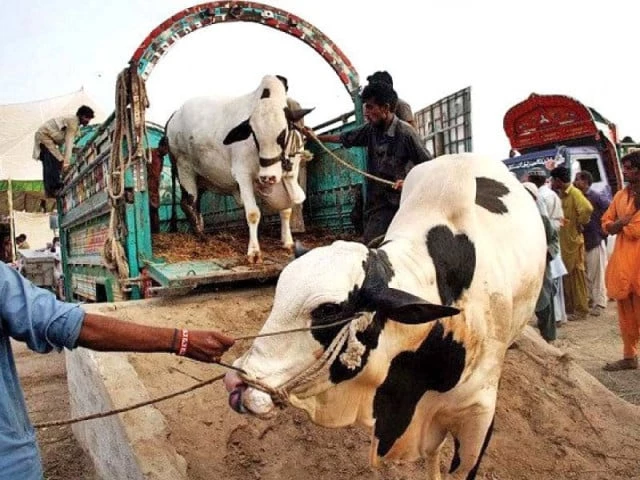
Offals discarded locally find their way from the streets of Punjab to international markets
FAISALABAD:
What many households throw away as waste after Eidul Azha becomes a valuable source of income for nomadic communities and sanitation workers, who collect animal remains and sell them in local and international markets.
For Abdul Ghafoor, a nomad living in a roadside tent along Sargodha Road, Eid is the most profitable time of the year.
He said the seasonal increase in sacrificial animal waste provides him with an income he could not match during the rest of the year.
He explained that a specific part of cattle intestines, locally called ‘Chodra’ in trade slang, has significant commercial value.
According to him, he extracts a part of the stomach lining attached to the intestines, the size of a football, and sells it to local dealers for 800 to 1,000 rupees, making money immediately.
He explained that these middlemen clean, salt and dry the material before selling it to big traders, especially in Karachi, from where it would be exported to China.
In China, it is then processed for use in medical manufacturing, including surgical sutures used in operations around the world.
These finished products are also re-imported to Pakistan for use in hospitals and medical facilities.
Ghafoor claimed that by collecting such materials from urban and rural areas during Eid, he earned over Rs 100,000 on the first day alone.
He added that competition for collection often leads to conflicts with municipal sanitation workers, especially those associated with ‘Suthra Punjab’, as both groups consider the material to be very valuable.
An official of the district Animal Husbandry Department, Dr Suhail Anjum, explained that large ruminants such as cows and buffaloes have four gastric compartments: rumen, reticulum, omasum and abomasum.
He explained that the part commonly collected and sold commercially is the omasum, which plays a role in digestion and is made up of several thin layers of tissue.
He added that in the international meat and medicine supply chain, particularly in exports to China, processed omasum (also known as beef tripe) is used in industrial applications, including the production of surgical sutures and other medical materials.
Dr Anjum noted that this seasonal trade has become a profitable informal industry, which is why nomadic collectors and sanitation workers actively compete for access to materials during Eid.
He added that this competition often results in clashes at dump sites.
He further said that the market for livestock by-products sees a surge during Eid, transforming what is normally a waste into a temporary but very lucrative economic opportunity for many low-income workers.


