
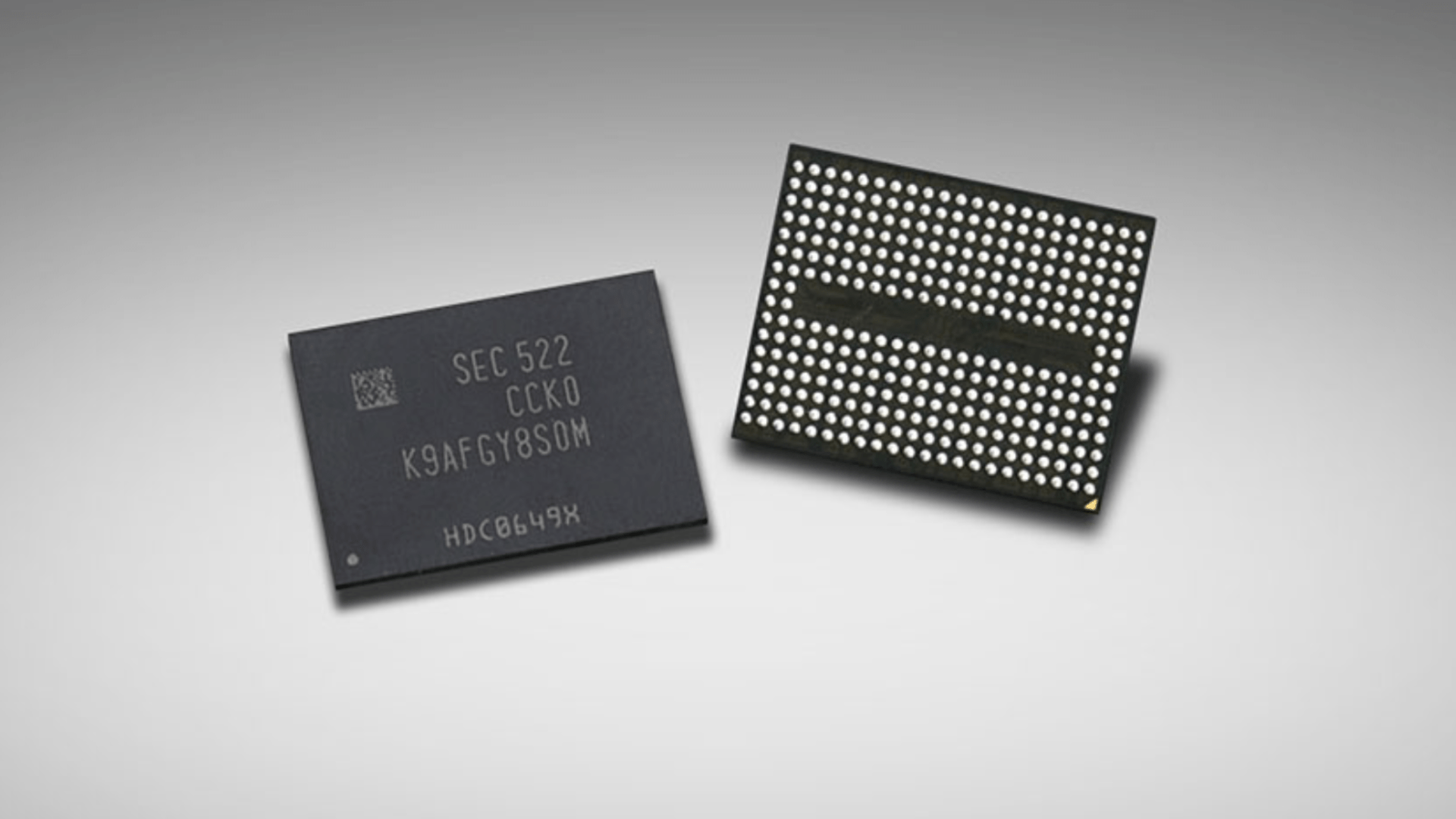
- Samsung wants NAND layer count to reach four digits this decade
- Future M.2 SSDs could go from 8TB to 32TB capacity
- Cellular multi-bonding could replace traditional approaches to growing NAND density
Samsung has been developing a NAND strategy expanding toward 1,000-layer memory designs as demand for denser storage continues to accelerate across industries.
The roadmap, disclosed at the IEEE/JSAP VLSI 2026 Symposium, extends current vertical scaling plans well beyond existing commercial products.
At the center of these ambitions is a future generation of storage capable of pushing familiar SSD capabilities into uncharted territories.

The path from today’s drives to tomorrow’s 32TB M.2 SSDs
Samsung expects its NAND technology to reach around 420 layers by 2029 before surpassing 560 layers in 2030.
Beyond this point, the company intends to explore architectures with between 900 and 1,000 layers within future generations of flash memory.
Rather than building a towering NAND structure, Samsung plans to combine multiple batteries using its Cell Multi-Bonding technology approach.
The method brings distinct NAND structures together in a single package to achieve densities that resemble a single 1,000-layer device.
Samsung specifically discussed combining two structures of approximately 450 layers to approximate the effective density associated with future four-digit layer counts.
According to the company’s projections, this arrangement could increase storage density up to four times that of current generation solutions.
One example shown during the presentation involved an 8TB QLC M.2 drive that could potentially scale up to 32TB capacities.
This scenario would allow for much larger SSDs without increasing physical dimensions, thus preserving the compact M.2 form factor that many users remember well.
The same scaling approach could eventually help enterprise drives exceed 100TB while bringing talk of petabyte SSDs closer to reality.
The engineering issues between Samsung and a petabyte SSD
Samsung has acknowledged that increasing the number of layers leads to manufacturing complications that become increasingly difficult as the structures rise vertically.
A major concern is wafer warpage, where taller structures can become distorted during production and reduce manufacturing consistency or yields.
Another challenge lies in maintaining alignment accuracy across hundreds of stacked layers, requiring extremely precise overlay control throughout manufacturing processes.
Even relatively minor gaps between layers can affect the long-term reliability, performance and manufacturing efficiency of finished storage products.
To limit warping effects, Samsung plans to introduce an Upper Chuck design intended to stabilize increasingly complex wafer structures.
The company also discussed overlay correction technologies intended to improve alignment accuracy as future NAND structures continue to grow.
These developments come as scaling down conventional processes becomes increasingly difficult, forcing memory manufacturers to adopt more sophisticated vertical architectures.
Samsung separately discussed a record generation of 400-layer NAND that could help push AI hyperscaler SSD capabilities beyond the 200TB barrier..
The company also associated 430-layer NAND technology with a future in which 100TB SSDs become increasingly common in enterprise deployments.
Samsung will work with Hafnia ferroelectrics to expand the practical layer count beyond 1,000 layers.
However, whether these designs will ultimately deliver 32TB consumer M.2 drives or petabyte SSDs depends on manufacturing realities rather than roadmaps.
Samsung’s latest roadmap, however, suggests that the race for NAND supremacy depends on ingenuity rather than downsizing.
Via the 3D guru
Follow TechRadar on Google News And add us as your favorite source to get our news, reviews and expert opinions in your feeds. Make sure to click the Follow button!
And of course you can too follow TechRadar on TikTok for news, reviews, unboxings in video form and receive regular updates from us on WhatsApp Also.


