
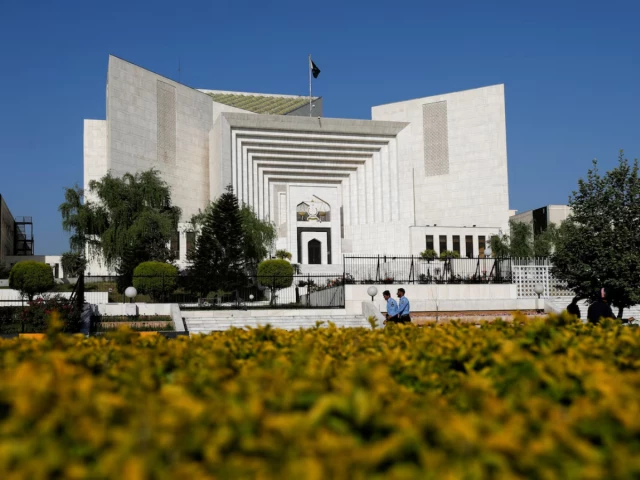
Police officers walk past the Supreme Court of Pakistan building, in Islamabad, Pakistan April 6, 2022. REUTERS
ISLAMABAD:
The Supreme Court has held that the doctrine of “complete justice” is a broad and comprehensive principle aimed at ensuring justice at all costs, so that fairness is not compromised or distorted on the basis of mere technicalities.
The Court emphasized that justice must prevail over procedural rigidity, emphasizing that the ultimate duty of the judiciary is to correct injustice and ensure that erroneous orders or actions do not persist.
An eight-page judgment written by Justice Muhammad Ali Mazhar while hearing a promotion case emphasized that laws were made for man and “man is not made for laws”. He added that a wrong order and action cannot be perpetuated and it is the ultimate duty of the court to remedy the injustice.
“The statutory rules and regulations, while providing for disciplinary measures and sanctions, also protect the service rights of employees and non-compliance with these laws and rules amounts to inherent illegality and violation of the rights of employees.”
According to the facts of the case, the respondent was appointed to the post of Assistant Chemist and Metallurgist in BPS-17 on a two-year contract pursuant to a letter dated October 10, 2009.
He was subsequently selected and recommended by the Federal Public Service Commission (FPSC) for regular appointment to the same post vide notification dated September 22, 2011.
The central issue in the case was that the respondent was given additional charge for a higher post, CC&M (BS-18), vide a letter dated March 2, 2012 and continued to serve in such capacity continuously for almost eight years until his regular promotion, effective August 17, 2020.
He then filed a departmental appeal seeking backdated promotion, which was dismissed on May 26, 2021.
He then applied to the Federal Service Tribunal (TFS), which accepted the appeal and delivered the impugned judgment accompanied by certain instructions.
“Purely temporary”
A division bench of the SC noted that an interim arrangement refers to a purely temporary and makeshift appointment intended to maintain official functioning until a permanent or regular solution is available.
“It is mainly used as an interim measure to fill a vacant position so that public services cannot be disrupted. The interim agreement includes the tenor of the engagement as ‘ad hoc’, ‘support charge’, ‘current charge’ and/or ‘interim or additional charge’.”
The court further observed that such appointments are neither recognized as permanent or regular appointments within a cadre, nor does holding such posts on a provisional basis confer any right to regular promotion as a vested right in the higher grade.
He added that interim agreements should not last for an unlimited period.
“Prolonged one-off charges, supervisory charges, current charges and/or interim or additional charges are indeed a form of exploitation which is not only egregious but terribly frustrates the spirit of the service laws. Therefore, an indefinite, unlimited or infinite period of time does not support the philosophy of the phrase ‘interim arrangement’, which is not intended to keep employees in the trap of uncertainty like a sword of Damocles.
“Under the Constitution, the State has the duty and duty to ensure social and economic justice to ensure transparency and fairness in the structure of public service as a larger fragment of the doctrine of good governance,” the judgment observed.
The judgment further notes that under Article 3 of the Constitution, the State must ensure the elimination of all forms of exploitation and the progressive realization of fundamental principles, including “from each according to his ability to each according to his work”.
“In our view, it aims to nip oppressive or autocratic actions in the bud while ensuring impartiality with non-discriminatory treatment at the local level, respecting the laws and procedures that exist to serve the ends of justice rather than confining individuals under the cover of rigid technical formalities.”
The judgment noted that misdeeds of departmental authority, administrative bodies, government departments or public officials, most often result in abuse of power, procedural irregularities or bad faith conduct which includes destabilization of laws and rules through administrative or managerial overreach and adventurism.
She explained that the legal maxim “A communi observantia non est recedendum” denotes a legal principle that when the law specifies a particular way of doing something, it must be done that way.
He added that it was a well-known code of conduct that no one should be harmed by the act of the court, which emphasizes that for a complete sense of administration of justice, a clear and obvious error or oversight on the part of the court should be rectified and no man should suffer due to the fault of the court.
“In our opinion, this slogan should be applied to the administrative actions of administrative bodies in the same manner while they are exercising their functions conferred upon them by law and rules and their decisions should be in accordance with jus naturale and quantum meruit, although in accordance with law and rules, but without claiming to be more informed or prudent than the laws and rules.”
The ruling noted that the doctrine of reasonable time or reasonable time, as a whole, deciphers that instead of allowing indefinite postponement to comply with or discharge an obligation, the act must be accomplished within a fair period of time.
“Here too, the interim provisions regarding the act of non-assignment of a person to an important post, whether by way of appointment or promotion, cannot be left unregulated, but keeping in mind the doctrine of reasonable time, the task of appointment/promotion should have been completed within a reasonable time which may be extended by three to six months in order to meet the requirements.”
“Religious adherence to this timetable will not become a cause of worry or grievance if an incumbent performing duties on a higher post on ad hoc/acting duties, care or additional charges is not confirmed or updated by the Departmental Promotion Committee or the Central Selection Board, as the case may be. Then, for sure, the interim arrangement will be terminated, but in this case, the respondent has remained in limbo with an undecided fate at least for eight years, resembling a provisional arrangement in violation of the rules of appointment, promotion and transfer.
The Court concluded that the objective of good governance cannot be achieved through the arbitrary or unreasonable exercise of discretionary powers, but only through fairness, transparency and reflection in accordance with the constitutional provisions, notably Articles 4 and 25.
In conclusion, the SC rejected the ministry’s request and upheld the decision of the Federal Service Tribunal.


