
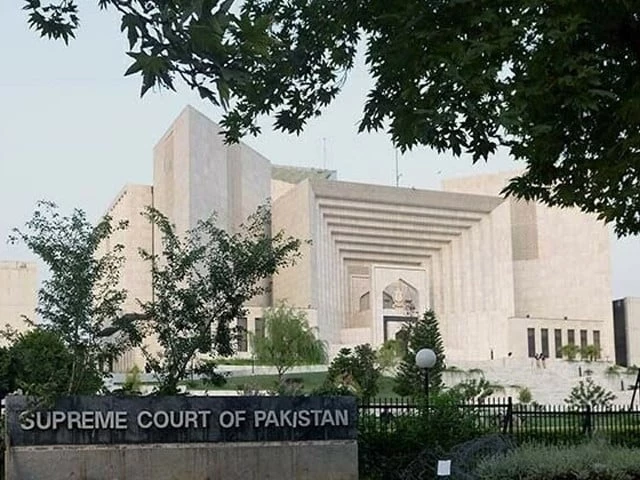
ISLAMABAD:
The Supreme Court has ruled that the state’s inherent power to compulsorily acquire private property for public purposes is not absolute, stating that courts have a constitutional duty to ensure that property owners receive fair compensation that reflects the true value of their property rather than arbitrary or outdated assessments.
In a detailed 20-page judgment written by Justice Muhammad Ali Mazhar, a division bench upheld the decision of the Peshawar High Court (PHC) to increase compensation for privately acquired land in Swabi district. The ruling establishes broad legal principles governing compulsory land acquisition, emphasizing that constitutional guarantees protecting property rights must be balanced against the state’s power of eminent domain.
The judgment also cautioned acquiring agencies against delay in acquisition procedures, observing that prolonged delays coupled with outdated valuation methods unfairly deprive landowners of just compensation.
She ordered courts to take into account inflation, land price appreciation and the future potential of the property when determining compensation.
“The role of the Court is to ensure equitable compensation in the acquisition of property as guardian of constitutional rights. Although the doctrine of eminent domain is the inherent power of the State to compulsorily acquire private property for a public purpose, even against the wishes of the owner, this power is not absolute and is strictly regulated by the Constitution to prevent the despotic exercise of State authority while prudently maintaining balance with the fundamental rights of citizens,” the judgment said.
The bench further observed that one of the primary responsibilities of the judiciary is to ensure that compensation truly reflects the true value of the property acquired.
“The most recognizable work of fiction is structured on the metaphor ‘gold for gold’ and not copper for gold’ which is primarily used as a judicial principle to ensure a fair and just reward so that the owner is not left in a more serious financial crisis but receives a sum of money which is not less than the loss imposed in the public interest or for the public good.”
Explaining the concept of market value, the court said it represents the amount a willing buyer would normally pay to a willing seller.
“The dogma of potential value informs the future use of the land which must also be considered by the courts for remedial action. If compensation is not entirely rational, courts may vary or increase the amount of compensation, including if the amount is found to be based on outdated valuation rates or if the award appears unreasonable or manipulated.”
The judgment also expresses concerns over delays in acquisition procedures, saying authorities often prolong both payment of compensation and possession of land.
“The acquiring agency cannot sleep during the acquisition procedure. It is quite common to see that the acquisition procedure and payment of compensation are delayed for an indefinite period and that landowners remain deprived of fair compensation for their acquired land.”
“Even the possession of the properties is delayed due to the lackadaisical attitude of the land acquisition officers, which also creates complications. Indeed, the time period between the initial notification and the final allotment is an essential element and a key factor in determining the price,” it is observed.
The court added that when the acquisition procedure remains pending for years, compensation based solely on the value of the property at the time of notification cannot be considered fair.
“If the acquisition proceedings are delayed for years, including taking possession of the land, the market value shown from the date of notification can no longer be construed as fair and equitable, but rather the Court must apply the doctrine of inflationary trends and potential value to take into account the intelligent rise in land prices and inflation that followed due to deep slumber of the acquiring department.”
The judgment highlighted several factors that courts should consider when determining the potential value of a property, including its proximity to highways, bypasses, industrial areas, transport links and civic amenities.
He also said that when a large tract of land is acquired for a single project, individual plots should not be undervalued, while agricultural land located in a commercial development context should be assessed in light of its actual development potential.
“From time to time, courts, sensitive to the doctrine of collective justice, strike a balance between public and private interests.”
The bench noted: “On the face of it, the key takeaway in this case was the determination of fair compensation for the land acquired rather than acquiring it at an improbable or disposable price. »
“There is no doubt that the acquisition of land in the public interest is very sacrosanct, but at the same time, the payment of fair compensation is also inevitable and unavoidable to safeguard the fundamental right to own and enjoy property rights,” he further emphasizes.
The Supreme Court also emphasized the importance of appellate jurisdiction, holding that the right to appeal is a substantial legal right available to an aggrieved party.
“It is a solemn duty of the court to redress injustice caused by manifest errors. The court of appeal acts as a curative forum to ensure that justice is not compromised by errors in the lower levels of the judiciary, because the right of appeal is not merely a procedural step but a substantive right of a litigant which is considered a continuation of the original proceedings.”
The judgment further recognizes property rights as a universally accepted fundamental human right.
“As mandated by Article 23 of the Constitution of the Islamic Republic of Pakistan, 1973 (Constitution), every citizen shall have the right to acquire, hold and dispose of property in any part of Pakistan, subject to the Constitution and any reasonable restriction imposed by law in the public interest, while Article 24 emphasizes that no person shall be deprived of his property except in accordance with law and no property shall be acquired or taken into possession by force except for a public purpose, and except by authority of law which provides for compensation and either fixes the amount of compensation or specifies the principles and manner by which compensation is to be determined and paid.


