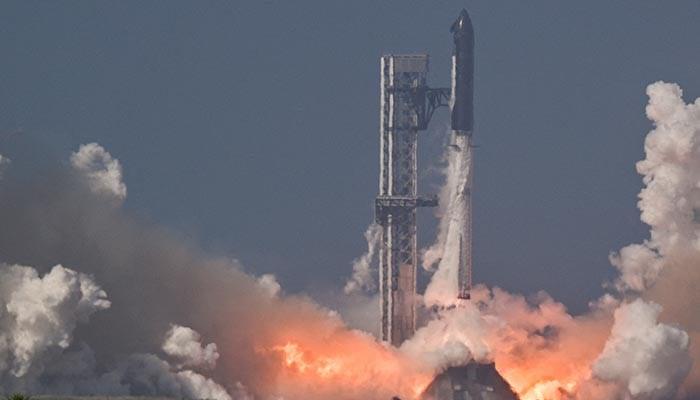
SpaceX’s Starship spacecraft crashed into the Indian Ocean on Friday after the company conducted a successful test flight of the latest version of its massive rocket.
The trip didn’t go without some problems, but SpaceX employees shown during a livestream screamed with joy after the test flight comes as the Elon Musk-owned company prepares for a potentially record-breaking IPO.
The gigantic rocket blasted off into space shortly after 5:30 p.m. local time (10:30 p.m. GMT).
The company had no plans to recover the booster or upper stage, and the final splashdown was spirited but controlled, as planned.
“Splashdown confirmed!” » the company wrote on X.
SpaceX primarily aimed to demonstrate its redesigns in flight.
The third-generation Starship spacecraft carried out a maneuver that saw it right itself and restart its engines for control, even though one of them was out of commission.
It also deployed its 22 simulated satellites, including two that attempted to photograph the spacecraft’s heat shield for analysis.
The vehicle had passed through space but was not exactly in the right orbit after one of its engines malfunctioned during an initial burn.
“I wouldn’t call it a nominal orbital insertion,” said company spokesperson Dan Huot, adding, however, that it was “within the limits” of a previously analyzed trajectory.
After the Super Heavy booster separated from the upper stage as planned, Huot said on the livestream that the booster failed to complete its so-called boost-back burn.
The booster quickly fell back to Earth, uncontrolled, in the Gulf of Mexico. SpaceX wasn’t planning to recover the booster anyway, but was still hoping for an accurate return.
Musk applauded his team on X, calling the flight “epic.”
“You have scored a goal for humanity,” he said.
“A long way to go”
Friday’s flight followed an aborted test the day before.
The countdown stopped and started until it was determined that the last minute red flags could not be addressed in time.
Musk quickly posted on X that “the hydraulic pin holding the tower arm in place has not retracted.” SpaceX said this issue was fixed overnight.
The company is facing increased scrutiny after SpaceX filed an IPO application with U.S. financial regulators earlier this week, likely in June, in what is expected to become a record IPO.
Friday marks Starship’s 12th flight overall, but the first in seven months.
The latest model is larger than its predecessor, measuring just over 407 feet (124 meters) when fully stacked.
Much depends on SpaceX’s progress: The company is under contract with NASA to produce a modified version of Starship to serve as a moon landing system.
The US space agency’s Artemis program aims to return humans to the Moon, as China pursues a rival effort that targets 2030 for its first crewed mission.
Clayton Swope, an aerospace expert at the Center for Strategic and International Studies, told AFP that “the upgraded version of Starship did most of what SpaceX hoped it would do at launch.”
But he noted that considerable time had passed since the last test flight.
NASA aims in 2027 to test an in-orbit rendezvous between its spacecraft and at least one lunar lander, which SpaceX and rival Blue Origin – the company owned by Jeff Bezos – are working to develop.
This Artemis phase is intended to be a step towards achieving a crewed moon landing before the end of 2028, and before the end of Donald Trump’s presidency.
But for Swope, “there is a long way to go and many more test flights before Starship is ready for the next Artemis mission.”
Before Friday’s test, NASA Administrator Jared Isaacman appeared at the SpaceX program pre-launch and said, “We’re looking forward to this flight, because we hope that in the not-so-distant future we’re going to join Earth’s orbit.”
After the test, Isaacman heaped praise on X, congratulating SpaceX on “one heck of a V3 starship launch.”
“One step closer to the Moon…one step closer to Mars,” the NASA official said.