
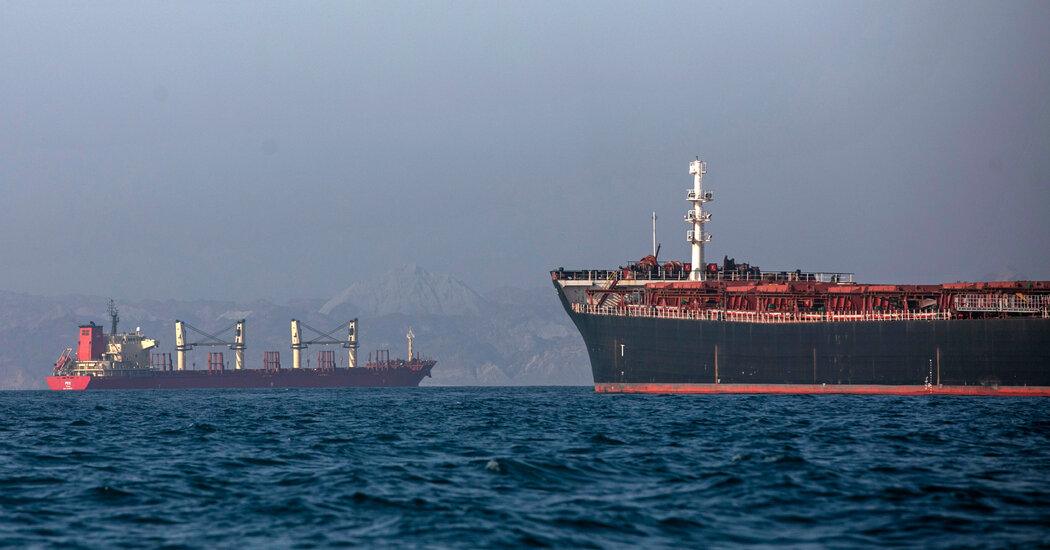
Tehran is trying to formalize – and monetize – its control over the Strait of Hormuz, previously a transit point for a fifth of the world’s oil and gas, by imposing passage fees.
What Iran is proposing violates the rules that underpin international shipping, under which countries cannot charge for safe passage on international waterways, and are unlikely to succeed, analysts say. Yet it is destabilizing the shipping industry, creating even more uncertainty for companies whose ships and workers have been stuck in the Persian Gulf for nearly three months as the war in Iran drags on.
The worry is that Iran, emboldened after leading the United States into a bind by invoking a powerful geographic chokepoint, could find a way to influence traffic across the strait even after the conflict ends. Iranian threats underscore the war’s potential to cause lasting damage to the global economy.
A toll payment system would not be acceptable, Arsenio Dominguez, head of the International Maritime Organization, said in an interview Friday. He spoke after it was revealed this week that Iran and Oman, a U.S. ally that borders the strait, were in talks over a system that would provide fees for passage through the strait.
“I don’t entertain conversations about mandatory tolls, about things that go beyond freedom of navigation, the right of innocent passage,” said Mr. Dominguez, whose organization, a United Nations agency, regulates global shipping.
Michelle Wiese Bockmann, an analyst at maritime intelligence firm Windward, said she believes Iran’s plans are posturing in its prolonged standoff with President Trump.
But the stakes are high. According to the United Nations Conference on Trade and Development, 11 billion tons of global trade are transported by sea each year.
“If you remove this principle of freedom of navigation in the Strait of Hormuz, then where do you draw the line? » said Ms. Bockmann. “This then opens up further choke points for negotiations at a time when the waters are contested. »
Iran presented its proposal in the form of service fees, transit fees or environmental fees. Under international law and conventions, countries that oversee certain man-made waterways, including the Panama Canal and Suez Canal, can charge fees, while straits used for international navigation must be free.
Besides legal issues, one of the main reasons for the inapplicability of Iran’s plans is insurance, Ms. Bockmann said. Ships that make payments to Iran could violate sanctions imposed by the United States and other Western countries, and insurers would therefore be reluctant to provide them with coverage. f
The U.S. Treasury Department recently warned ship operators not to make payments to Iran, and many European governments have their own sanctions against Iran. No Western company has publicly declared making payments to Iran. As desperate as they are to free their vessels unable to leave the Persian Gulf, most shippers are unwilling to engage in such deals, industry officials say.
Mr. Trump said on Thursday that the United States would not tolerate any toll system for crossing the strait. “We want it to be free,” he said in the Oval Office. “We don’t want tolls. It’s international. It’s an international waterway.”
Still, Iran announced new measures last week to consolidate control of the waterway.
On Monday, Iran launched a regulatory agency called the Persian Gulf Straits Authority to manage operations in the strait, including overseeing a fee that could reach up to $2 million per vessel. And last Saturday, Iran introduced a plan, called Hormuz Safe, that would allow shipping companies to pay the government for insurance coverage, using cryptocurrency, when transiting the strait.
The Islamic Revolutionary Guard Corps navy said the only safe route to transit the strait was through an Iranian-designated corridor, and any ship deviating from that route risked attack.
India, Iraq, Pakistan and other countries have negotiated deals with Iran to pass their ships through. But the main entities paying fees to the Persian Gulf Straits Authority include owners of so-called ghost fleet ships linked to China and the United Arab Emirates, according to Windward.
On Wednesday, Iran announced that it was significantly expanding the area it claims to control to the waters around the Strait of Hormuz, including part of the Gulf of Oman, which is adjacent to the strait.
After U.S. and Israeli forces attacked Iran in late February, Iran virtually shut down traffic across the strait, causing energy prices to skyrocket. About 1,500 ships and 20,000 sailors remained stranded in the Persian Gulf, and traffic passing through the strait was reduced to a trickle. Before the closure, more than 130 ships crossed the strait daily.
Oscar Seikaly, chief executive of NSI Insurance Group, an insurance broker, said Iran’s attempts to exert control over the waterway would not be effective. A US blockade monitors the waters beyond the strait to track Iranian ships, leaving Iran unable to export its own oil as it attempts to establish a counter-narrative that it is in control.
“They don’t control anything,” he said.
As of Thursday, U.S. Central Command had redirected 94 commercial ships and disabled four. Due to Iran’s inability to export its crude oil, Iran is expected to soon run out of storage space for the oil it produces. Its storage facilities on Kharg Island, Iran’s main oil export terminal, are more than 80% full, according to Kpler, a maritime data company.
One of the risks of Iran’s threats to take control of shipping through the Strait of Hormuz is that other countries may begin to consider the influence they could exert over the international straits they border.
One such area is the Strait of Malacca, a key waterway bordered by Indonesia and Malaysia in Southeast Asia. Last month, Indonesia’s finance minister made a brief public comment on the imposition of tolls in the strait, which ships currently transit for free, in accordance with international law.
The remark struck a chord. The idea of starting to impose tolls in the Strait of Malacca was quickly rejected — by Malaysia’s foreign minister as well as another Indonesian official.


