
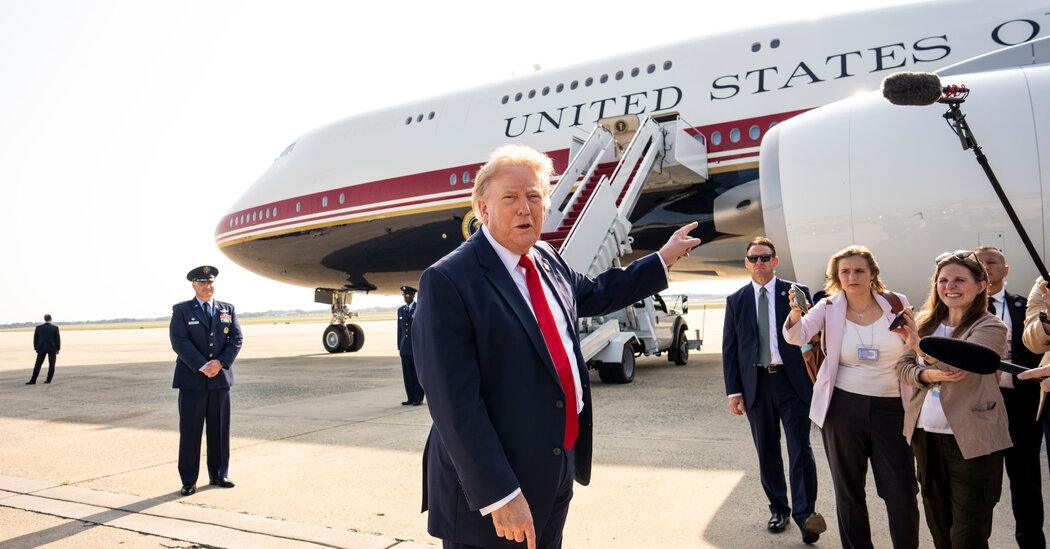
The Trump administration subpoenaed several New York Times journalists on Friday after the newspaper reported this week on security concerns regarding the new Air Force One gifted by Qatar to President Trump.
The subpoenas — which aim to force journalists to testify before a federal grand jury in Manhattan on Wednesday — constitute an extraordinary escalation in President Trump’s efforts to threaten and intimidate independent news organizations.
In some cases, the subpoenas were issued by federal agents who showed up at the journalists’ homes.
The Times denounced the administration’s actions.
“The appearance of federal law enforcement agents at journalists’ doorsteps should shock the conscience of every American who believes in the Constitution and the freedom of the press it protects,” David McCraw, the Times’ lead editorial lawyer, said in a statement Friday evening.
“Our journalists report the facts and defend the American public’s right to know how their government works and how their taxpayer dollars are used,” Mr. McCraw wrote. “This brazen act should only be seen as an attempt to prevent the public from knowing what is happening in their country by intimidating journalists and preventing them from doing their jobs. »
The subpoenas contain few details, requesting only that the journalists testify “concerning an alleged violation of federal criminal law.” They were issued by Jay Clayton, the US attorney in Manhattan. Mr. Clayton, who heads one of the nation’s most important law enforcement offices, was recently nominated by Mr. Trump to serve as director of national intelligence.
Representatives for the White House and the U.S. Attorney in Manhattan did not immediately respond to inquiries Friday evening.
Among the Times journalists who received subpoenas were Julian E. Barnes, Eric Lipton, Tyler Pager and Eric Schmitt, who reported on Wednesday that Mr. Trump left Turkey aboard the former Air Force One as a security measure, at the request of the Secret Service. On Thursday, the Times reported that the new Air Force One, a Boeing 747-8 donated by Qatar, lacked some advanced safety features of the older plane, including anti-missile capabilities. Both articles cite sources who spoke on condition of anonymity to discuss sensitive security matters.
Before Wednesday’s article was published, a senior official with the Federal Bureau of Investigation contacted the Times to request that the article be preserved, calling it a matter of national security, according to a person familiar with the conversation. The FBI official spoke with a reporter and an editor from the Times’ Washington bureau; the manager refused to explain the security issue when asked. (A Times spokesperson, Charlie Stadtlander, confirmed this information.)
Mr. Trump has long criticized the media. But during his second term, he acted aggressively using the immense powers of the federal government in his efforts to attack the press.
Earlier this year, the Justice Department sought testimony from journalists from the Wall Street Journal and the Washington Post. The Justice Department withdrew the subpoenas after both news organizations fought back in sealed filings.
Both Democratic and Republican administrations have launched investigations into leaks regarding the disclosure of classified information. But subpoenas issued to journalists are not common, and First Amendment supporters say they can cripple news-gathering work.
In January, FBI agents took the rare step of searching the home of a Washington Post reporter, Hannah Natanson, as part of an investigation into a government contractor’s handling of classified documents. Officers seized phones, laptops and a smart watch after executing a search warrant. Ms. Natanson had spent months speaking with government employees while reporting on the Trump administration’s efforts to reduce the federal workforce.
The Times is a party to several lawsuits involving Mr. Trump and his administration.
The president sued the Times last year, accusing it of defaming him, disparaging his reputation and seeking to undermine his 2024 candidacy.
In December, the Times sued the Defense Department after it imposed restrictions on journalists covering the military. The company sued again after the agency reduced journalists’ physical access to the Pentagon.
In May, the Equal Employment Opportunity Commission sued the Times, accusing it of employment discrimination. The Times filed a counterclaim Friday, claiming the lawsuit was an act of retaliation for its coverage of the Trump presidency and a violation of its First Amendment rights.
Benjamin Weiser reports contributed.


