- The Pentagon announced the withdrawal of 5,000 troops.
- Two senior Republican lawmakers express concerns.
- Movement spells end at the Long Range Missile Battalion in Germany.
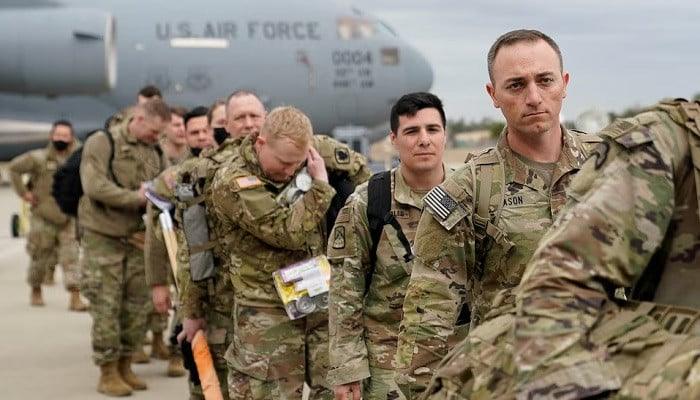
The planned withdrawal of 5,000 US troops from Germany has sparked a new debate over Europe’s defense responsibilities, with German Defense Minister Boris Pistorius saying the move should prompt European allies to strengthen their own military capabilities.
The Pentagon confirmed Friday the withdrawal of Germany, the largest American military center in Europe, against a backdrop of growing tensions between Washington and European capitals over the war in Iran and customs tariffs.
However, US President Donald Trump has indicated that this reduction could only be the beginning. “We’re going to reduce the number of people significantly, and we’ll reduce them well beyond 5,000,” he told reporters in Florida on Saturday when asked about the plan.
The announcement also sparked concern from two senior Republican lawmakers, who warned that troops should not be withdrawn from Europe, highlighting divisions within Washington over the future of the U.S. military presence on the continent.
As part of the US decision, a Biden-era plan to deploy a US battalion equipped with long-range Tomahawk missiles to Germany was also scrapped – a blow to Berlin, which had pushed for the move as a powerful deterrent against Russia.
Republican lawmakers Sen. Roger Wicker and Rep. Mike Rogers, chairmen of the Senate and House Armed Services Committees, said they were “very concerned.” They said troops should not be moved from Europe, but rather moved east.
“Prematurely reducing the US forward presence in Europe before these capabilities are fully exploited risks undermining deterrence and sending the wrong signal to (Russian President) Vladimir Putin,” they said in a joint statement.
NATO working with Washington for more details
Pistorius said the partial withdrawal was expected and would affect the current US presence of nearly 40,000 troops stationed in Germany.
“We Europeans must take more responsibility for our own security,” Pistorius said, adding that “Germany is on the right track” by developing its armed forces, accelerating its military acquisitions and building infrastructure.
From his first term, Trump called for a reduced military presence in Germany and repeatedly urged Europe to take responsibility for its defense. However, he stepped up his threat earlier this week after clashing with German Chancellor Friedrich Merz, who questioned Washington’s exit strategy in the Middle East.
The Pentagon said the troop withdrawal is expected to be completed within the next six to 12 months. He did not specify which bases would be affected, or whether troops would return to the United States or be redeployed to Europe or elsewhere.
A NATO spokesperson said the alliance was working with the United States to understand the details of the decision.
Polish Prime Minister Donald Tusk, whose country is seeking assurances of continued U.S. support on NATO’s eastern flank amid the ongoing Russo-Ukrainian war, also expressed concern over the alliance’s latest setback.
“The greatest threat to the transatlantic community lies not in its external enemies, but in the ongoing disintegration of our alliance. We must all do what it takes to reverse this disastrous trend,” Tusk wrote on X on Saturday.
The Pentagon’s plans are Washington’s latest blow to Germany this weekend, after Trump announced he would raise tariffs on EU auto imports to 25%, accusing the EU of failing to honor a trade deal – in a move that threatens to cost the German economy billions.
A foreign policy official from Chancellor Merz’s CDU party said the two announcements should be seen in light of pressure on Trump both domestically and abroad, amid weak opinion polls and pressure over unresolved conflicts in Ukraine, Venezuela and Iran.
“In this context, troop withdrawal and trade policy seem less to be an expression of a coherent strategy than a political reflex and a reaction born of frustration,” Peter Beyer told Reuters.
A long-range fire battalion canceled
NATO members have pledged to take more responsibility for their own defense, but with tight budgets and vast gaps in military capabilities, it will take years for the region to meet its own security needs.
Germany wants to increase the number of active Bundeswehr troops from the current 185,000 to 260,000, although critics of the defense minister have called for more in response to a widely perceived growing threat from Russia.
The U.S. military presence in Germany, which began as an occupying force after World War II, reached its peak in the 1960s, when hundreds of thousands of U.S. military personnel were stationed there to counter the Soviet Union during the Cold War.
The presence includes the giant Ramstein Air Base and Landstuhl Hospital, both of which were used by the United States to support its war in Iran, as well as in previous conflicts in Iraq and Afghanistan.
The Pentagon’s decision means an entire brigade will leave Germany and a long-range fires battalion that was to be deployed later this year will be canceled.
Long-range firing was to provide an additional deterrent against Russia, while the Europeans developed such long-range missiles themselves.
The United States “holds a factual monopoly within NATO” on long-range fire, Christian Moelling, director of the European defense think tank EDINA, wrote on X. “That is why it is operationally more serious than the number of troops.”