
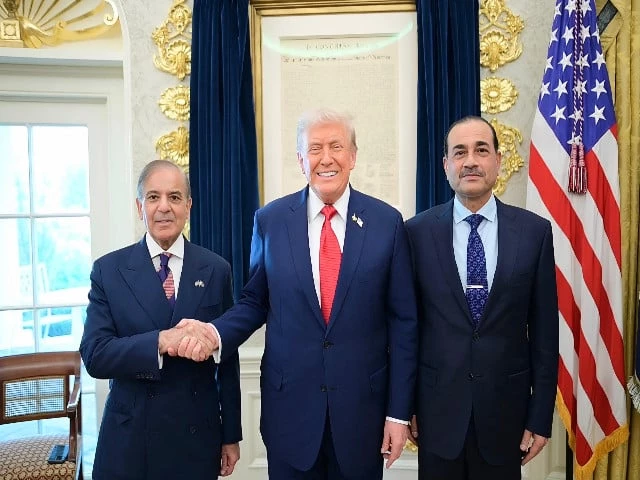
Prime Minister Shehbaz Sharif and Field Marshal Asim Munir meet with US President Donald Trump at the White House in Washington DC on September 25, 2025. Photo: mimeo
US President Donald Trump on Friday praised Prime Minister Shehbaz Sharif and Defense Force Chief and Chief of Army Staff Field Marshal Asim Munir following a breakthrough in Iran’s announcement to open the Strait of Hormuz to commercial shipping.
In an article on Truth Social, he said: “Thank you to Pakistan and its great Prime Minister and Field Marshal, two fantastic people! »
Relations between Pakistan and the United States underwent a significant thaw in 2025-2026, moving from a cold period to warm, strategic and pragmatic engagement during President Donald Trump’s second term. This shift is largely due to a major reset in relations following President Trump’s intervention in regional conflicts, particularly his role in brokering a ceasefire between Pakistan and India in May 2025.
The first thaw in relations between Pakistan and the United States occurred through secret exchanges against terrorism, a sign of substantial cooperation. In March last year, Trump unexpectedly praised Pakistan’s anti-terrorism efforts during a national address, prompting a policy shift.
The short but intense May 2025 skirmish with India became a watershed moment, showcasing Pakistan’s military discipline, strategic focus and asymmetric capabilities – qualities that would have surprised Trump.
Despite India’s repeated denials, Prime Minister Shehbaz continued to praise President Trump for his role in brokering a ceasefire between the two nuclear-armed neighbors, and nominated him for the Nobel Peace Prize, saying his intervention helped save millions of lives.
The praise was reciprocal, with Trump praising the prime minister and also praising CDF Munir, reiterating his claims that he had helped avert a war between Pakistan and India in May 2025.
Relations between the two countries took a new turn when Trump invited Munir to a lunch – the first such meeting for a Pakistani military leader – followed by a red carpet visit to the US Central Command headquarters for high-level talks.
Following a ceasefire following the protracted war in Gaza, Trump announced the formation of a “Peace Council” including Pakistan, again praising Sharif at his inaugural summit.
Addressing the event, Trump said, “I like that guy,” referring to Sharif, as he recounted the efforts that led to last year’s ceasefire between Pakistan and India. He also praised Munir during his speech.
Earlier this year, the United States and Israel launched a joint offensive against Iran on February 28, killing dozens of senior military officials, including then-Supreme Leader Ali Khamenei, before a two-week ceasefire was brokered by Pakistan earlier this week.
Tehran responded with drone and missile strikes targeting Israel, as well as Jordan, Iraq and Gulf countries harboring U.S. military assets, and restricted shipping through the Strait of Hormuz, a key passage for oil and gas shipments.
Fighting then spread to Lebanon after Israel launched an offensive there, widening the conflict as the United States and Israel continued their attacks on Iran.
As the conflict continued to expand and intensify, Pakistan became a mediator alongside other regional powers in the escalating crisis. As the negotiation process began, the United States and Iran exchanged their respective positions, but initial discussions did not result in any progress. However, following Pakistan’s sustained diplomatic efforts, both sides agreed to hold talks in Islamabad last week.
But Washington and Tehran failed to reach an agreement in Islamabad over the weekend in negotiations that were part of broader efforts to end the conflict.
Later, Trump announced a naval blockade of the Strait of Hormuz, which took effect at 1400 GMT on Monday.
Although the talks ended without results, they left some hope, with both sides indicating their willingness to continue negotiations. Efforts resumed this week, with Trump expressing optimism that a deal could be reached soon.
While a new round of dialogue is expected this weekend, Iran has taken a step towards de-escalation by announcing the reopening of the strategic Strait of Hormuz to all commercial navigation.


