
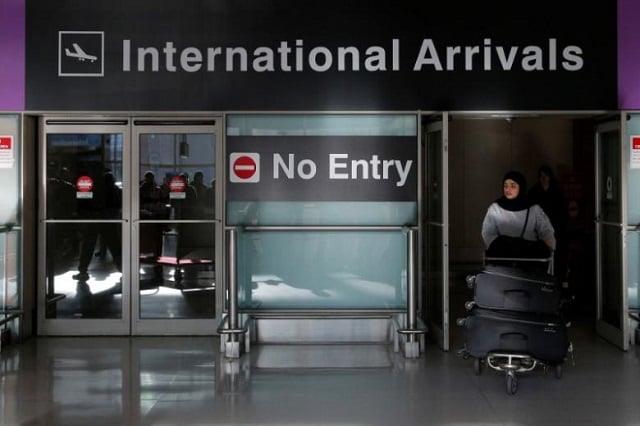
A new ban on traveling by President Donald Trump could prohibit people from Afghanistan and Pakistan from entering the United States next week on the basis of a government security and risk verification government, three familiar sources with the case said.
The three sources, which requested anonymity, said that other countries could also appear on the list but did not know which ones.
This decision comes back to the ban on the first mandate of the Republican President of Travelers of Seven Nations Mainly Muslim, a policy that has undergone several iterations before it was confirmed by the Supreme Court in 2018.
Former President Joe Biden, a democrat who succeeded Trump, repealed the ban in 2021, calling him “a task on our national conscience”.
The new ban could affect tens of thousands of Afghans who have been authorized to reinstall in the United States as refugees or on special immigrant visas because they may take over Taliban to work for the United States during a 20-year war in their country of origin.
Trump has published a decree of January 20 demanding an intensified verification of the security of any foreigner requesting admission to the United States to detect national security threats.
This ordinance ordered several members of the cabinet to submit by March 12 a list of countries from which travel should be partly or entirely suspended because their “verification and screening information are so deficient”.
Afghanistan will be included in the recommended list of countries for a full travel ban, said the three sources and another who also asked not to be identified.
The three sources said Pakistan would also be recommended for inclusion.
The state departments, justice and internal security and the office of the national intelligence director, whose leaders supervise the initiative, did not immediately respond to requests for comments.
A source stressed that Afghans have been authorized to reinstall in the United States as refugees or on special visas that first suffer intense screening which makes them “more well approved than any population” in the world.
The office of the State Department which oversees their resettlement requires an exemption for holders of special immigrant visas of the travel ban “but it is not supposed to be granted,” said the source.
This office, the coordinator of Afghane relocation efforts, was invited to develop a plan by April for its closure, Reuters reported last month.
The Taliban, who seized Kabul as the last American troops withdrew in August 2021 after two decades of war, are faced with an insurrection by the regional branch of the Islamic State. Pakistan is also struggling with violent Islamist activists.
Trump’s directive is part of a repression of immigration he launched at the start of his second term.
He presented his plan in an October 2023 speech, committing to restrict people of the Gaza, Libya, Somalia, Syria, Yemen and “everywhere who threaten our security”.
Shawn Vandiver, the chief of #Afghanevac, a coalition of groups that coordinate the evacuation and resettlement of Afghans with the American government, urged those who hold valid American visas to travel as soon as they can.
“Although no official announcement has been made, several sources in the US government suggest that a new travel restriction could be implemented in next week,” he said in a statement.
This “may have a significant impact on Afghan visa holders waiting for relocation” in the United States, he said.
There are some 200,000 Afghans who have been approved for the resettlement of the United States or which have requests for visa for American refugees and special immigrants.
They were blocked in Afghanistan and nearly 90 other countries – including around 20,000 in Pakistan – since January 20, when Trump ordered a 90 -day freeze on refugees and foreign assistance that finances their flights.


