- Iran responds by striking the US air base in Jordan with ballistic missiles.
- Kuwait and Bahrain activate air defense measures following Iranian attacks.
- Iran warns regional infrastructure will be targeted if US threats persist.
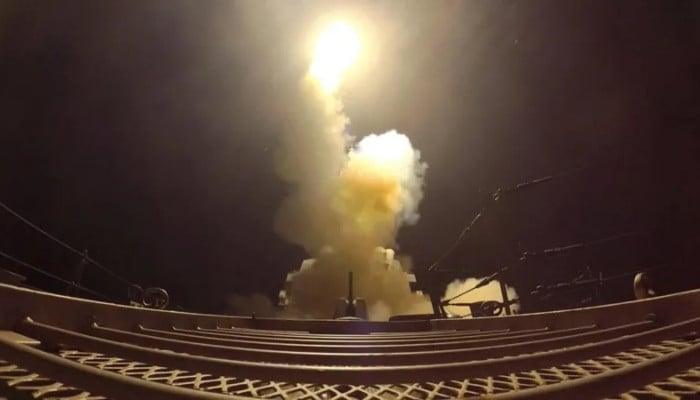
TEHRAN: The United States launched new strikes against Iran on Thursday, with bridges and transportation infrastructure among the apparent targets, while Tehran responded with attacks on U.S. allies in the Gulf.
The resumption of fighting around the vital Strait of Hormuz came a month after the signing of a preliminary agreement aimed at ending the conflict, which erupted in late February with massive US-Israeli strikes against Iran.
The US Central Command (CENTCOM) announced Thursday evening that it was carrying out a new wave of strikes aimed at “further degrading Iranian military capabilities”, the sixth consecutive night of attacks by US forces.
Iranian state media reported strikes on two bridges, a railway station and an airport in the south of the Islamic republic, near the strategic strait, crucial for global oil and gas flows.
Three people were killed in the attack on bridges in Hormozgan province, state television reported on Telegram.
Tehran state television previously reported two explosions in the western city of Bushehr, home to Iran’s only civilian nuclear power plant, in a “continued aggression by the American enemy.”
Tehran had previously warned it would target the region’s infrastructure if US President Donald Trump followed through on his threat to attack power plants and bridges in Iran – although the White House said it remained “open to diplomacy”.
Iran’s Revolutionary Guards said Thursday they struck a U.S. air base in Jordan with ballistic missiles in response to what they described as a U.S. attack near a children’s cancer hospital near Ahvaz in the southwest.
‘Never back down’
Iranian state media said the hospital was evacuated following U.S. airstrikes on the area, which Foreign Ministry spokesman Esmaeil Baqaei called “barbaric.”
Hani, a 34-year-old teacher from Ahvaz, said the strikes were “very intense”, adding: “My hands are shaking. There were at least 11, 12 explosions. My ears are exploding.”
U.S. allies in the Gulf, meanwhile, responded to the attacks, with Kuwait saying Friday morning that its air defenses were again battling missile and drone attacks, and Bahrain sounding air raid sirens.
A senior Iranian military spokesman called on the United States to withdraw from the region, saying “we will never back down on the Strait of Hormuz,” state television reported.
The Strait of Hormuz was briefly reopened after the US-Iran deal in June, but Tehran said last week it would be closed again “until the United States ends its aggression.”
The United States also reimposed its blockade of Iranian ports.
On Thursday, the US military said its forces had boarded a ship in the Gulf of Oman to “ensure full compliance”, adding that three ships had been redirected since the blockade resumed.
Threats to infrastructure
Pakistani Foreign Ministry spokesman Tahir Andrabi said Islamabad would “continue to encourage all parties to end violence and resume negotiations at the technical level” under the memorandum of understanding it helped broker last month.
But Iran’s top negotiator, Mohammad Bagher Ghalibaf, warned that a deal “only makes sense when its clauses are valid and implemented.”
White House press secretary Karoline Leavitt told reporters Thursday that Trump would hold Iran “accountable” for returning its word, but said “he’s still open to diplomacy at the same time.”
“They expressed that they still want to make a deal with the president. We are talking with them, but again, the president will not allow them to shoot at ships in the strait without paying the consequences,” she said.
Trump had previously threatened to strike Iranian power plants and bridges unless Tehran returned to the negotiating table, telling Fox News: “Next week it’s going to be really bad for them. »
On Thursday, the spokesperson for Iran’s military headquarters said that if the United States followed through on its threats, “all infrastructure in the region” would be “destroyed.”
Since last week, new US attacks have killed at least 30 people in Iran, government spokeswoman Fatemeh Mohajerani said.