
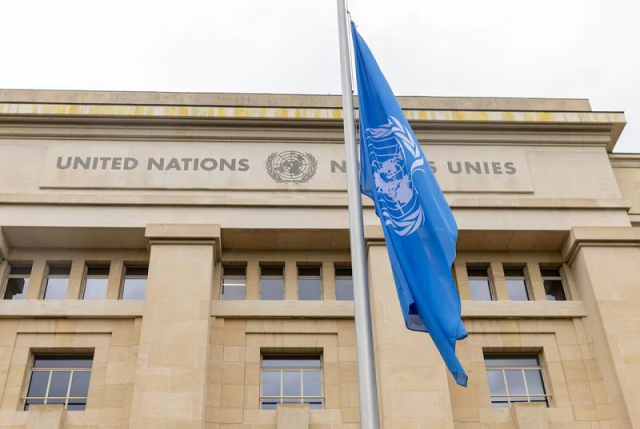
The United Nations flag flies at half-mast at the European headquarters in Geneva, Switzerland, November 13, 2023. PHOTO: REUTERS
WASHINGTON/NEW-YORK:
The United States reaffirmed its support for Pakistan’s right to defend itself against terrorism as Islamabad stepped up its diplomatic campaign at the United Nations, highlighting the heavy human and economic toll of terrorism in the country and calling for a stronger global counterterrorism strategy.
Responding to questions about ongoing tensions between Pakistan and Afghanistan, the US State Department said Washington “supports Pakistan’s right to defend itself against terrorist attacks”, adding that “the Pakistani people have suffered greatly at the hands of terrorists”.
Pakistan accuses Afghan Taliban authorities of harboring terrorists responsible for attacks inside Pakistan, particularly members of the banned group Tehreek-e-Taliban Pakistan (TTP), as well as groups involved in Balochistan, including the Balochistan Liberation Army (BLA) and the Majeed Brigade.
The remarks came as the UN General Assembly overwhelmingly adopted a Pakistan-backed resolution on the ninth review of the UN Global Counter-Terrorism Strategy (GCTS), after the United States, Israel and Argentina broke consensus on the document.
The resolution, titled “The United Nations Global Counter-Terrorism Strategy: Ninth Review,” retains the four fundamental pillars of the framework and urges member states to finalize a comprehensive convention aimed at closing critical gaps in existing international law and establishing a universally binding legal framework.
The resolution was adopted by a recorded vote of 140 in favor and three against – Argentina, Israel and the United States – while Japan did not participate in the vote. Japan’s delegate later said the abstention was the result of a technical error and that his delegation had intended to vote in favor.
Addressing the plenary meeting, Permanent Representative of Pakistan to the UN Ambassador Asim Iftikhar Ahmad welcomed the adoption of the resolution and expressed hope that it would strengthen global efforts to combat terrorism through stronger multilateral cooperation.
“Pakistan has remained at the forefront of global counter-terrorism efforts, having been instrumental in its success over the years, particularly against Al-Qaeda and other groups, and in the process, we have also made immense sacrifices as the main victim of terrorism,” he said.
The ambassador told the General Assembly that terrorism against Pakistan was “supported, sponsored by our adversaries in the region through their support for proxy groups such as the TTP, BLA, Majeed Brigade, as well as other groups, including ISIL-K, and their affiliates.”
He said more than 1,200 Pakistanis lost their lives in terrorist attacks last year alone, adding that terrorism transcends national borders and has become an increasingly interconnected and decentralized global threat, requiring a multifaceted international response.
Ambassador Ahmad expressed disappointment that the latest review of the United Nations Global Counter-Terrorism Strategy failed to address emerging challenges despite efforts by Pakistan and the Organization of Islamic Cooperation (OIC) to strengthen the document.
“For a future without terrorism, a robust multilateral strategy is necessary,” he said, calling for a comprehensive assessment of emerging threats in the physical and virtual domains and realistic pathways to resolve protracted conflicts.
He also urged the international community to reaffirm the right to self-determination in accordance with international law, reject attempts to equate legitimate struggles for self-determination with terrorism, and condemn states complicit in state terrorism against peoples living under foreign occupation.
The envoy further called for measures to combat xenophobia, racism and other forms of intolerance, counter the growing threat posed by violent nationalist, far-right, neofascist and supremacist groups, eliminate Islamophobic rhetoric and terms such as “Islamic terrorism” and “radical Islam”, and end the stigmatization of Muslims.
He also called for reforms to the UN counterterrorism architecture and sanctions regime and called on international bodies such as the Financial Action Task Force (FATF) to remain inclusive, transparent and free from political manipulation.
He said the failure to reach consensus after three years of negotiations represented a missed opportunity but should serve as a wake-up call for stronger international cooperation, adding that Pakistan remained committed to working with all UN member states to strengthen global efforts against terrorism.


