
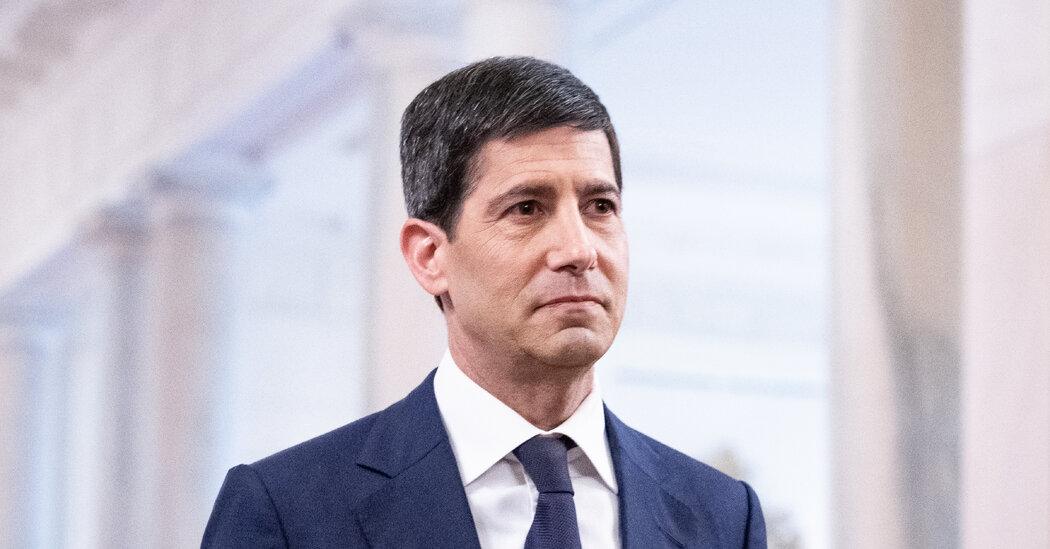
Kevin M. Warsh is no stranger to delicate balancing acts, having helped formulate the Federal Reserve’s response to the global financial crisis as governor more than a decade ago. But the tightrope he must now navigate as president of the central bank is particularly precarious.
Mr. Warsh, just weeks into his tenure as head of the Fed, inherited a host of economic challenges. A deal was reached to end the war with Iran, but the energy shock caused by months of tension has pushed inflation to its highest level in three years. Central bank officials appear to disagree over the need to more openly consider raising interest rates. And uncertainty over what message Mr. Warsh, who has called for regime change at the Fed, will send at his first news conference Wednesday, has kept financial markets on edge.
A move by Mr. Warsh to play down pricing pressures and talk about rate cuts would draw a significant backlash from many of his new colleagues. It would also raise questions about his commitment to bringing inflation back to the Fed’s 2% target. Talking tough on inflation and keeping open the possibility of a rate increase would help bolster his credibility, but risk angering President Trump, who has not wavered in his desire to lower interest rates.
Mr. Warsh’s pledge to rethink how the Fed communicates adds yet another complication. He thinks policymakers should speak less frequently and avoid giving signals about what the central bank might do next on rates. Warsh says this so-called forward guidance locks the Fed in, making it harder for central bankers to pivot if necessary.
Mr. Warsh will do his best on Wednesday to avoid pointing in either direction — an approach that risks injecting an extra dose of volatility into markets that are already bracing for a rate hike toward the end of the year.
“Given the novelty of the moment, since this is Warsh’s first press conference, there is really great opportunity for what one might call ‘market misinterpretation’ of his message,” said Kris Dawsey, head of economic research at DE Shaw Group, a hedge fund. “It will take some time for the market to really calibrate its communications.”
The beginnings of Warsh
On Wednesday, the Fed is expected to hold rates steady in a range of 3.5 to 3.75 percent for a fourth straight meeting.
The policy statement that will accompany the rate decision is expected to abandon what officials have described as “easing bias,” a position that suggests a rate cut is the most plausible next move. This proposal attracted significant opposition at the last meeting in April.
What will be difficult to immediately determine is whether the changes to the statement reflect growing support within the Fed for raising rates or are simply a byproduct of Mr. Warsh’s long-standing objection to forward guidance.
Wednesday’s statement will be accompanied by the dot plot, which aggregates what the 19 policymakers believe could happen to rates over the coming years. The central bank also publishes what it forecasts for inflation, unemployment and growth over the same time horizon.
One of Mr. Warsh’s first decisions as president is whether or not he will provide his own projections. Withdrawing from the process would align with his past criticism of the dot plot and his promise to lead a “reform-oriented” Fed. It would also help distract from what Ellen Meade, who served as a senior advisor to the Fed’s board of governors until 2021 and is now a professor at Duke University, described as “the ridiculousness of microscopic point-scoring.”
But there could be downsides. “Not doing so would look like malicious dissent against one’s own committee,” said Michael Feroli, chief U.S. economist at JP Morgan.
It’s this group of policymakers that Mr. Warsh will need to convince if he is to make progress on the changes he wants to implement, including reducing the Fed’s $6.7 trillion portfolio of government bonds and mortgage-backed securities.
Changes to the cadence or content of what the Fed releases in terms of officials’ forecasts do not require final committee approval, said Kurt Lewis, who served as a senior adviser to Jerome H. Powell when he was Fed chairman.
But Mr Lewis stressed that making these changes unilaterally would be a break with tradition. In the past, such changes have only occurred after extensive deliberation until consensus was reached, although support was ultimately not unanimous. This was the case in 2012, when the Fed began publishing its officials’ rate forecasts.
With or without Mr. Warsh’s forecast on Wednesday, most officials are willing to lower their rate cut expectations from estimates three months ago. As a result, the median estimate is expected to show at least no reduction by the end of the year, rather than the quarter-point reduction previously forecast. A number of officials are likely considering a rate increase, reflecting what is expected to be a significant upward revision to inflation expectations.
Fixed bar for a hike
Yet the case for an immediate rate increase is not clear.
The prices of goods and services have risen sharply since the start of the war with Iran. But so far the effect on “core” inflation, which doesn’t take into account volatile food and energy prices, has been more muted, suggesting the conflict in the Middle East has yet to cause a significant fallout. In May, core inflation rose just 0.2 percent, according to the latest Consumer Price Index report, or 2.9 percent compared to the same period last year.
The announcement of a truce on Sunday and the expected resumption of maritime activity via the crucial Strait of Hormuz had an immediate effect on energy markets. The price of Brent crude, the global benchmark for oil, fell to its lowest level in about three months on Monday, at $83 a barrel. Gasoline prices tend to fluctuate every few days.
The labor market, despite its strengthening in recent months, is also not a source of inflation, said Richard Clarida, a former Fed vice chair and now a global economic adviser at investment giant PIMCO. Unemployment is stable, businesses are hiring at a faster pace and some workers are getting pay raises, although most of those wage gains have been wiped out by the recent surge in inflation. All this has happened as overall productivity has recovered, easing pressure on employers.
“I still think the bar for a rate hike is high, but obviously not insurmountable,” Mr. Clarida said.
That would change quickly if there are signs that Americans are starting to lose confidence that the Fed will return inflation to 2% — a growing risk in light of recent shocks.
Even before the war with Iran, progress toward this goal had stalled. Tariffs imposed by Mr. Trump have driven up prices, while costs for services such as hotels and transportation have remained surprisingly high.
Spending on the artificial intelligence boom has also soared, leading to “inflation straight out of Econ 101 with demand outpacing supply,” said David Seif, an economist at Nomura. Mr. Warsh argued that the proliferation of AI would have a “structurally disinflationary” effect and allow the Fed to cut rates. But his new colleagues seem very skeptical about this justification in the current context.
A new approach
For Mr. Warsh, the Fed should focus on big, fundamental questions like how AI could transform the economy and filter economic data through that type of lens rather than getting bogged down in debates about what might happen to rates in the next six weeks.
“There’s a bit of an imbalance in focusing so much on month-to-month bumps and fluctuations that are very difficult to predict and are quite noisy,” said Randall S. Kroszner, a University of Chicago economist who served as central bank governor alongside Mr. Warsh.
This emphasis, Mr. Warsh argued, has contributed to a cacophony of opinions from Fed officials that often results in mixed signals and poorly calibrated policy settings.
But Mr. Warsh is unlikely to be able to significantly reduce the amount other policymakers speak, although he will have the latitude to shape the substance of what they debate.
Officials will also have even more incentive to speak out if they do not feel that Mr. Warsh is representing the committee’s views at news conferences held after each of the eight policy meetings a year. At his confirmation hearing, Mr. Warsh noted that legally the central bank did not need to hold as many meetings, but stopped short of approving any reduction.
Mr. Lewis, Mr. Powell’s former adviser who is now head of central bank policy at the investment bank Piper Sandler, warned that markets could freeze if Mr. Warsh cuts back on Fed communications too dramatically and chooses to avoid details at Wednesday’s news conference.
“Less communication does not necessarily mean less information, but if it is legitimately less information, one should expect greater uncertainty about how the policy will work and therefore greater volatility,” Mr Lewis said.


