
Faisal Kundi welcomes formation of three-member committee on CNG issue in KP, thanks PM Shehbaz Sharif
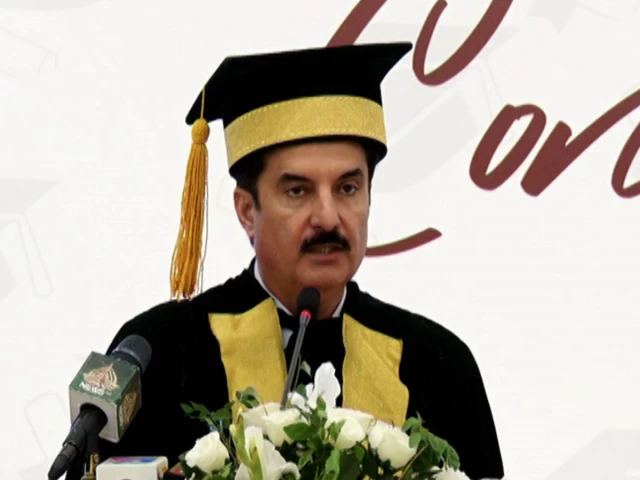
Khyber-Pakhtunkhwa Governor Faisal Karim Kundi speaking at the convocation of Abaseen University in Peshawar. PHOTO: EXPRESS
PESHAWAR:
Governor Faisal Karim Kundi on Tuesday said Khyber-Pakhtunkhwa was not demanding wheat from the federation but rather demanding its share of water, stressing that constitutional rights must be respected. He added that if the province provides electricity, gas and minerals to the country, it must also receive its fair share under the Constitution.
Speaking at the convocation at Abaseen University in Peshawar, the governor said efforts had been made to ensure that the federal government listened to provincial concerns and said the federal government had formed a three-member committee on the issue of closures of CNG stations in the province.
Kundi, welcoming the move, thanked Prime Minister Shehbaz Sharif and said a meeting would be held with him, including representatives of the provincial government. The governor said Ali Pervez, Rana Sanaullah and Rana Tanveer had been included in the committee.
KP has been grappling with a CNG shortage since April as several fuel stations remain closed, forcing millions of residents to struggle to access affordable fuel. The situation has also disrupted economic activity across the province.
Governor Kundi added that a meeting with the committee will be held soon, which will also be attended by representatives of the provincial government and the opposition. He said transportation of wheat was restricted, while smuggling forced people to buy expensive wheat from the market. “We don’t want wheat from the federation; we want our share of water,” he said, adding that if the province gets its share of water, “then we will provide wheat to Punjab.”
A day earlier, KP Chief Minister Sohail Afridi had slammed the Punjab government, saying it was committing “atrocities” against KP by restricting wheat supplies. “Article 151 of the Constitution does not authorize any ban on inter-provincial movement of food items,” he said, adding that people of KP were forced to buy the most expensive flour in the country.
“Punjab has damaged national unity by stopping the supply of flour,” Afridi had said, warning that the failure of the federal government’s policies was being blamed on the KP government.
Also on Monday, Afridi wrote a letter to Prime Minister Shehbaz, demanding immediate intervention over the federal government’s decision to cut gas supply to the CNG sector in the province. In the letter, he said the CNG sector’s requirements of “approximately 36 to 40 MMCFD of gas” had been “diverted to the fertilizer sector”, a move which he said had “paved the way for widespread agitation and poses a serious threat to law and order in the province”.
Meanwhile, in an article on He added that KP produces “nearly 508 MMCFD of natural gas against a demand of around 130 MMCFD”, but the people continue to face difficulties.
Thanks to the PM @CMShehbaz for the constitution of a committee on the critical issue of CNG closure in Khyber Pakhtunkhwa. KP produces nearly 508 MMCFD of natural gas against the requirement of around 130 MMCFD, but our people continue to face unnecessary hardship. Under article 158 of…
– Faisal Karim Kundi (@fkkundi) May 19, 2026
Referring to the constitutional provisions, he said, “Under Article 158 of the Constitution of Pakistan, the province producing natural gas has the first right and precedence over its utilization. »
Kundi stressed that “the constitutional rights of the people of KP must be respected”. He also thanked the KP government and all political parties for their support on this issue. “On issues concerning the rights of KP and the welfare of our people, we must rise above political differences and speak with one voice,” he said.
In December, the Punjab government imposed what the KP provincial government called unconstitutional and illegal restrictions on the interprovincial transportation of wheat and flour.
Pakistan Flour Mills Association President Muhammad Naeem Butt said in January that restrictions had forced about 80 percent of flour mills in KP to close, while only 20 percent operate by purchasing expensive smuggled wheat from Punjab.
CNG shortage
Severe hardship has hit students, parents and daily commuters in Peshawar and across KP after the closure of CNG stations due to acute shortage of natural gas. Most school van and bus operators in the province have suspended their services due to the unavailability of CNG, while public transport that has switched to petrol has sharply increased their fares, thereby increasing the financial burden on citizens.
In several regions, unexpected natural gas outages have further aggravated the problems of domestic and commercial consumers. The closure of CNG stations in April forced many vehicles to either stop operating or run on more expensive gasoline, leading to further hikes in transportation rates. School transporters are among the most affected. Owners of Suzuki vans and buses say running on gasoline is beyond their financial capabilities, leaving them with no choice but to park their fleet.
Kundi on Sunday urged the federal government to immediately take notice of the province’s growing problems, warning that growing public frustration over shortages and governance failures could eventually push people onto the streets. He called on the federal government to urgently address key issues facing the province, including the suspension of CNG supplies and restrictions on the movement of wheat.
Since taking over as KP chief minister last October, Afridi has repeatedly accused the federal government of discriminating against the province. On May 6, Afridi announced a province-wide general strike, ordering government employees to suspend routine administrative work to protest what the provincial government calls the Centre’s “discriminatory treatment” in financial and constitutional matters.
Two PTIs
During the press conference, Kundi turned his attention to the current KP provincial government. He said there should be two Tehreek-e-Insaf in Pakistan, one for Adiala Jail and the other for running the government. “If you sit in Adiala four days a week, it becomes ‘Adiala work’,” he added. He further said that the provincial government should have implemented the orders of the Peshawar High Court regarding CNG stations.
The governor added that action should have been taken against the administration which closed the CNG stations, and the chief minister should have ensured accountability.
Kundi on Sunday reiterated these sentiments, advising Afridi to focus on the issues and governance of the province rather than the Adiala prison, saying the affairs of the province should take priority over political protests.
The PTI has been holding protests every Tuesday and Thursday against the imprisonment of its founding president and the alleged difficulties he is facing in detention. CM Afridi, like other PTI leaders, remained actively involved in these protests.


