
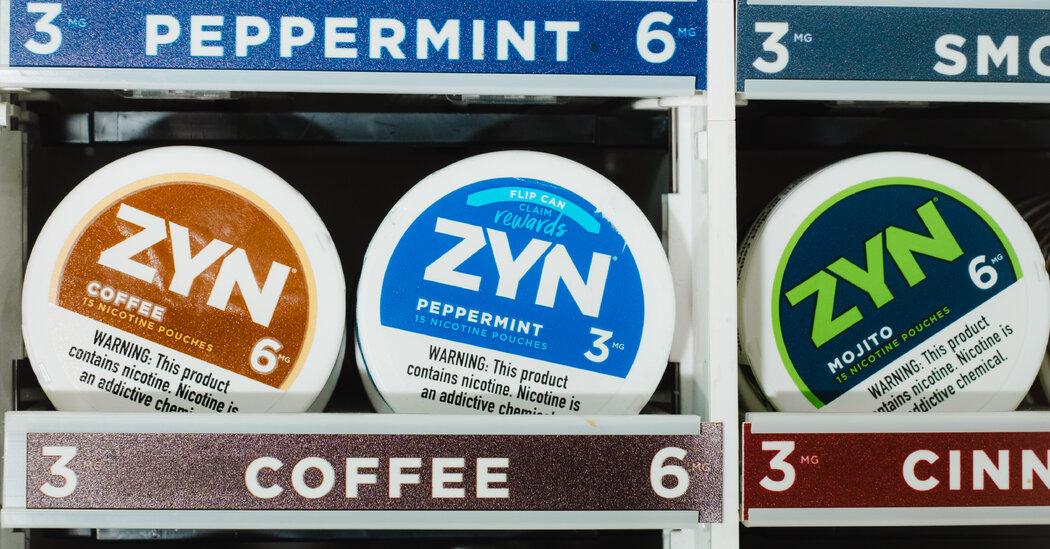
As the popularity of nicotine pouches explodes, tobacco companies are investing heavily in factories across the United States and creating new jobs, from Florida to Colorado.
Along with vaping products, big tobacco companies have captured the nicotine pouch market to offset the sharp decline in domestic cigarette sales. Sleeve sales are expected to reach more than $40 billion globally by 2033, up from $6.9 billion in 2025, according to an analysis by Grand View Research, a market research firm.
Companies are rushing to meet demand, investing more than $1 billion so far in crop production to meet the growth. Several states have welcomed the industry’s forays into the latest nicotine products, awarding millions of dollars in tax credits and subsidies.
But the marketing of nicotine-laden items like sachets, gum and lozenges as another safe alternative to traditional cigarettes has increased public health concerns. Experts accuse the tobacco industry of once again willfully ignoring decades of science that have proven nicotine’s addictive nature and fueling demand by producing ever more potent varieties.
Reminiscent of Juul and other flavored vaping products that have sparked a public outcry over their use among teens, the pouches — tobacco-free “lip pillows” placed between the cheek and gum — have revived warnings that nicotine is highly addictive and can cause a host of conditions, such as anxiety and cardiac arrhythmia. Experts say it also threatens the adolescent’s still-developing brain, with the potential to affect behavior and cognitive functions.
Colorado Gov. Jared Polis, a Democrat, defended his state’s decision to support a new $600 million factory in Aurora, built by Philip Morris International, which benefits from $4.5 million in tax credits.
“We were the first state to legalize marijuana and now have more than 650 dispensaries, have legalized natural medicine and have nearly 50 regulated healing centers that offer psilocybin,” said Governor Polis. “Of course we want safer alternatives to smoking, like Zyn, in our state.”
These extensions demonstrate the influence of the tobacco industry in the growing debate on the safety of this new generation of products.
As a major donor to President Trump, the industry has enjoyed a friendlier reception from his administration than from other presidents.
In May, the Food and Drug Administration issued new guidance loosening regulations on nicotine pouches and vapes, a week after tobacco company Reynolds American donated $5 million to a Trump-backed super PAC.
In late June, the FDA announced that it would allow certain products from one brand, Zyn, to be marketed as having a lower risk of certain cancers and diseases than cigarettes.
The pouches also have a significant recall with Robert F. Kennedy Jr., the U.S. Secretary of Health, who described the pouches as “probably the safest way to consume nicotine” and acknowledged their use.
Zyn is produced by Swedish Match, a subsidiary of Philip Morris International. Its Aurora plant employs more than 120 people and plans to expand to 500 people. Additionally, the company spent $232 million to build a factory in Owensboro, Kentucky, and employs 340 people there.
Over the past two years, Reynolds has created about 1,000 jobs in the United States, primarily through expansion of pouch manufacturing, according to Luis Pinto, a company spokesman.
Altria, which manufactures Marlboro cigarettes, produces the requested brands! and so on! MORE in Richmond, Virginia. The company won FDA approval in December for additional sachet products under a new streamlined program. (Altria was known as Philip Morris, which was renamed in 2008 and moved its international sales to Philip Morris International.)
In December, Swisher, known for its Swisher Sweets cigars, announced a $135 million expansion of its factory in Jacksonville, Florida. The company said it plans to create at least 240 jobs to support the production of nicotine and caffeine pouches.
And Swedish company WiJo is spending $13 million to open its first pouch factory in North America, in Lexington, South Carolina.
In South Carolina, a large Juul factory in Lexington County that had benefited from tax breaks and subsidies closed after a federal ban on most flavored vapes in 2020, and politicians said they were happy to see it go. But officials in the same county last year granted tax incentives to WiJo for its sachet factory.
The U.S. tobacco industry has imported nicotine pouch technology from Sweden, often by purchasing companies in that country. Altria purchased Helix Sweden in a series of transactions beginning in 2019. Philip Morris International purchased Swedish Match for $16 billion in 2022.
Garrett Nelson, senior equity analyst at CFRA, said smokeless nicotine products, like pouches and vapes, were generating new revenue for a tobacco industry that appeared moribund.
“They’re now seen as growth companies, and there’s a lot of optimism around products like Zyn and IQOS and other smoke-free products,” Mr. Nelson said in an interview.
Zyn dominates the pouch market.
“If you look at the first quarter, they have 61 percent of the retail dollar market share of the nicotine pouch market in the United States and, by volume, about 56 percent of the market share,” Mr. Nelson said.
While most of Philip Morris International’s revenue continues to come from cigarettes, Zyn has helped the company nearly double its stock price in two years.
But supposedly safer alternatives to traditional smoking have not allayed concerns about nicotine addiction. Symptoms include irritability, restlessness, difficulty concentrating, anxiety, and changes in appetite and mood.
The American Lung Association has sounded the alarm that the sachets are becoming the latest avenue for young people to develop an addiction. Citing similar concerns, the World Health Organization in May called for stricter regulation of these substances. In April, France went further by banning nicotine sachets, sparking trade tensions with Sweden.
Sam Dashiell, a PMI spokesman, disputed claims that these products targeted young people, saying the pouches were marketed to the 25 million adult Americans who still smoke cigarettes.
“Smoke-free products are a better option for current nicotine users of legal age who would otherwise continue to smoke or use other traditional tobacco products,” Dashiell said.
Proponents of pouches often cite success in Sweden, where smoking rates have declined significantly and the shift from cigarettes to pouches is sometimes called “the Swedish model.”
These products use nicotine extracted from tobacco leaves or synthetic nicotine, which is increasingly common. The sachets contain a powdered mixture of nicotine, flavorings and other ingredients that dissolve in the mouth.
Pouches are often presented as much more than just a cigarette substitute. Some MAHA-aligned health influencers (aka Zynfluencers) support them as a hack for energy and cognitive enhancement. Conservative media host Tucker Carlson, co-owner of a sachet brand, promotes the combination of nicotine and caffeine products “for the perfect coffee break.”
Mr Dashiell said Phillip Morris International did not pay social media influencers to market its covers.
Dr. Gina Kruse, a professor of medicine at the University of Colorado Anschutz who studies smoking cessation, said more research is needed to determine the effects of nicotine pouches.
“A lot of studies looking at things like the cytotoxicity of the sachets or their constituents come from industry,” she said. “And there is an urgent need for more independent research to understand the risks involved.”
She added that a big concern is the potential for sachets to become an “on-ramp” to nicotine addiction and drive people to turn to harmful products like cigarettes. “And there are certainly concerns about flavors appealing to young people,” Dr. Kruse said.
A growing concern is that companies are increasing nicotine levels, making the pouches more potent and addictive, said Sven Jordt, a distinguished professor at Duke University School of Medicine.
Dr. Jordt, a member of the FDA’s Tobacco Products Advisory Committee, said the highest levels of nicotine in some popular pouches had increased from six to eight milligrams of nicotine per pouch to nine to 15 milligrams. “It’s definitely a quantum leap.”
The strongest pouches include Grizzly and Velo Plus from Reynolds American and Zyn Ultra from Philip Morris International, he said.
“We need to study what happens with long-term use, across the entire digestive system,” he said.
“It’s another source of artificial sweeteners, with its own problems,” added Dr. Jordt. “What happens to sleep behavior, what happens to fertility? There need to be studies on oral health – how does that affect gum health?”
Dr. Jordt said Sweden was a leading example: “They now have an epidemic of oral smoking and I think that could, unfortunately, be the future in the United States. »
Factory expansion “indicates these companies’ strategies for the future,” he said.
Reynolds American’s Mr. Pinto said the company plans to spend $3.2 billion by 2030 to make more nicotine products, with pouches driving the bulk of that expansion.


