
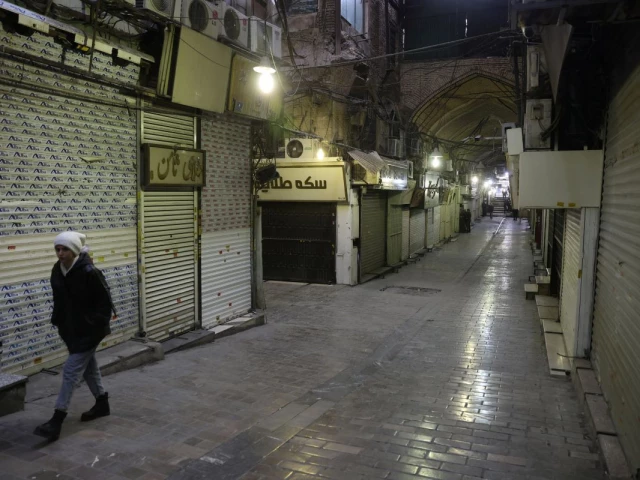
People walk past closed shops, following protests against falling currency values, in the Grand Bazaar in Tehran, Iran, January 15, 2026. PHOTO: WANA (West Asia News Agency) via REUTERS
ISLAMABAD:
In a bid to curb rising energy consumption amid a deepening energy crisis, the federal government on Monday ordered the closure of markets and shopping malls in most parts of the country from 8 p.m. on April 7, while Sindh remains the only province to finalize its implementation pending consultations with stakeholders.
The decision was taken at a high-level meeting chaired by Prime Minister Shehbaz Sharif, during which a broader review of fuel management, energy conservation and austerity measures was conducted against the backdrop of ongoing geopolitical tensions in the Middle East.
According to a statement issued by the Prime Minister’s Office (PMO), the new timings will apply to Punjab, Balochistan, Khyber Pakhtunkhwa (KP), Islamabad, Gilgit-Baltistan and Azad Jammu and Kashmir.
However, markets at the KP divisional headquarters were given an extension till 9 p.m. following consultations with the provincial government, while discussions continue in Sindh to determine a mutually agreed schedule.
The borders extend beyond the points of sale.
Bakeries, restaurants, tandoors and other food-related businesses will have to close at 10 p.m., while wedding halls, marquees and other similar places hosting wedding ceremonies will also observe the same closing time.
The government further imposed restrictions on private weddings, banning home ceremonies after 10 p.m.
However, medical stores and pharmacies have been exempted from the restrictions to ensure uninterrupted access to essential services.
Officials said the measures were part of a coordinated national response to growing energy pressures following disruptions to global oil supply chains, particularly across the Strait of Hormuz, following the outbreak of the US-Israeli conflict with Iran on February 28.
The disruption of this key maritime corridor, through which almost a quarter of the world’s oil supplies previously passed, has led to a sharp rise in fuel prices and strained supply lines.
The PMO statement said the government has simultaneously rolled out relief measures, including a digital wallet subsidy scheme under which financial assistance, including a transaction of Rs 100,000, has already been disbursed.
The provision of subsidized fuel for targeted segments continues as part of a broader strategy to protect the public from rising costs.
Prime Minister Shehbaz Sharif expressed gratitude to the chief ministers of Punjab, KP, Balochistan and Gilgit-Baltistan, as well as the Prime Minister of Azad Kashmir, for reaching consensus on an issue of “national importance”.
He expressed hope that Sindh would also align with the policy after completing consultations with stakeholders.
As part of the relief efforts, the Prime Minister also announced that inter-city public transport services would be provided free of charge in Gilgit and Muzaffarabad for a month, with the federal government bearing the cost.
Deputy Prime Minister Ishaq Dar, Minister for Economic Affairs Ahad Cheema and other senior officials attended the meeting.
Sindh consults traders
Meanwhile, Sindh Chief Minister Murad Ali Shah held a separate meeting with business representatives, including officials of the Karachi Chamber of Commerce and Industry and Korangi Association of Commerce and Industry, to discuss the proposed market schedules.
According to a statement issued by the Sindh CM’s office, Murad said “we will all have to play our role considering the situation in the country”, emphasizing the need to save energy while ensuring that the burden on low-income groups remains minimal.
He assured traders that no final decision would be made without their input, adding that their recommendations on opening hours would be considered before being forwarded to the Prime Minister.


