
Givt absorbed the shock for two to three weeks, supporting the load internally while ensuring uninterrupted availability
ISLAMABAD:
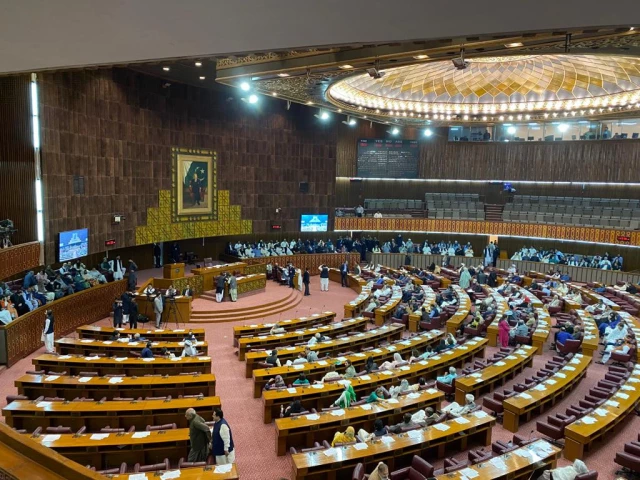
The government on Monday defended its handling of rising fuel prices, telling the National Assembly that emergency measures, including subsidies exceeding 100 billion rupees, had been put in place to protect consumers after global oil markets were rocked by the Iran crisis and disruptions to key supply routes.
In a policy statement to the House, Oil Minister Ali Pervaiz Malik said the situation had taken a dramatic turn following the February 28 attack on Iran, which disrupted global energy flows, particularly through the Strait of Hormuz, which carries 25 to 30 percent of the world’s oil supply.
He said crude prices, which were hovering around $70 per barrel, shot up to $170, while diesel prices rose to $280 in global markets.
“No one had prepared for such conditions,” the minister said, adding that the government needed to quickly develop a response plan after the crisis broke out.
He said authorities had chosen not to allow shortages or chaos in fuel supplies, pointing out that one option had been to freeze prices at the cost of long queues and public distress.
Instead, the government absorbed the shock for two to three weeks, bearing the burden internally while ensuring uninterrupted availability.
He said alternative supply routes had been put in place after the disruptions in Hormuz, with Prime Minister Shehbaz Sharif, the deputy prime minister and the army chief engaging Gulf countries to secure supplies.
Malik thanked Saudi Arabia, the United Arab Emirates and Oman for facilitating oil deliveries through special arrangements, while also acknowledging Iran for allowing Pakistani ships to pass through the Strait of Hormuz despite tensions.
The minister said Pakistan, which depends on Hormuz for about 90 percent of its oil imports, was facing cascading challenges as LNG supplies were also affected, making a long-term gas deal ineffective.
He said the government had convened a wide-ranging national consultation, involving the President, the Prime Minister, the chief ministers of the four provinces, the Prime Minister of Azad Kashmir and the caretaker chief minister of Gilgit-Baltistan, to formulate a unified response.
“We all collectively ensured that people were not forced to queue,” he said, adding that targeted relief mechanisms have been designed for all segments, from motorcyclists to farmers.
Detailing the relief measures, Malik said the grants were being disbursed through a transparent and technology-driven system developed by the IT ministry, and the funds had already reached millions.
A subsidy of Rs100 per liter for motorcyclists has been introduced for three months, while intercity transport has also been subsidized.
Bus owners get Rs 100,000 per month and rail fares for the general public have not been increased.
He added that government-run intercity transport services had been made free in some cases.
Farmers are being provided support through Kisan cards and other digital platforms, while uninterrupted gas supply has been ensured to 10 fertilizer factories to avert a fertilizer crisis, keeping prices below Rs 4,500.
The minister said a committee of ministers reviewed the availability and prices of oil and fertilizer on a daily basis, while the supply of domestic gas had been managed to ensure availability during peak times for cooking.
He acknowledged that while consumers faced price pressures, the government had prioritized uninterrupted supply over shortages.
The opposition, however, strongly criticized the government’s approach.
Speaking during the debate, lawyer Gohar Ali Khan questioned the justification for the price increase, saying the government had increased fuel prices more steeply than countries in the region.
He claimed that while global prices had increased by about 3 percent, Pakistan had increased prices by up to 20 percent, subsequently increasing them further by 42 to 54 percent.
He also criticized the imposition of higher levies and questioned why the government had not asked oil companies to cut profits, as has been the case in India.
Gohar said the government first increased the tax on petroleum to Rs 160 per liter before reducing it to Rs 80, and called for continuation of the debate in the next session.
He also highlighted economic hardship, citing the case of a woman who reportedly died of starvation despite benefits from Benazir’s income support program.
He criticized the Prime Minister for not attending Parliament, thus comparing him to the previous PTI government.
Responding to criticism, Minister Malik said the opposition’s concerns were not based on complete information, suggesting details had not been properly conveyed to the provincial level.
He argued that fuel prices had risen globally by up to 80 percent in some cases and that Pakistan’s response had focused on protecting the public while ensuring continuity of supply.


