
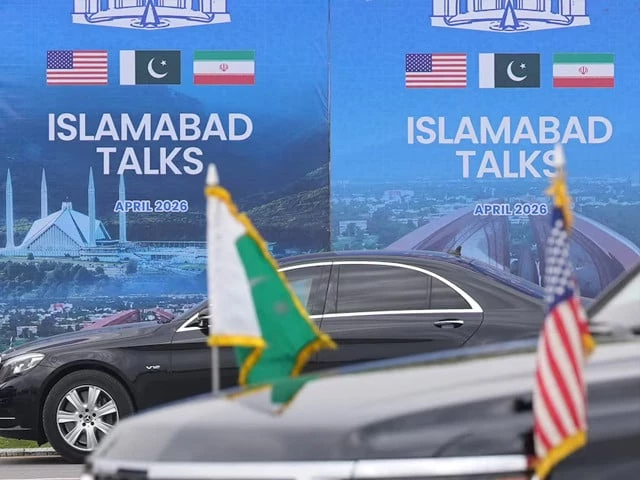
Despite Trump’s posture, everything suggests that secondary channels are still active to avoid the worst case scenario.
ISLAMABAD:
Initial proposals exchanged between Iran and the United States through Pakistan failed to break the deadlock, while Islamabad now awaits a series of revised proposals from Tehran, seeking to end the war that has already disrupted oil supplies and threatened the global economy.
Amid growing uncertainty, messages from Iran and the United States are mixed.
US President Donald Trump posted a simulated image of himself holding a gun and wearing aviator sunglasses on his Truth Social platform, along with a warning for Iran.
“NO MORE MR. NICE GUY,” the text on the image reads, alongside an image of the American flag.
Trump also had a message for Iran in an early morning message, writing: “Iran can’t get their act together. They don’t know how to sign a non-nuclear deal. They better get smart soon! President DJT.”
Despite Trump’s posture, everything suggests that backdoor channels are still active to avoid the worst case scenario.
On the other hand, Prime Minister Shehbaz Sharif on Wednesday gave for the first time more details on Pakistan’s mediation efforts and indicated that a response from Tehran was expected.
The prime minister told the cabinet that the Iranian foreign minister, after visiting Islamabad twice, then Oman and Russia, had spoken to him.
“I spoke to him (Araghchi) on the phone and he assured me that detailed meetings had taken place and after consultations with the leadership, a response would be given as soon as possible,” Shehbaz added, without divulging further details.
The prime minister’s remarks suggest that a detailed response from Tehran on how to end the war has not yet been received.
Amid a fragile ceasefire in Gaza and a deepening humanitarian crisis, Pakistan told the UN Security Council that it upholds universal respect for international law and the peaceful resolution of disputes and remains actively engaged in advancing diplomatic pathways towards peace and stability in the Middle East.
“The root cause of instability in the Middle East remains the unresolved question of Palestine and the continued Israeli occupation of Arab lands,” Ambassador Asim Iftikhar Ahmad, Pakistan’s permanent representative to the UN, said during a debate on the situation in the Middle East.
“It is not expansionist ambitions nor illegal wars, it is the vacation of occupation, for the realization of a Palestinian state, the two-state solution, which is the only viable framework for a just, lasting and comprehensive peace,” he added.
In his speech, Pakistani envoy Ambassador Asim Ahmad said more than 800 Palestinians had been killed by Israeli strikes since the ceasefire was announced, highlighting both the scale of the crisis and the sensitivity of the situation. “It is essential to fully respect and consolidate the ceasefire and ensure sustained, unhindered and enhanced humanitarian assistance.”


