
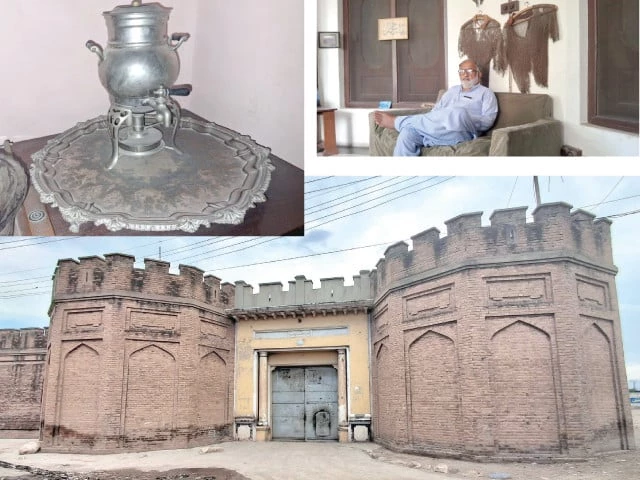
Once the seat of political power, the great Qalla of the historic village is fighting for its survival
PESHAWAR:
Sheikhan, a historic village on the outskirts of Peshawar, is a living testimony to a glorious past that has largely disappeared. Once famous for its abundant irrigation water from the Bara River and the highly prized Bara variety of rice, whose exquisite taste is believed to be due to the mineral-rich waters of the river, the village’s glorious past survives today mainly in stories.
The Bara River, which made Sheikhan the first village in the district to benefit from its flow, was diverted in the 1980s to irrigate land in the Khyber tribal district, ending an era of agricultural prosperity.
The village takes its name from Sheikh Abu Saeed Baba, a saint who emigrated from Ghazni in Afghanistan. The local Mohmand tribe offered him vast fertile lands and abundant water. Its jagir is said to span over 45,000 channels.
During the British Raj, Sheikh Akbar Khan, head of the Sheikhan clan, was appointed as the ‘Hakim’ of the region. In 1870, he built a magnificent haveli outside the village. His son, Nawab Mehboob Ali Khan, later expanded the structure. Mehboob Ali Khan rose to prominence as a political officer in the Malakand Agency, overseeing Swat, Dir and Chitral, and also served in Afghanistan.
Today, Nawab Mehboob Ali Khan’s three-acre haveli continues to dominate the landscape, a proud but weathered reminder of a time when the village was a center of political influence for the family.
Speaking to The Express PK Press Club, Sheikh Akbar Ali Khan, grandson of Nawab Mehboob Ali Khan, said his clan had been inhabiting the village for almost 400 years.
“This haveli, locally called Qalla in Pashto, was built in stages starting in 1870,” he explained. “Initially two rooms were built to accommodate the constant flow of guests. They were expanded in 1912 and finally in 1945.”
Akbar Ali Khan recalled that this imposing structure was the only landmark visible for miles across the vast hinterland. It included a public kitchen (langar) as well as a separate kitchen for special guests with cooks specializing in English, Arabic and local cuisines. Nawab Mehboob Ali Khan, an alumnus of Aligarh Muslim University, adorned the haveli with rare paintings and decorative items collected from all over India.
His brother, Sher Ali Khan, joined the police and served as an officer of Yakatoot Police Station in Peshawar, but died at a young age.
Maintaining the historic structure has become a daunting task. “In Lahore and other parts of the country, families have converted their palaces and havelis into hotels, but this is not feasible in Sheikhan as this city borders Bara in the Khyber tribal district where terrorism remains a concern,” Akbar Ali Khan said.
He added that millions of rupees would be required to preserve the building and keep it intact for future generations.
The Sheikhan haveli, although still standing, now symbolizes both the enduring legacy of a powerful clan and the challenges of preserving history in a changing and uncertain region.


