
Minister of State for Foreign Affairs appreciates Pakistan’s constructive role as Dar reaffirms commitment to peace
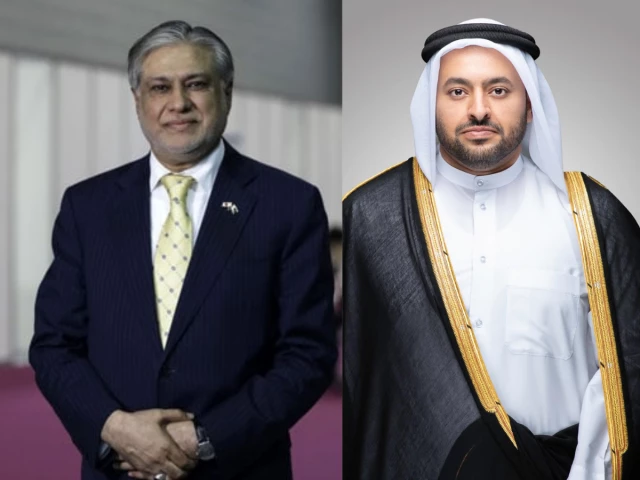
Deputy Prime Minister and Minister of Foreign Affairs Ishaq Dar (left), Qatari Minister of State for Foreign Affairs Mohammad bin Abdulaziz Al-Khulaifi (right)
Deputy Prime Minister and Minister of Foreign Affairs Ishaq Dar discussed the regional situation with Qatar’s Minister of State for Foreign Affairs Mohammad bin Abdulaziz Al-Khulaifi in a telephone conversation on Monday, according to the Ministry of Foreign Affairs (MOFA).
The two leaders discussed “the evolving regional situation and issues of common concern”, the foreign ministry said, adding that they “underlined the importance of dialogue and diplomatic engagement to address regional challenges”.
Deputy Prime Minister/Foreign Minister Mohammad Ishaq Dar @MIshaqDar50 spoke today with the Minister of State for Foreign Affairs of Qatar, Mohammad bin Abdulaziz Al-Khulaifi @Dr_Al_Khulaifi.
They discussed developments in the regional situation and issues of mutual interest. Both sides… pic.twitter.com/73RNy9OQpg
— Ministry of Foreign Affairs – Pakistan (@ForeignOfficePk) May 18, 2026
According to the Ministry of Foreign Affairs, the Qatari minister appreciated Pakistan’s “constructive role and continued diplomatic efforts”, while Dar reaffirmed Pakistan’s commitment to “advancing the common goals of peace, stability and prosperity in the region and beyond”.
This call comes as communications are ongoing between Pakistan and Qatar, in the context of the US-Israeli war against Iran.
Yesterday, Prime Minister Shehbaz Sharif spoke with Prime Minister and Foreign Minister of Qatar Sheikh Mohammed bin Abdulrahman bin Jassim Al Thani, thanking Qatari leaders for their support for Pakistan’s mediation and de-escalation amid ongoing regional tensions.
This is the second telephone conversation between the two leaders in a week. On May 10, Prime Minister Shehbaz spoke with the Qatari Prime Minister, exchanging views on the developing regional situation and reaffirming his support for peace in the region.
Read: US sets five conditions for Iran deal: report
Earlier, on May 7, the two leaders had a “productive exchange of views” on the regional situation during a telephone conversation. Prime Minister Shehbaz and Abdulrahman once again reaffirmed their commitment to facilitating ongoing peace efforts to ensure lasting peace between the United States and Iran.
On February 28, the United States and Israel launched a joint offensive against Iran. Tehran retaliated by striking Israel and other Gulf countries harboring U.S. assets.
Pakistan then positioned itself as a key peace broker, brokering a two-week ceasefire and hosting the highest-level U.S.-Iran talks since the 1979 Islamic Revolution. Although the “Islamabad Talks” ended without a deal, the ceasefire was maintained and then extended at Islamabad’s request.
The United States and Iran are expected to hold a second and final round of negotiations in Islamabad, but no official confirmation has been received from either side on this. Despite no confirmation, Pakistan has expressed optimism that a peace deal between the United States and Iran will be concluded “soon”.


