
NEWYou can now listen to PK Press Club articles!
Jared Armstrong’s basketball career didn’t turn out exactly as he had hoped, but what he did with the sport was a nice consolation prize.
Armstrong was unable to play Division I basketball due to a foot injury, but played professionally in Israel.
When Armstrong was offered the opportunity to play in Israel, he was granted citizenship there, a nod to his Jewish heritage. Now his goal is to “make sure he’s remembered as just a basketball player.”
CLICK HERE FOR MORE SPORTS COVERAGE ON PK Press Club
Jared Armstrong gives back to his Jewish community. (Basketball Jared Armstrong)
That’s why Armstrong is building courts in Israel and in the Jewish communities of his hometown of Philadelphia.
“I’ve always had the passion that basketball is going to end one day. What are you going to do after your career? I just didn’t want to be another statistic. They say 50 percent of guys go bankrupt within five years of playing, whether in the NBA or overseas. So my goal is basically to try to build a business, which is rare, while you’re playing. That way, when I’m done, I’ll have something to fall back on,” he recently said. Armstrong told PK Press Club Digital.
Armstrong said the events of Oct. 7 pushed him even further to help his communities.
“I think what kept me going was seeing that a lot of the kids, when I came back and decided to play, didn’t have an outlet. I saw how much the kids wanted it,” Armstrong said. “They were hungry for it. They weren’t in school and they really didn’t have anything to do. After our first clinic, it really motivated me to keep doing it for them because I know if I was in their shoes, I would want someone to do it for me.”
“It was about giving back to the place where I started my career,” he added. “Obviously, I’m Jewish and that of my family, and I’ve never really been a religious person. I’ve always been more of an action-based guy and how you treat people. Morals and values and principles are what I believe in. I think it’s very important for me to show kids what’s possible with a ball and a dream.
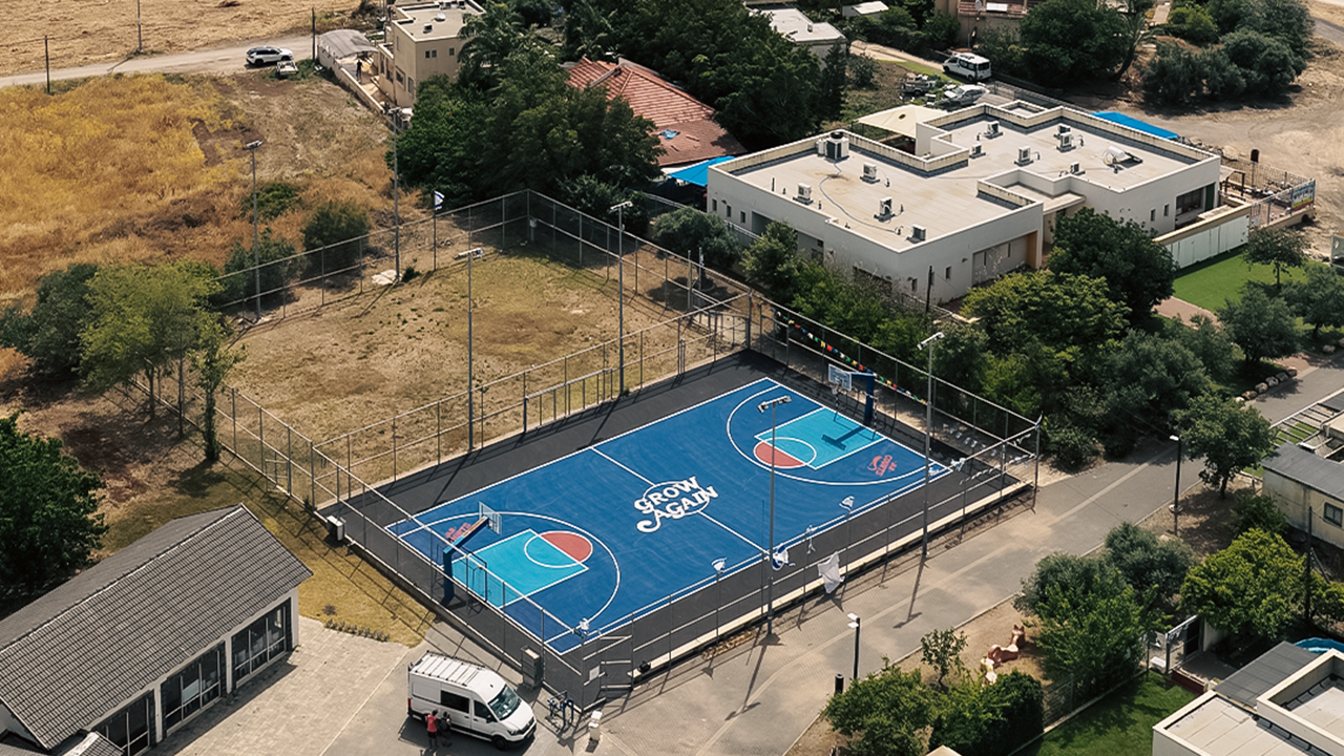
This court was built in Poria with the help of Armstrong. (Basketball Jared Armstrong)
JALEN BRUNSON SHAKES FEAR FROM FIRST QUARTER KNEE, MARKS 30 AS KNICKS STEAL GAME 1 OF FINALS FROM SPURS
In addition to his philanthropic work, he is behind the upcoming JAB Classic in August – one of only two million-dollar basketball tournaments in existence, featuring former NBA players and top international professionals, all competing on one stage with one mission: to use the power of sport to unite and inspire.
“This idea has been in the works for almost two years. Money is not the main attraction here. The real goal of the tournament is to fight hatred,” Armstrong said.
“Hate is rising, and I think sports is a great way to not only amplify the message, but also show that unity is possible. For us, unity and understanding the message is very important, but bringing all of these players under one roof also creates an opportunity for community engagement. It gives a lot of inner-city kids the chance to see their favorite players, who they otherwise wouldn’t be able to see during the NBA season. I think there are a lot of intangibles here. too.”
And as the NBA Finals begin, Armstrong will always reflect on what basketball has done not only for him, but for countless others.

Armstrong builds basketball courts in Israel and in Jewish communities in his hometown of Philadelphia. (Basketball Jared Armstrong)
CLICK HERE TO DOWNLOAD THE PK Press Club APP
“I wouldn’t be where I am or in this position without this game. I believe basketball can save the world,” he said. “It’s an inexpensive sport that anyone can play. You literally only need a ball and a hoop. I think that’s what sets it apart and makes it such a meaningful and powerful game.
“You have to communicate. You have to get to know other people. You don’t go on a basketball court and be silent. In football, you can wear a helmet and pads and no one really knows you, but in basketball, everyone has to get to know each other. I think there are a lot of intangibles that you learn from the game that translate directly into your daily life.”