
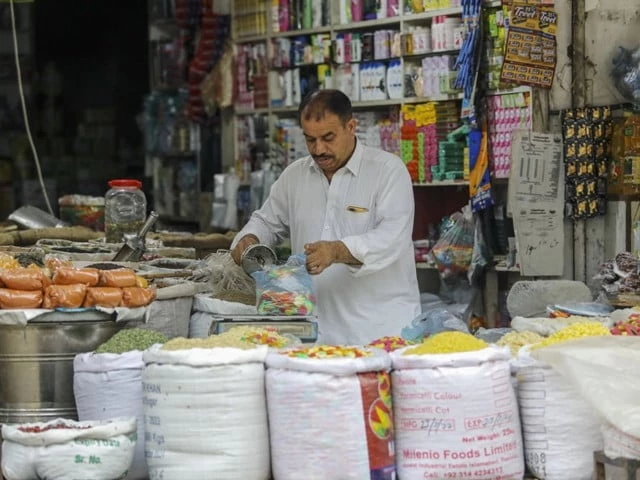
As the federal government introduces another simplified tax system for retailers, skepticism is growing over its implementation.
LAHORE:
The Federal Government has decided to introduce a flat or simplified tax system for small traders and traders in Budget 2026-27, with the aim of bringing more businesses into the tax net and generating additional revenue. However, previous experiences with similar schemes and current trends in tax collection have raised doubts about the initiative’s ability to achieve its ambitious goals.
According to budget documents, the government has introduced a simplified tax regime for traders with an annual turnover of up to Rs 200 million. The program aims to encourage small businesses to register with the tax system, with officials hoping for around 50 billion rupees in additional revenue.
Former Federal Board of Revenue (FBR) member Mustafa Ashraf said the initiative was a positive step, but highlighted his concerns over combining documentation efforts with a fixed tax system. “The government claims to have around 4 million taxpayers, and if 1 million taxpayers contribute Rs 25,000 each, it could generate Rs 25 billion. However, similar merchant tax systems introduced in the past have failed to produce significant revenue,” Ashraf said.
For the financial year 2026-27, the FBR has been assigned a tax collection target of Rs 15.26 trillion, with the retail sector identified as a major area for revenue growth. Economic experts believe that despite accounting for a significant portion of Pakistan’s economy, retail contributes comparatively less to tax collection.
Pakistan has around 3.5 to 4 million traders, but many remain outside the formal tax system. Successive governments have introduced various initiatives to tax traders, including fixed taxation schemes, but most have failed to meet expectations.
A similar fixed tax regime was introduced in 2014 under the Pakistan Muslim League-Nawaz (PML-N) government, followed by other schemes such as the pro-trader scheme. Despite ambitious registration targets, only a limited number of traders have become part of the tax system, leading to a gap between expected and actual revenue collection.
Tax figures from Lahore markets also show differences in business activity and tax payment. Reports indicate that Multan Road Market contributed around Rs 10 billion in taxes, while Wapda Town Market paid around Rs 1.63 billion. Other markets, including Urdu Bazaar Lahore, contributed around Rs 338.7 million, while DHA Y-Block Market brought in around Rs 248 million.
Meanwhile, some markets reported much lower tax contributions, including Naulakha Bazaar with around Rs14.2 million and Sarafa Bazaar with around Rs2.35 million. Experts point out that these figures reflect the gap between actual business activity and tax payments in several markets.
Trader organizations say rising electricity costs, inflation and increased business expenses have already created difficulties for traders. The government, however, believes that integrating retailers into the formal tax system will strengthen the economy and improve revenue collection.
Former Speaker of the Lahore House Mian Muhammad Ali felt that the FBR’s new fixed tax system was an important step. “The tax amount of Rs 25,000 is low and would provide traders with a tax certificate and protection from repeated audits and investigations. Small retailers would effectively pay around Rs 2,000 per month under this system,” Ali noted.
Ali suggested that the government should keep the tax rate fixed for five years, arguing that since the system was approved by Parliament, any major changes should also require Parliament’s approval.
Economic experts stress that the success of the project will ultimately depend on the government’s ability to bring millions of traders into the tax net and meet its revenue targets, rather than repeating the shortcomings of previous initiatives.


