
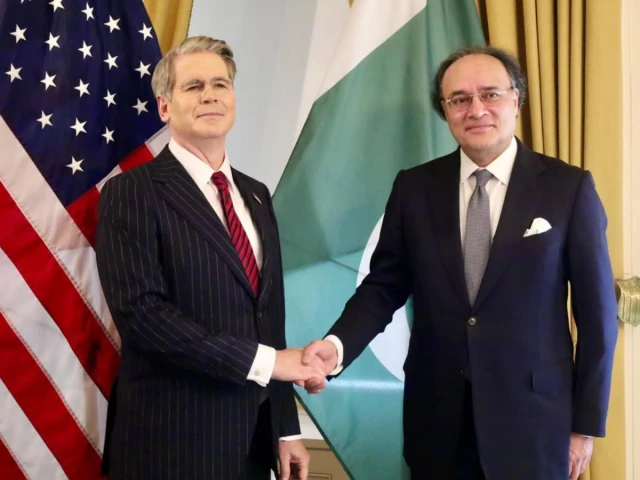
FinMin tells the US Treasury that the country has moved from macroeconomic stabilization to sustainable export-led growth.
Finance Minister Muhammad Aurangzeb meets with US Treasury Secretary Scott Bessent in Washignton DC. PHOTO:
Pakistan on Tuesday demanded greater support from the United States for better access to international capital markets, stronger foreign exchange reserves and better sovereign credit ratings, as Finance Minister Muhammad Aurangzeb met with US Treasury Secretary Scott Bessent.
According to the Finance Ministry, Aurangzeb briefed the US Treasury Secretary on Pakistan’s economic progress, saying the country had moved from “macroeconomic stabilization to sustainable export-led growth”.
During the meeting, the Finance Minister also highlighted “the negative impacts of the regional situation on the Pakistani economy”, stressing that the economy remained vulnerable to geopolitical developments in the region.
وفاقی وزیرِ خزانہ و محصولات سینیٹر محمد اورنگ زیب کی امریکی ہم منصب سکاٹ بیسنٹ سے ملاقات
وزیرِ خزانہ سینیٹر محمد اورنگ زیب نے امریکی وزیر خزانہ کو پاکستان کے میکرواکنامک استحکام سے پائیدار اور برآمدات پر مبنی گروتھ کے سفر سے آگاہ کیا
وزیرخزانہ نے علاقائی صورتحال کے پاکستانی… pic.twitter.com/bYdKRDFXpt
– Ministry of Finance, Government of Pakistan (@Financegovpk) July 21, 2026
The ministry said Aurangzeb was seeking “greater US support for Pakistan’s market access, based on better access to international capital markets, higher foreign exchange reserves and improved sovereign credit rating.”
The finance minister expressed Pakistan’s desire to see the United States cooperate on “improved access to international capital markets, increased foreign exchange reserves and increased market access based on sovereign credit ratings.”
The two sides also discussed prospects for expanding bilateral economic relations and investments.
The Ministry of Finance said that “the two sides reaffirmed their commitment to deepening bilateral economic cooperation, promoting more US investments and advancing strategic projects.”
He added that Pakistan and the United States expressed “commitment to promoting economic cooperation, increasing American investments and ensuring the progress of strategic projects.”
Aurangzeb on Tuesday held a virtual meeting from Washington DC with top management of international banking consortia under the Global Medium Term Note Program and Pakistan’s International Sukuk Program.
The meeting marked the start of a strategic partnership with selected financial institutions.
The consortia have been appointed for three years and will support issuances in Pakistan’s sovereign capital market of conventional and Islamic financing instruments. Once the required documentation and all applicable formalities are completed, the government intends to use these structures for frequent issuance, as and when required, in line with its financing strategy.
Pakistan’s re-engagement with international capital markets is supported by the country’s improving macroeconomic environment. Sustained fiscal consolidation, the reconstitution of external reserves, the strengthening of debt sustainability indicators and the continued implementation of structural reforms have strengthened investor confidence and economic credibility.
The positive reassessment of Pakistan’s macroeconomic outlook is also reflected in the significant compression of sovereign credit spreads, with market pricing increasingly reflecting the strength of underlying credit fundamentals and confidence in the country’s reform trajectory.


