
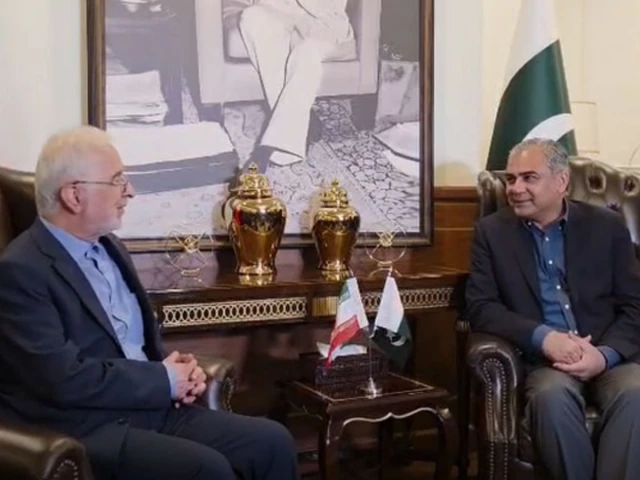
The two countries agree to further strengthen bilateral relations, enhance mutual trade and improve coordination mechanisms.
Interior Minister Mohsin Naqvi speaks with his Iranian counterpart Eskandar Momeni in Islamabad. PHOTO: RADIOPAK
Pakistan and Iran on Wednesday agreed to strengthen cooperation in combating terrorism and narcotics, preventing illegal immigration and combating human trafficking, as Interior Minister Mohsin Naqvi held talks with his Iranian counterpart Eskandar Momeni in Islamabad.
Momeni arrived in Islamabad on Monday with a high-level delegation amid renewed tensions in the Middle East. The visit came amid heightened regional tensions after the United States and Iran exchanged strikes, with Washington targeting sites in Iran and Tehran’s forces retaliating against U.S. military assets in the region.
The United States and Iran signed a memorandum of understanding last month mediated by Pakistan to end their conflict and reach a lasting peace deal, but tensions have escalated again.
ایران کے وزیر داخلہ اسکندر مومنی کی وزارت داخلہ آمد، پاکستانی ہم منصب محسن نقوی نے پرتپاک خیرمقدم کیا
فیڈرل کانسٹیبلری کے چاق و چوبند دستے نے ایرانی وزیر داخلہ کو سلامی پیش کی pic.twitter.com/nzA50fLd8V
– Ministry of Interior GoP (@MOIofficialGoP) July 22, 2026
Naqvi warmly received Iranian Interior Minister Eskandar Momeni upon his arrival at the airport, where a well-organized contingent of federal police presented him with a guard of honor.
Depending on the state Radio Pakistanthe two sides agreed to strengthen cooperation in the fight against terrorism, the fight against narcotics, the prevention of illegal immigration and human trafficking.
During the meeting, the two ministers highlighted the need to adopt a common strategy to prevent terrorism and drug trafficking in the Pakistan-Afghanistan-Iran region, with particular emphasis on combating threats emanating from the Afghan border.
Read: PM Shehbaz urges US, Iran to exercise restraint during meeting with Iranian minister
The two ministers also reaffirmed their commitment to further strengthen bilateral relations, enhance trade and improve coordination mechanisms to expand cooperation between the two neighboring countries.
Speaking on the occasion, Naqvi said Pakistan was ready to expand cooperation with Iran in all sectors.
He also appreciated the efforts of Iranian Foreign Minister Abbas Araghchi and Interior Minister Eskandar Momeni, saying they had made “exceptional efforts for peace.” Naqvi expressed hope that “good news will emerge and peace will prevail.”
According to the Interior Ministry, the Iranian delegation included the Governor General of Sistan and Baluchestan, the Iranian Deputy Interior Minister, the Iranian Deputy Minister of Urban Development and Transportation, the head of the Iranian National Oil Company, the special representative of the Iranian Minister of Agriculture and other senior officials.
The meeting was also attended by State Minister for Interior Talal Chaudhry, Federal Secretary Interior, Chairman NADRA, Director General Federal Investigation Agency (FIA), Director General Anti-Narcotics Force (ANF), Inspector General Federal Police, Director General National Cyber Crime Investigation Agency (NCCIA), Director General Immigration and Passports, Chairman Capital Development Authority (CDA), Inspector General of Police Islamabad and other secretaries of the Interior Ministry.
According to Anadoluquoting Iranian state television channel IRIBMomeni is visiting Pakistan at the invitation of Interior Minister Mohsin Naqvi to advance bilateral cooperation between Tehran and Islamabad. The Iranian government, in an article on
“After his visit to Pakistan, Momeni will travel to New Delhi, India, at the invitation of his Indian counterpart to attend the BRICS Ministers’ Meeting on Disaster Management, focusing on disaster risk reduction,” the statement said.
The conflict intensifies
U.S. forces struck Iran for the ninth straight day Monday as concerns grew over shipping through the Strait of Hormuz after Iran said two oil tankers exploded and were immobilized.
In a statement, US Central Command said it had launched “a new wave of strikes” aimed at “degrading” Iran’s ability to attack commercial shipping in the strait’s vital shipping lanes. He gave no further details.
The strikes are part of a growing cycle of attacks between the United States and Iran after the failure of an interim ceasefire deal signed a month ago, intensifying the fight for control of the Strait of Hormuz, which has disrupted energy supplies and stoked fears of global inflation.
A joint de-escalation proposal from Pakistan and Qatar urged the United States and Iran to return to their pre-July 9 positions “as a first step” to resume stalled negotiations to permanently end their months-long war, Pakistani government sources said. Anadolu.


