
Just a few weeks ago, the U.S. economy appeared to be enjoying a summer break.
The war with Iran appears to be easing. Energy markets had begun to calm down. Prices at the pump had fallen and, across the economy, inflation had begun to ease.
It’s a welcome respite for American families and businesses, which have weathered more than a year of shocks unleashed by President Trump’s global trade war.
But the reprieve did not last.
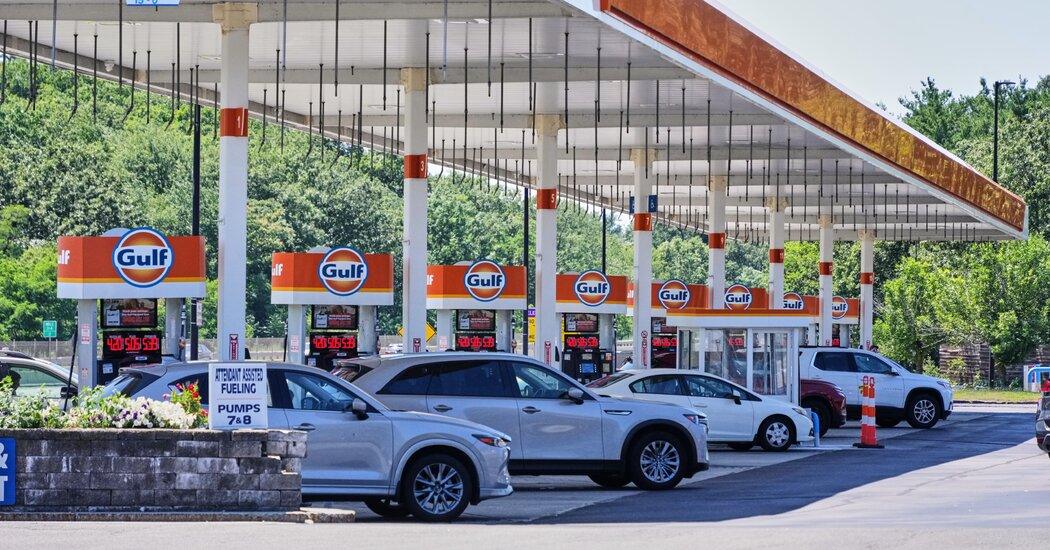
The growing military conflict with Iran entered a dangerous new phase this week, spooking energy markets and sending global oil prices to $100 a barrel. The anxiety has spilled over into gasoline prices, which have topped $4 a gallon in much of the country, according to AAA. And the uproar coincided with the return of Mr. Trump’s trade brinkmanship, as the White House on Friday formalized a series of new tariffs on dozens of countries.
These rights apply to some of the United States’ largest trading partners, including members of the European Union, and they are expected to be the first of many more to come. Customs tariffs are taxes that apply to imported products. Once again, the president’s actions threaten to increase costs for some American businesses and consumers.
These forces, taken together, have complicated the country’s economic outlook in a familiar way. In the past, economists believed that the end of hostilities in the Middle East would mean a gradual return to normal. Instead, renewed fighting has cast doubt on those assumptions, making the country’s long, hard fight against inflation as frustrating as ever.
“The longer the war lasts, at the current level of intensity, the worse it is for consumers,” said Olu Sonola, head of U.S. economics at Fitch Ratings.
The economic woes were particularly acute for Mr. Trump, less than four months before the midterm elections. Yet at a rally in Marietta, Georgia, on Wednesday, the president appeared indifferent to the fallout from the war with Iran, a conflict he has repeatedly downplayed.
Mr Trump said inflation was “declining”, pointing to falling prices in June, before promising that energy costs in particular would “come down, maybe lower than where they started”.
“But just give me some time,” he added.
Mr. Trump’s comments highlighted the stakes for the economy as well as the Republican Party, as voters grow increasingly impatient with the nation’s economic developments. Many told pollsters they were frustrated with Mr. Trump’s agenda and unhappy with the state of the war.
From the start, Mr. Trump tried to present the intervention as essential for national security, arguing that he had to prevent Iran from acquiring nuclear weapons. His economic message faltered in the process. Repeatedly, he dismissed the costs of conflict, mused that the consequences could be far worse, and expressed optimism that the United States could absorb any blow.
In many ways, the economy has shown resilience and could grow 2.3% this year, analysts at Oxford Economics estimated this month. The job market also remains strong, posting slower but steady gains last month.
But inflation remains a scourge weighing on Americans’ finances. Despite recording the biggest monthly decline in six years, consumer prices overall were still 3.5 percent higher in June than they were a year earlier. This is well above the 2% target set by the Federal Reserve.
The White House celebrated the latest inflation data, which came precisely as the United States and Iran resumed hostilities – raising fears that any improvement could be short-lived. The expected rise in oil and gas prices soon followed, as maritime traffic in the Strait of Hormuz slowed again.
The troubles essentially halted weeks of gradual improvements. Before the resumption of hostilities, retail gas prices fell 15 percent and jet fuel prices fell 35 percent from spring peaks, according to a report released this month by Goldman Sachs. Economists predicted the drop would lower consumer prices across the board, given that energy affects everything from transportation to fertilizer.
But Goldman Sachs also predicts that a major escalation of the war, which would push oil to $100 a barrel, could exacerbate inflation beyond even volatile goods like food and energy in the months to come.
“Volatility and unpredictability are the new normal,” said Atsi Sheth, chief credit officer at Moody’s Ratings. She said the hostilities confirmed her prediction that oil prices would remain high throughout the year.
In April, when the United States and Iran reached their first ceasefire, Ms. Sheth said, economists expected inflation to decline slowly from its peak in May, but stabilize around 3 percent. Today, she said, the resumption of war raises the “risk that this downward trend will not go smoothly”.
The consequences of a prolonged return to war could prove far-reaching, particularly for low-income Americans, who spend a larger share of their monthly income on energy costs.
If hostilities cause energy prices to spike for months, it could lead to higher home heating bills. On Thursday, the National Energy Assistance Director Association estimated that the average oil-heated household could see costs increase by as much as $1,700 this winter if crude remains at $100 a barrel.
That compares to about $1,100 last winter, according to the association, which represents state directors for a federal program that helps low-income Americans pay their heating bills. The group called on Congress to approve additional funds for the program
Geopolitical discord has added to the challenges facing the Federal Reserve, which is scheduled to meet next week. The uncertainty is raising new doubts about whether policymakers led by Kevin M. Warsh, the new Fed chairman, would choose to keep interest rates unchanged in response to inflation.
Even before the war, the Fed was very busy with the new problems posed by the rise of artificial intelligence. Central bank officials also managed shocks from Mr. Trump’s global trade war, as his ever-changing list of tariffs rippled across the economy.
These prices have changed again this week. The Trump administration finalized a list of new taxes on imports from much of the world on Friday, the biggest step in the president’s attempt to recreate the tariff system that the Supreme Court struck down in February.
Starting at midnight, many imports from more than 80 countries, including Canada, Mexico and the European Union, are subject to taxes of 10 percent or 12.5 percent. The duties, imposed under Section 301 of the Trade Act of 1974, are intended to combat unfair trade practices, particularly concerns that these countries have failed to crack down on “forced labor.”
Mr. Trump plans to subject other countries in Europe and Asia to similar tariffs in the coming months due to overproduction of certain goods. Separately this week, he announced a 50 percent tariff on many products from Canada, including wine, hockey sticks and paper, saying the country was discriminating against American industry.
These policies could increase the average tariff rate on imports to 12.8% by the end of the year, according to an initial analysis from the Yale Budget Lab, which studied the administration’s previously announced tariffs. (Some of those rates have since changed.) That compares to 9.8 percent if the administration did not act and let an existing 10 percent tariff expire around the world.
For consumers, price changes could also result in real losses. Households could face an average of $1,100 in additional annual costs under Mr. Trump’s full suite of recent policies, compared with about $550 under current law, the nonpartisan think tank found.
The flurry of new tariff announcements recalled the frenetic start of Mr. Trump’s second term, when rate flip-flops often disrupted the global economy and complicated things for businesses.
The courts then blocked the president from using a decades-old law to impose these duties on a whim. That, Fitch’s Mr. Sonola said, helped create a more predictable process, although he noted that Mr. Trump had not yet accomplished all of his planned tasks.
“If we end up being surprised by much higher tariff rates,” Mr. Sonola added, “it will only add to the misery.”


