
Opposition leader condemns treatment of protesters, accuses government of turning provinces into colonies
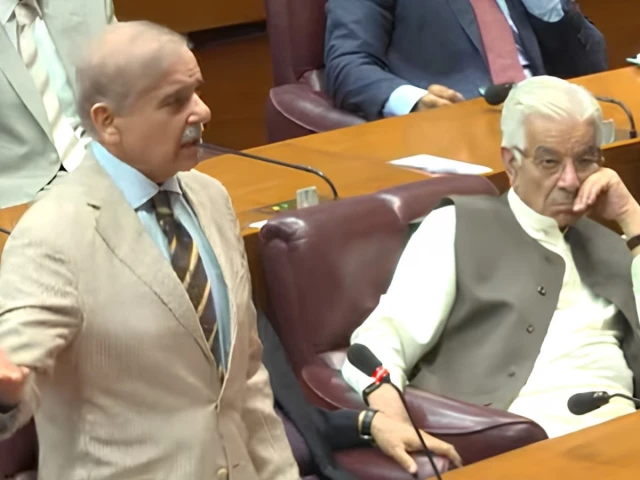
Prime Minister Shehbaz Sharif addresses the budget debate in the National Assembly, June 13, 2026.
Prime Minister Shehbaz Sharif on Saturday used the floor of the National Assembly to respond to a wide-ranging speech by Opposition Leader Mahmood Khan Achakzai, defending the government’s record on Balochistan and fighting terrorism while promising a detailed response to the Opposition Leader’s remarks in due course.
The exchange took place during the ongoing budget debate, chaired by President Ayaz Sadiq and in the presence of Finance Minister Muhammad Aurangzeb.
The session began with an insufficient quorum, with only 52 members present compared to the 84 required. Despite the absence of a quorum, the debates continued. President Sadiq also announced the establishment of a budget office in the Parliament Library to assist lawmakers with budget-related information.
Separately, the speaker censured Pakistan Tehreek-e-Insaf (PTI) lawmaker Iqbal Afridi, accusing him of misbehavior, use of abusive language and assaulting people. Sadiq said he had no right to occupy the chair if he could not ensure the protection of others.
Read: Budget 2026-27: the government reduces taxes and ends the surtax for four brackets of employee income
Opening the debate in front of what he described as “almost empty chairs”, Achakzai condemned what he called a campaign against the Pashtun people in Balochistan and rejected attempts to portray the Pashtuns as terrorists.
“We condemn those who say that Pashtuns are terrorists,” he said, adding that Pashtuns have never compromised their freedom or acted as agents of any external power. “I consider it a grave sin to discriminate against a human being on the basis of their color, race or language,” he added.
Achakzai invoked historical grievances in Balochistan, referring to the execution of Nawab Nauroz Khan and his sons during the era of Field Marshal Ayub Khan, the raid on the residence of Ataullah Mengal, the disappearance of Mengal’s son and the killing of Akbar Bugti, whose funeral prayers, he said, were not allowed.
“Pakistan cannot be run like this,” he remarked.
The opposition leader also paid tribute to former Prime Minister Zulfikar Ali Bhutto, saying he contributed to the unification of Pakistan after the country’s dismemberment. He recalled visiting Nusrat Bhutto after Bhutto’s execution and finding her upset over the confiscation of her property, saying he had intervened to protect them.
Achakzai further criticized the government’s handling of the protests, alleging that children gathered at D-Chowk to demand the release of PTI founder Imran Khan were shot dead and women and children were subjected to unacceptable treatment following the May 9 unrest.
He accused successive governments of treating Balochistan, Khyber Pakhtunkhwa and Sindh as colonies, remarking that “even the British were better in comparison”.
Commenting on the merger of the former Federally Administered Tribal Areas (FATA), Achakzai argued that India had responded by revoking the special constitutional status of occupied Kashmir. He added that many of those who once rallied in support of Kashmir were now protesting on a national level.
Reaffirming the constitutional right to protest, Achakzai turned his attention to Waziristan, describing it as a region where every piece of land had a recognized owner. He said the deployment of the army there had consequences that were still being felt today.
Calling for restraint, he urged the government not to “mix the army and the state”, warning that young people, both on the civilian and security sides, were losing their lives. “The people of Waziristan are the owners of Waziristan,” he said.
Learn more: Income tax calculator for the 2026-27 budget: discover your new net salary
Despite his criticism, Achakzai adopted a conciliatory tone towards the end of his speech, addressing the prime minister directly and proposing that political forces sign a memorandum of understanding to move forward collectively.
He recalled holding late-night meetings with Shehbaz Sharif to ease tensions between the Pakistan People’s Party and the Pakistan Muslim League-Nawaz, facilitating a meeting between Nawaz Sharif and Benazir Bhutto in London, meeting Nawaz during his exile and helping unite 36 political parties around a common agenda.
He concluded with a pointed question: “Isn’t it a violation of the Constitution to cause winning candidates to lose?”
Responding from the audience, Prime Minister Shehbaz said he had listened carefully to Achakzai’s speech but would reserve a detailed response for a later occasion. “I will not give a detailed response at this time. I will do so at an appropriate opportunity,” he said.
Describing Parliament as a house representing the four provinces, the Prime Minister said political differences were natural but the existence of Pakistan remained the foundation of everyone’s collective future. “Any sacrifice made for Pakistan is too little,” he said.
Rejecting Achakzai’s criticism over the rights of provinces, Shehbaz said there could be no disagreement over the right of provinces to national resources. He cited Balochistan’s share in the Reko Diq project and noted that the province’s allocation under the National Finance Commission Award 2010 had doubled, with Punjab contributing Rs 11 billion to the deal.
The Prime Minister also highlighted development initiatives in Balochistan, including a Rs75 billion solarisation program for farmers and construction of a two-lane highway costing Rs300 billion.
Addressing security issues, Shehbaz said external actors were involved in fueling terrorism in Balochistan and defended the fencing of the Pakistan-Afghanistan border as a necessary measure.
He added that members of the armed forces and police continue to sacrifice their lives daily in the fight against terrorism, especially in Khyber Pakhtunkhwa.
“These martyrs leave their own children orphans to prevent the nation’s children from becoming orphans,” he said, urging lawmakers to honor and respect those who gave their lives.
Following the Prime Minister’s remarks, PTI Chairman Gohar Ali Khan’s lawyer briefly addressed the House, saying the speech “did not answer our questions”. President Sadiq asked him to keep his comments brief.


