
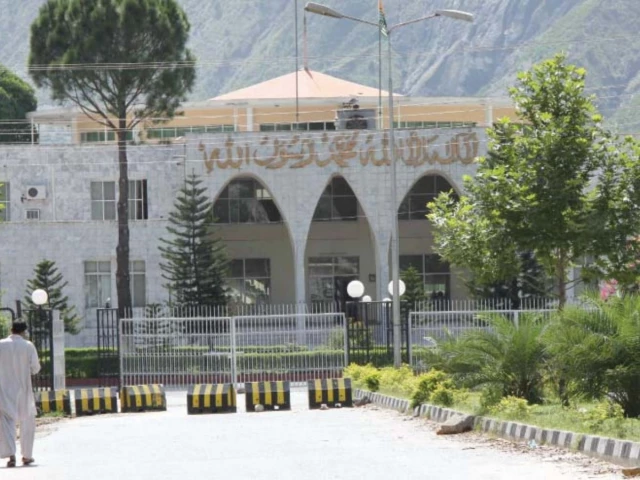
AJK Legislative Assembly. Photo: Express
ISLAMABAD:
Azad Jammu and Kashmir (AJK) Chief Election Commissioner Ghulam Mustafa Mughal on Tuesday announced that the upcoming AJK elections would begin on July 27 as scheduled, but polling would now be held in three phases in different divisions with armed forces deployed to supervise the electoral process.
“As per the revised schedule, polling in Mirpur division will be held on July 27, while Muzaffarabad division and 12 refugee constituencies will go to polls on August 2. Elections in Poonch division will be held on August 10,” Mughal said while speaking at a press conference in Muzaffarabad.
He added that the elections would be held under the supervision of the armed forces.
The announcement comes at a politically charged time, as election campaigns enter their final week and authorities race to complete logistical and security preparations for one of the region’s most closely watched elections.
A day earlier, AJK took an important step ahead of its July 27 Legislative Assembly elections, as advance voting for government employees on election duty concluded peacefully in eight districts, with an overwhelming voter turnout and election authorities declaring themselves fully prepared to conduct what they promised would be free, fair and transparent elections.
The special poll, seen as the Election Commission’s first major test before polling day, took place in all districts except Rawalakot and Sudhnoti, where voting was postponed for security reasons. Despite the exceptions, officials described the process as smooth, orderly and uneventful, with turnout exceeding 80 percent in almost all precincts where voting took place.
With less than a week to go before the polls, the PML-N and PPP have intensified their campaigns with top national leaders making high-profile appearances in a bid to galvanize supporters and vote banks ahead of the race for the 45-member AJK Legislative Assembly.
Read: More than 80% participation in AJK advance voting
Background
The recent unrest and deadly clashes broke out in certain areas, notably in Rawalakot, where the JAAC had organized a sit-in in front of the Rawalakot Combined Military Hospital. AJK police say armed JAAC members opened fire on security forces deployed during a planned attack, leaving four people dead and around 20 injured. The JAAC, however, disputes this version, saying that security forces used tear gas and fired shells towards the hospital.
According to the AJK Police, three individuals linked to the JAAC and four law enforcement personnel were killed during the protests. The JAAC, however, said in a statement that seven people were killed and dozens injured when street shootings took place in the dark after the electricity was reportedly cut off.
The 53-member AJK Legislative Assembly has 12 seats reserved for Kashmiri refugees, people who fled Indian-controlled Kashmir in 1947 and 1965 and are now scattered across Pakistan. Six seats represent refugees from the Jammu division (~434,000 people) and six from the Kashmir Valley (~30,000 people) – an already lopsided arrangement that many see as unfair.
Learn more: Politics resumes ahead of July 27 AJK elections
The region experienced one of its most turbulent periods in October last year, when JAAC-led protests erupted demanding constitutional and governance reforms. At least nine people, including three police officers, were killed during the unrest.
The JAAC, which organized the protests and strike, had presented a broad charter of demands, including an end to the privileges enjoyed by the ruling elite, the removal of 12 assembly seats reserved for refugees and the abolition of the quota system.
Two days after the violence, the government and the JAAC reached an agreement on 12 basic points and 13 additional points. Under the agreement, both sides agreed to constitute a high-level committee to look into the issue of refugee seats in the AJK Legislative Assembly.


