
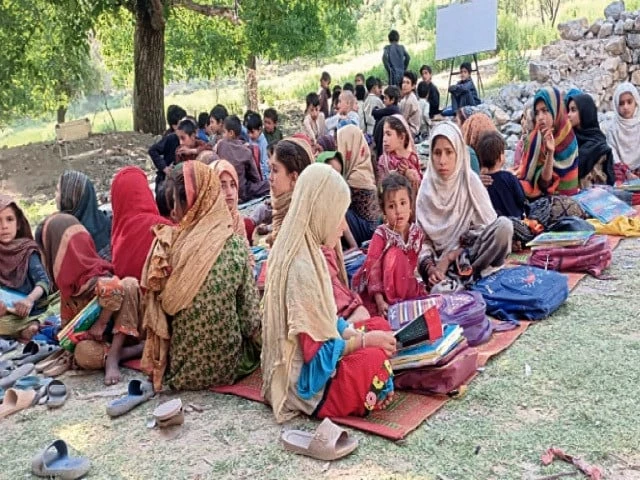
Lack of bachelor’s degree programs and transportation makes female students struggle to continue their education
BARA:
More than 600,000 residents of Bara tehsil in the Khyber tribal district have access to only one public girls’ university. Yet the institution suffers from a serious lack of basic facilities, higher education programs, transportation and security, forcing many female students to abandon their studies or compromise their ambitions.
Students, parents and local elders have strongly urged the Khyber-Pakhtunkhwa government and the Higher Education Department to immediately introduce four-year bachelor’s degree programmes, establish modern laboratories, provide official transport and ensure permanent teachers so that girls in the region are not deprived of higher education.
Najma Abdullah, an Urdu student at Government Girls Degree College Bara and a resident of Malik Din Khel, told The Express PK Press Club that lack of university transport had forced her to live at her grandmother’s house near the college because her house is too far away.
She said she initially enrolled in the microbiology program three years ago, but the program was dropped due to lack of affiliation, resulting in the loss of three valuable academic years. Najma wanted to pursue biology, but had to settle for AD Urdu as no science program is available in the college.
“Bara girls have no shortage of talent, but poverty, transportation problems and lack of higher education facilities force most students to abandon their studies midway,” she said.
Najma also called for government buses to transport students, noting that many girls walk long distances, which is not only exhausting but also dangerous.
Another student, Sonia Abdul Jaleel, said that although some problems have been partially resolved since the establishment of the college, fundamental problems persist, including lack of proper science laboratories, furniture, fans and adequate security.
Sonia adds that the lack of a playground is another major concern for students.
Asma Batool, a student from Orakzai district who also wanted to study a bachelor’s degree in computer science, echoed similar grievances. “There is no official transfer center and due to the general security situation in the area, students and parents do not feel safe,” she said.
According to sources, at least 20 students are required to start a bachelor’s degree program in any subject. Currently, the college only offers an Associate of Arts (Urdu) degree with 20 students, while 382 girls are enrolled in the combined first and second years.
College administration officials said the biggest barrier to starting bachelor’s programs is the lack of bachelor’s level laboratories and necessary infrastructure. The existing laboratories were provided as part of a higher education project, but full-fledged bachelor’s programs require dedicated and modern laboratories for computer science, biology, chemistry and other subjects.
When contacted for comments, MPA and Chairman District Development Advisory Committee (DDAC) Khyber, Abdul Ghani Afridi, said the college was previously operating under a PMU project but its regular SNA has now been approved. He said permanent recruitment of teaching and non-teaching staff, including lecturers, class IV employees, drivers and accounting staff, will be completed soon.
Afridi added that the solarization of the college has been completed and furniture has been provided. Any remaining gaps would be addressed on priority. He assured that all necessary steps were being taken to launch four-year AB programs, including the provision of necessary laboratories and other facilities.
Concerning transport, he indicated that work is underway to provide university buses. For security reasons, instructions were given to the district police officer Khyber to increase the police force at the college.
“The government is committed to making the Government Girls Degree College Bara a standard educational institution so that girls in the region can acquire higher education in a safe and conducive environment,” the MPA said.


